


A comparison of proximity and land use regression traffic exposure models and wheezing in infants
- PMID: 17384778
- PMCID: PMC1817699
- DOI: 10.1289/ehp.9480
A comparison of proximity and land use regression traffic exposure models and wheezing in infants
Abstract
Background: We previously reported an association between infant wheezing and residence < 100 m from stop-and-go bus and truck traffic. The use of a proximity model, however, may lead to exposure misclassification.
Objective: Results obtained from a land use regression (LUR) model of exposure to truck and bus traffic are compared with those obtained with a proximity model. The estimates derived from the LUR model were then related to infant wheezing.
Methods: We derived a marker of diesel combustion--elemental carbon attributable to traffic sources (ECAT)--from ambient monitoring results of particulate matter with aerodynamic diameter < 2.5 microm. We developed a multiple regression model with ECAT as the outcome variable. Variables included in the model were locations of major roads, bus routes, truck traffic count, and elevation. Model parameter estimates were applied to estimate individual ECAT levels at infants' homes.
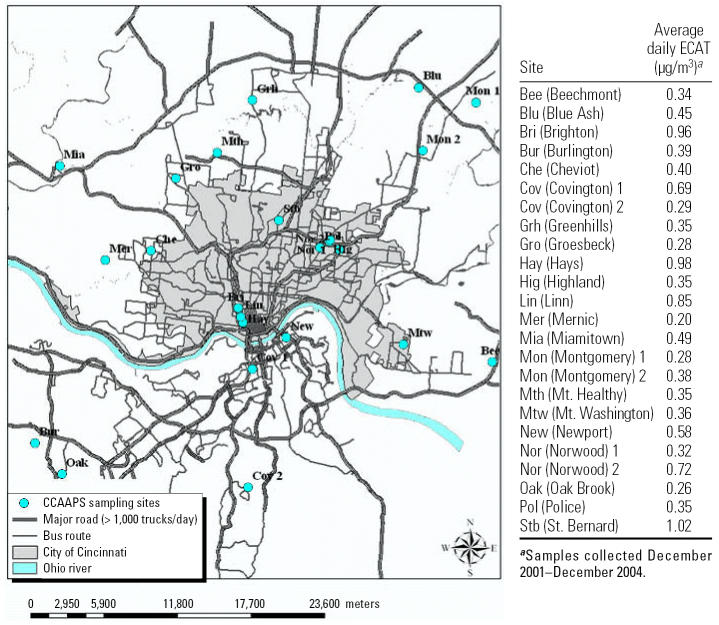
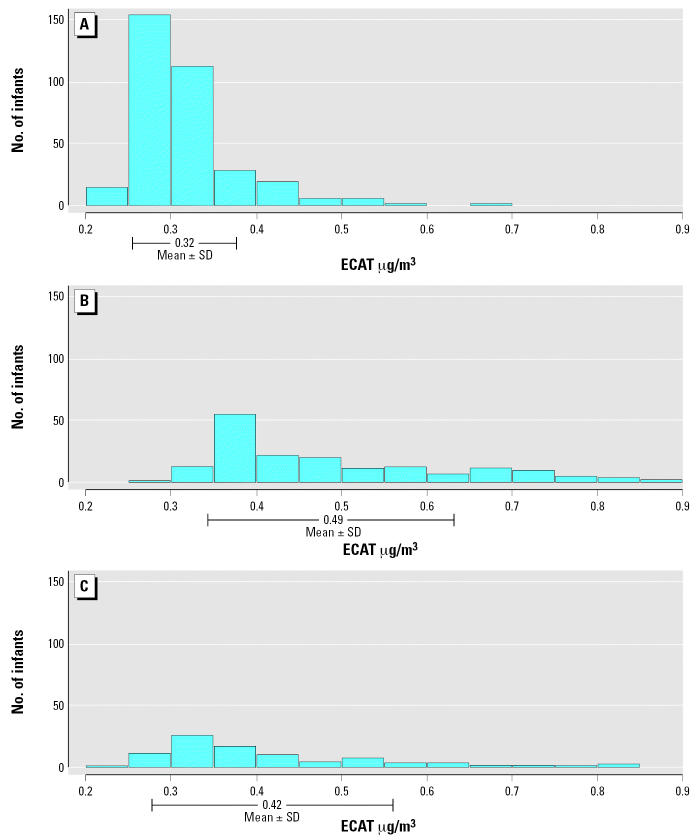
Results: The levels of estimated ECAT at the monitoring stations ranged from 0.20 to 1.02 microg/m(3). A LUR model of exposure with a coefficient of determination (R(2)) of 0.75 was applied to infants' homes. The mean (+/- SD) ambient exposure of ECAT for infants previously categorized as unexposed, exposed to stop-and-go traffic, or exposed to moving traffic was 0.32 +/- 0.06, 0.42 +/- 0.14, and 0.49 +/- 0.14 microg/m(3), respectively. Levels of ECAT from 0.30 to 0.90 mug/m(3) were significantly associated with infant wheezing.
Conclusions: The LUR model resulted in a range of ECAT individually derived for all infants' homes that may reduce the exposure misclassification that can arise from a proximity model.
Figures
References
-
- Akaike H. 1973. Information theory and an extension of the maximum likelihood principle. In: Second International Symposium on Information Theory (Petrov BN, Csaki F, eds). Budapest:Akademiai Kiado, 267–281.
-
- Birch ME, Cary RA. Elemental carbon based method for monitoring occupational exposures to particulate diesel exhaust. Aerosol Sci Tech. 1996;25:221–241. - PubMed
-
- Brauer M, Hoek G, van Vliet P, Meliefste K, Fischer P, Gehring U, et al. Estimating long-term average particulate air pollution concentrations: application of traffic indicators and geographic information systems. Epidemiology. 2003;14:228–239. - PubMed
-
- Briggs DJ, Collins S, Elliott P, Fischer P, Kingham S, Lebret E, et al. Mapping urban air pollution using GIS: a regression-based approach. Int J Geogr Inf Sci. 1997;11:699–718.
Publication types
MeSH terms
Substances
Grants and funding
LinkOut - more resources
Full Text Sources