. 2007 Apr 3;104(14):6037-42.
doi: 10.1073/pnas.0609675104. Epub 2007 Mar 26.

In vivo negative selection screen identifies genes required for Francisella virulence

Affiliations

In vivo negative selection screen identifies genes required for Francisella virulence

David S Weiss et al. Proc Natl Acad Sci U S A. .

Abstract

Francisella tularensis subverts the immune system to rapidly grow within mammalian hosts, often causing tularemia, a fatal disease. This pathogen targets the cytosol of macrophages where it replicates by using the genes encoded in the Francisella pathogenicity island. However, the bacteria are recognized in the cytosol by the host's ASC/caspase-1 pathway, which is essential for host defense, and leads to macrophage cell death and proinflammatory cytokine production. We used a microarray-based negative selection screen to identify Francisella genes that contribute to growth and/or survival in mice. The screen identified many known virulence factors including all of the Francisella pathogenicity island genes, LPS O-antigen synthetic genes, and capsule synthetic genes. We also identified 44 previously unidentified genes that were required for Francisella virulence in vivo, indicating that this pathogen may use uncharacterized mechanisms to cause disease. Among these, we discovered a class of Francisella virulence genes that are essential for growth and survival in vivo but do not play a role in intracellular replication within macrophages. Instead, these genes modulate the host ASC/caspase-1 pathway, a previously unidentified mechanism of Francisella pathogenesis. This finding indicates that the elucidation of the molecular mechanisms used by other uncharacterized genes identified in our screen will increase our understanding of the ways in which bacterial pathogens subvert the immune system.


Conflict of interest statement

The authors declare no conflict of interest.

Figures
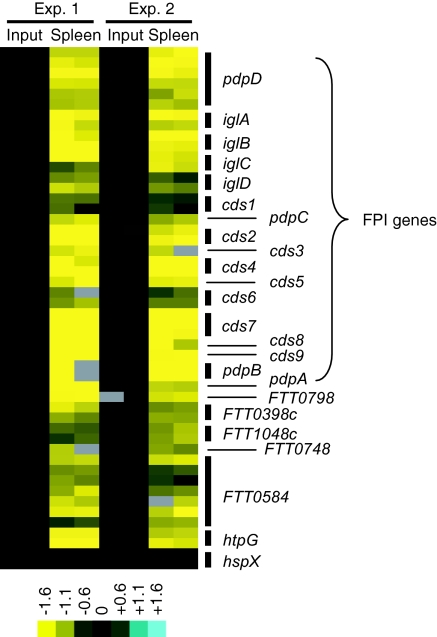
Fig. 1.
Fig. 1.
Array data for genes targeted in this study. Bacteria surviving in spleen samples 48 h after infection from two groups of five mice were collected. The transposon mutants present in each sample were identified by microarray analysis. Data for a subset of the negatively selected transposon insertion mutants is shown. Inputs are shown as controls. Blue represents overabundance of signal compared with the input, and yellow signal represents absence relative to the input. Multiple rows for a given gene represent multiple spots on the array.
Fig. 2.
Fig. 2.
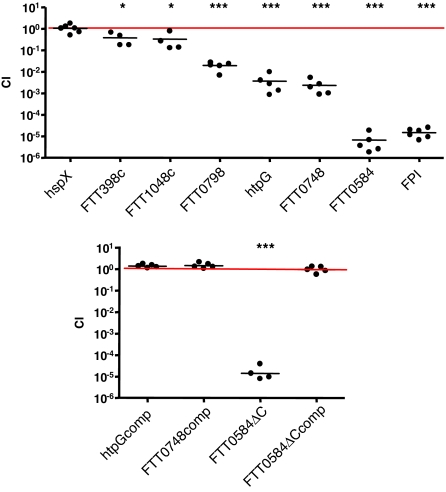
Targeted mutants in negatively selected genes are attenuated in vivo. Groups of four to six mice were s.c. infected with a 1:1 mixture of wild-type bacteria and the indicated bacterial strain. The data represent the CI value for cfu of mutant/wild-type in the spleen 48 h after infection. Bars represent the geometric mean CI value for each group of mice. Each experiment was performed at least twice. ∗, P < 0.05; ∗∗∗, P < 0.0005.
Fig. 3.
Fig. 3.
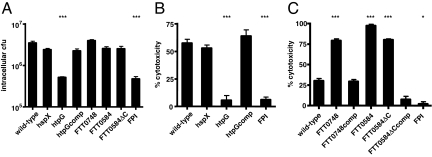
Macrophage replication and cytotoxicity assays reveal a class of Francisella virulence factors. Bone marrow-derived macrophages were infected with 10 bacteria per macrophage of the indicated bacterial strains. (A) Cells were lysed and bacteria were collected at 10 h after infection and plated for enumeration. (B and C) Macrophages were activated with heat-killed F. novicida for 12 h before infection. Cell death was quantified by LDH release at 7 (B) or 6 (C) h after infection. Data are representative of three independent experiments. Statistical significance as compared with wild-type: ∗, P < 0.05; ∗∗∗, P < 0.0005.
Fig. 4.
Fig. 4.
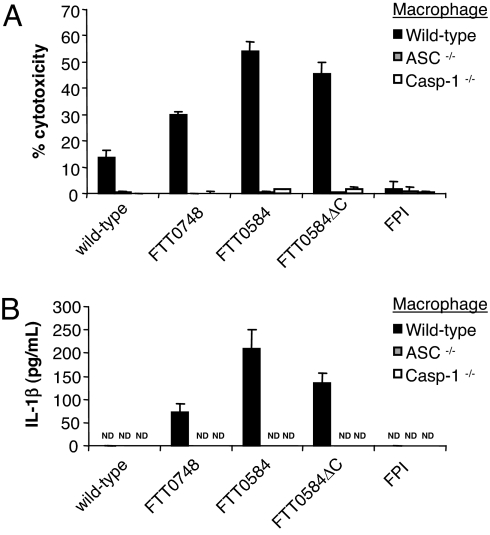
Rapid cell death and IL-1β release induced by the FTT0748 and FTT0584 mutants depends on host caspase-1 and ASC. Wild-type, caspase-1−/− and ASC−/− bone marrow-derived macrophages were activated with heat-killed F. novicida for 12 h and then infected with 10 bacteria per macrophage of the indicated strains. (A) Cell death was quantified by LDH release. (B) IL-1β in the supernatant was quantified by ELISA at 6 h after infection. Data are representative of three independent experiments. ND, not detected.

References

    1. Oyston PC, Sjostedt A, Titball RW. Nat Rev Microbiol. 2004;2:967–978. - PubMed
    1. Owen CR, Buker EO, Jellison WL, Lackman DB, Bell JF. J Bacteriol. 1964;87:676–683. - PMC - PubMed
    1. Telepnev M, Golovliov I, Grundstrom T, Tarnvik A, Sjostedt A. Cell Microbiol. 2003;5:41–51. - PubMed
    1. Golovliov I, Baranov V, Krocova Z, Kovarova H, Sjostedt A. Infect Immun. 2003;71:5940–5950. - PMC - PubMed
    1. Clemens DL, Lee BY, Horwitz MA. Infect Immun. 2004;72:3204–3217. - PMC - PubMed

Publication types

MeSH terms