The Latino paradox in neighborhood context: the case of asthma and other respiratory conditions
- PMID: 17395846
- PMCID: PMC1854858
- DOI: 10.2105/AJPH.2005.071472
The Latino paradox in neighborhood context: the case of asthma and other respiratory conditions
Abstract
Objectives: Evidence indicates that foreign-born Latinos have a health advantage compared with US-born persons of the same socioeconomic status. An explanation for this paradox has remained elusive. We examined the extent to which this paradox exists for the prevalence of asthma and other respiratory conditions. We then explored the role of neighborhood social context in understanding any observed advantage. We invoked theories of social organization, collective efficacy, and the urban ethnic enclave.
Methods: We combined data from the Project on Human Development in Chicago Neighborhoods Community Survey with 2 other data sources and used hierarchical generalized linear modeling techniques.
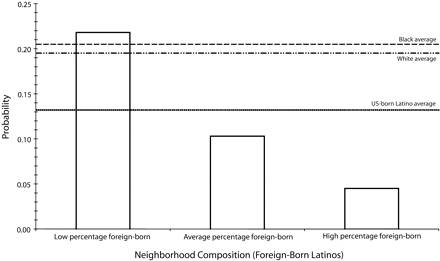
Results: We found a distinctly graded effect for asthma and other breathing problems among foreign-born Latinos, depending on community composition. Foreign-born Latinos embedded in a neighborhood that had a high percentage of foreign-born residents experienced a significantly lower prevalence of asthma and other breathing problems; those in communities that had a low percentage of foreign-born residents had the highest prevalence overall (even when compared with African Americans).
Conclusions: Foreign-born Latinos have a respiratory health advantage only in enclave-like settings. Contexts such as these may provide the cohesiveness critical for effective prevention.
Figures
References
-
- Patel KV, Eschbach K, Ray LA, Markides KS. Evaluation of mortality data for older Mexican Americans: implications for the Hispanic paradox. Am J Epidemiol. 2004;159:707–715. - PubMed
-
- Palloni A, Arias E. Paradox lost: explaining the Hispanic adult mortality advantage. Demography. 2004;41:385–415. - PubMed
Publication types
MeSH terms
Grants and funding
LinkOut - more resources
Full Text Sources
Medical