. 2007 May;8(5):504-9.
doi: 10.1038/sj.embor.7400934. Epub 2007 Mar 30.

S100A1 and S100B, transcriptional targets of SOX trio, inhibit terminal differentiation of chondrocytes

Affiliations

S100A1 and S100B, transcriptional targets of SOX trio, inhibit terminal differentiation of chondrocytes

Taku Saito et al. EMBO Rep. 2007 May.

Abstract

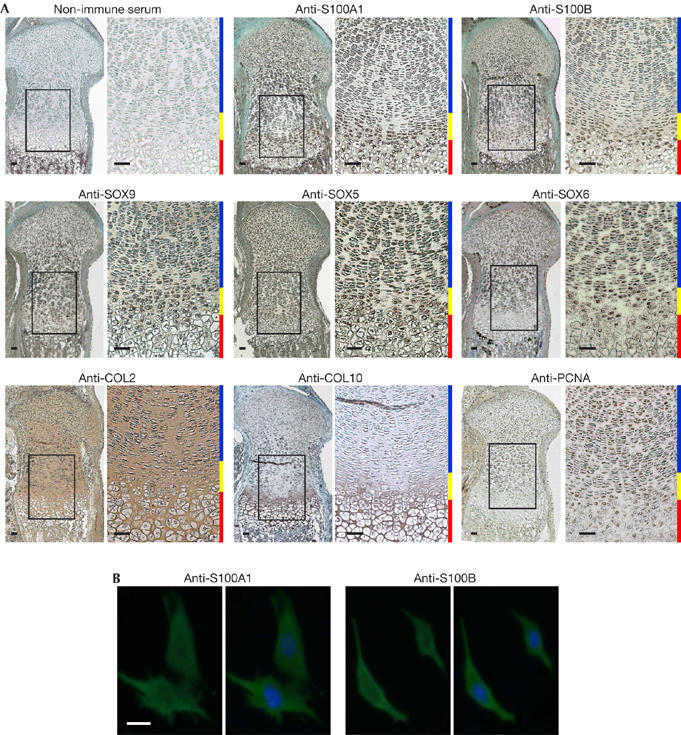
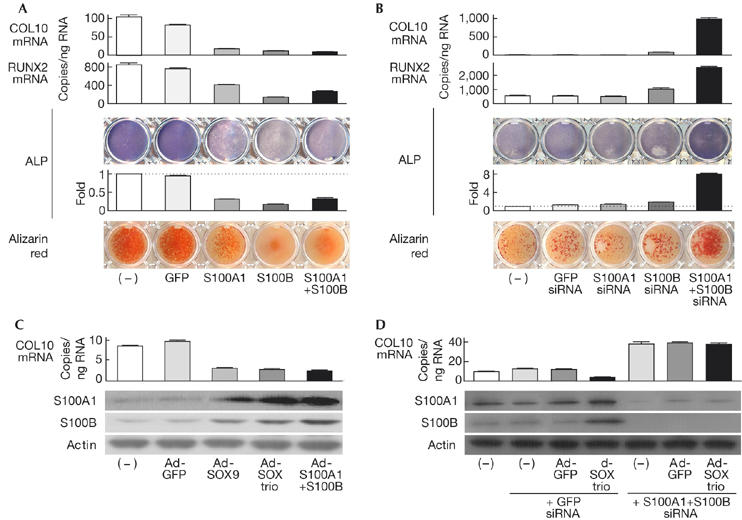
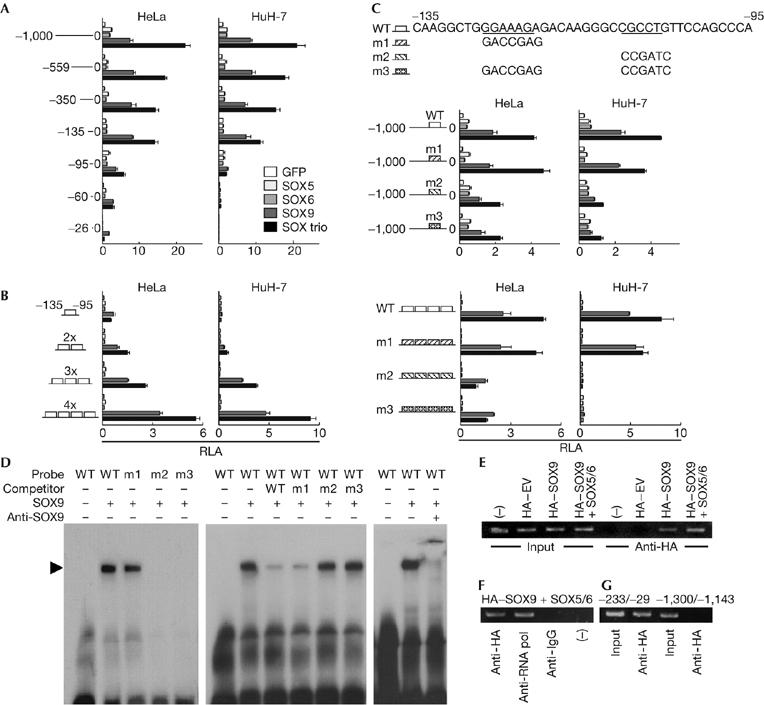
Transcription factor SOX9 (sex-determining region Y-type high mobility group box 9) and its coactivators SOX5 and SOX6 (the SOX trio) induce early-stage chondrocyte differentiation and suppress its terminal stage. To identify possible targets of the SOX trio, we carried out a microarray analysis and identified S100A1 and S100B as possible target molecules. S100 protein expression was localized in late proliferative and pre-hypertrophic chondrocytes of the mouse growth plate. Overexpression of S100A1, S100B or their combination in cultured chondrogenic cells did not induce early differentiation, but suppressed hypertrophic differentiation and mineralization. Silencing of both S100A1 and S100B stimulated terminal differentiation and reversed the SOX-trio-mediated inhibition. Finally, luciferase reporter, electrophoretic mobility shift and chromatin immunoprecipitation analyses showed that transcription of both S100 proteins is induced by the SOX trio, and also identified their respective enhancer elements in the 5'-end flanking region. We conclude that S100A1 and S100B are transcriptional targets of the SOX trio and mediate its inhibition of terminal differentiation of chondrocytes.


Figures
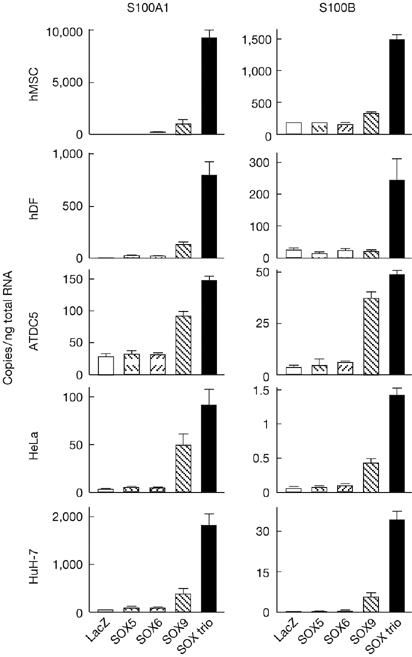
Figure 1
Figure 1
Expression of S100A1 and S100B is induced by SOX9 and the SOX trio in cultures of human mesenchymal stem cells, human dermal fibroblasts, ATDC5, HeLa and HuH-7 cells. The cells were adenovirally transfected with LacZ, SOX5, SOX6, SOX9 or the SOX trio, and the messenger RNA levels were determined by real-time reverse transcription–PCR analysis after 7 days of culture. Data are shown as means (bars)±s.d.s (error bars) for 4 wells/group. hDF, human dermal fibroblasts; hMSC, human mesenchymal stem cells; SOX, sex-determining region Y-type high mobility group box.
Figure 2
Figure 2
S100A1 and S100B proteins are detected in late proliferative and pre-hypertrophic chondrocytes of the growth plate and localize in the cytoplasm of ATDC5 cells. (A) Localization of the S100 and SOX proteins was examined by immunohistochemistry in the fetal mouse growth plate and compared with that of COL2, COL10 and PCNA as early differentiation, hypertrophic differentiation and proliferation markers, respectively. Inset boxes in the left-hand figures indicate the regions of the respective right-hand figures. Scale bars, 50 μm. Blue, yellow and red bars at the right-hand side of each pair of figures indicate layers of proliferative, pre-hypertrophic and hypertrophic zones, respectively. (B) Subcellular localization was examined by immunocytochemistry in ATDC5 cells transfected with S100A1 (left) or S100B (right) with or without nuclear counterstaining. Scale bar, 10 μm. COL2, type II collagen; COL10, type X collagen; PCNA, proliferating cell nuclear antigen; SOX, sex-determining region Y-type high mobility group box.
Figure 3
Figure 3
S100A1 and S100B mediate the suppression of terminal differentiation of chondrocytes by the SOX trio. (A) Messenger RNA levels of the terminal differentiation markers COL10 and RUNX2, ALP staining and activity, and Alizarin red staining in stable lines of ATDC5 cells with retroviral transfection of GFP, S100A1, S100B or a combination of both, and in non-transfected parental cells (–) after culture for 3 weeks with ITS (insulin, transferrin and sodium selenite) and 2 days with inorganic phosphate. (B) Analysis of the above markers in stable lines of ATDC5 cells retrovirally transfected with siRNA of GFP, S100A1, S100B or a combination of both, and in non-transfected parental cells (–) under the culture conditions given above. (C) COL10 mRNA level and S100A1 and S100B protein levels are shown as western blots in ATDC5 cells with adenoviral transfection of GFP, SOX9, the SOX trio or S100A1+S100B, and in non-transfected parental cells (–) after 10 days of a pellet culture. (D) Identical analysis in ATDC5 cells co-transfected with GFP or the SOX trio, and siRNA of GFP or S100A1+S100B, compared with those in non-transfected parental cells (–) after 10 days of a pellet culture. The graphs are expressed as means (bars)±s.d.s (error bars) for 3 wells/group. ALP, alkaline phosphatase; COL10, type X collagen; GFP, green fluorescent protein; PCNA, proliferating cell nuclear antigen; RUNX2, runt-related transcription factor 2; siRNA, small interfering RNA; SOX, sex-determining region Y-type high mobility group box.
Figure 4
Figure 4
The SOX trio transcriptionally induces S100A1 through activation of a SOX9 enhancer element in the 5′-end flanking region. (A) Deletion analysis using luciferase-reporter constructs containing a 1,000 bp S100A1 5′-end flanking region and the series of deletion fragments in HeLa and HuH-7 cells transfected with green fluorescent protein (GFP), SOX5, SOX6, SOX9 or the SOX trio. (B) Dose–response analysis of the tandem repeats of the identified responsive element (−135/−95; A1 box) in the transfected cells. (C) Site-directed mutagenesis analysis of either (m1 and m2) or both (m3) of the SOX-binding motifs in the A1 box in the transfected cells. Mutagenesis analysis was performed in the 1,000 bp construct (top) and in the tandem-repeat construct (bottom). (D) Electrophoretic mobility shift assay for specific binding of the SOX9 protein with the wild-type (WT) and the mutated (m1, m2 and m3) oligonucleotide probes of the A1 box (left). Cold competition with 50-fold excess of unlabelled WT and mutated probes (middle) is shown. Supershift by a SOX9 antibody of the complex of SOX9 protein and the WT probe is presented. (E) Chromatin immunoprecipitation assays for specific binding of SOX9 to the A1 box. Cell lysates of ATDC5 cells transfected with haemagglutinin (HA)-tagged empty vector (HA–EV) or HA-tagged SOX9 in the presence or absence of SOX5 and SOX6 (HA–SOX9+SOX5/6 or HA–SOX9, respectively) were amplified by a primer set spanning the A1 box (−233/−29) before (input) and after (anti-HA) immunoprecipitation with an HA antibody. (F) Immunoprecipitation of lysates of ATDC5 cells transfected with HA–SOX9 and SOX5/6 was carried out using an HA antibody, a positive control RNA polymerase II antibody (anti-RNA pol), a negative control non-immune IgG antibody (anti-IG), or without antibody (–), and amplified with the primer set mentioned above. (G) Amplification of lysates of ATDC5 cells transfected with HA–SOX9 and SOX5/6 was carried out using a primer set spanning (−233/−29) or not spanning (−1,300/−1,143) the A1 box, before (input) and after (anti-HA) immunoprecipitation with an HA antibody. The graphs are expressed as means (bars)±s.d.s (error bars) for 3 wells/group. SOX, sex-determining region Y-type high mobility group box.

References

    1. Akiyama H, Chaboissier MC, Martin JF, Schedl A, de Crombrugghe B (2002) The transcription factor Sox9 has essential roles in successive steps of the chondrocyte differentiation pathway and is required for expression of Sox5 and Sox6. Genes Dev 16: 2813–2828 - PMC - PubMed
    1. Bi W, Huang W, Whitworth DJ, Deng JM, Zhang Z, Behringer RR, de Crombrugghe B (2001) Haploinsufficiency of Sox9 results in defective cartilage primordia and premature skeletal mineralization. Proc Natl Acad Sci USA 98: 6698–6703 - PMC - PubMed
    1. Du XJ, Cole TJ, Tenis N, Gao XM, Kontgen F, Kemp BE, Heierhorst J (2002) Impaired cardiac contractility response to hemodynamic stress in S100A1-deficient mice. Mol Cell Biol 22: 2821–2829 - PMC - PubMed
    1. Foster JW et al. (1994) Campomelic dysplasia and autosomal sex reversal caused by mutations in an SRY-related gene. Nature 372: 525–530 - PubMed
    1. Ikeda T, Kamekura S, Mabuchi A, Kou I, Seki S, Takato T, Nakamura K, Kawaguchi H, Ikegawa S, Chung UI (2004) The combination of SOX5, SOX6, and SOX9 (the SOX trio) provides signals sufficient for induction of permanent cartilage. Arthritis Rheum 50: 3561–3573 - PubMed

Publication types

MeSH terms