


Amphetamine reward in the monogamous prairie vole
- PMID: 17400384
- PMCID: PMC2708345
- DOI: 10.1016/j.neulet.2007.03.019
Amphetamine reward in the monogamous prairie vole
Abstract
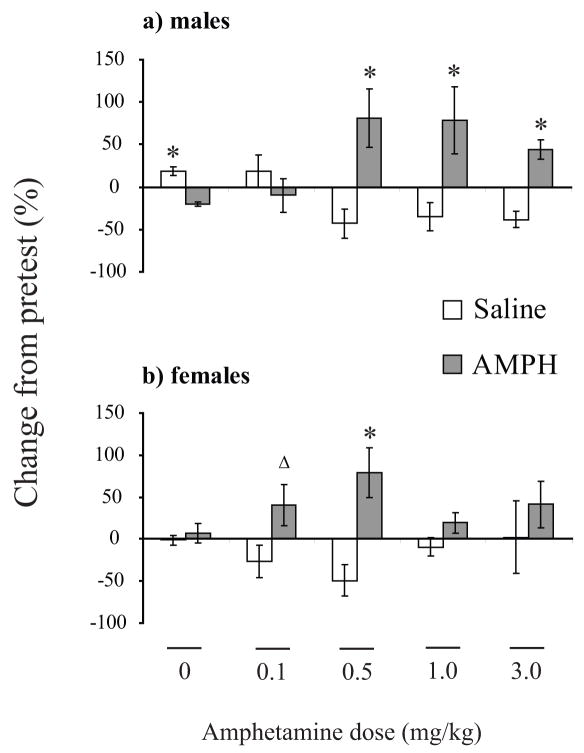
Recent studies have shown that the neural regulation of pair bonding in the monogamous prairie vole (Microtus ochrogaster) is similar to that of drug seeking in more traditional laboratory rodents. Therefore, strong interactions between social behavior and drug reward can be expected. Here, we established the prairie vole as a model for drug studies by demonstrating robust amphetamine-induced conditioned place preferences in this species. For both males and females, the effects of amphetamine were dose-dependent, with females being more sensitive to drug treatment. This study represents the first evidence of drug reward in this species. Future studies will examine the effects of social behavior on drug reward and the underlying neurobiology of such interactions.
Figures
References
-
- Ahmed SH, Koob GF. Transition from moderate to excessive drug intake: change in hedonic set point. Science. 1998;282:298–300. - PubMed
-
- Aragona BJ, Liu Y, Yu YJ, Curtis JT, Detwiler JM, Insel TR, Wang Z. Nucleus accumbens dopamine differentially mediates the formation and maintenance of monogamous pair bonds. Nat Neurosci. 2006;9:133–139. - PubMed
-
- Aragona BJ, Wang Z. The prairie vole (Microtus ochrogaster): an animal model for behavioral neuroendocrine research on pair bonding. Ilar J. 2004;45:35–45. - PubMed
-
- Bardo MT, Rowlett JK, Harris MJ. Conditioned place preference using opiate and stimulant drugs: a meta-analysis. Neurosci Biobehav Rev. 1995;19:39–51. - PubMed
Publication types
MeSH terms
Substances
Grants and funding
LinkOut - more resources
Full Text Sources
