. 2007 May;13(5):731-6.
doi: 10.1261/rna.436607. Epub 2007 Mar 30.

Bunyavirus mRNA synthesis is coupled to translation to prevent premature transcription termination

Affiliations

Bunyavirus mRNA synthesis is coupled to translation to prevent premature transcription termination

John N Barr. RNA. 2007 May.

Abstract

Messenger RNA transcription by Bunyaviridae family members is unique within the group of negative-strand RNA viruses as it requires on-going protein synthesis. The long-standing model explaining this phenomenon proposes that the translational requirement is not for a protein product, but instead is for ribosomal translocation along nascent mRNAs. This movement is proposed to disrupt spurious transcription termination signals that otherwise cause premature mRNA truncation leading to a fatal loss of gene expression. This model was tested by introducing translational stop codons into model RNA genomes of Bunyamwera virus, the prototypic member of the Bunyaviridae family. This directly showed that translation of nascent mRNAs prevents transcription termination. While such coupling of transcription and translation is common in prokaryotic systems, these results represent the first report of such obligatory coupling in a eukaryotic cell environment. The results also provide insight into the bunyavirus termination mechanism and suggest it is mechanistically similar to prokaryotic intrinsic termination.


Figures
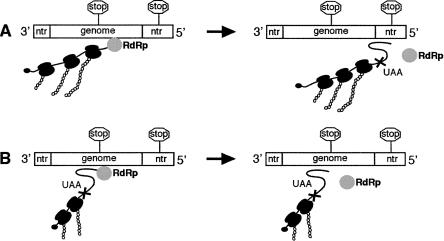
FIGURE 1.
FIGURE 1.
Model of obligatorily coupled bunyavirus transcription and translation. (A) Transcription termination requires RNA interactions involving the termination signal (shown as stop signs) or its complement in mRNA. Translating ribosomes prevent formation of interactions, so termination signals within genome coding regions are suppressed. Termination signals within NTRs are active, as these regions are not translated, thus allowing RNA interactions to form (shown as a loop). (B) When translation is inhibited, RNA interactions can form, thus activating previously silent termination signals within coding regions.
FIGURE 2.
FIGURE 2.
The BUNV transcription termination signal is nonfunctional when positioned within an ORF. (A) Schematic of pBUN-S(ren) and the RNAs expressed by the model BUNV segment it encodes. (B) Schematic of model BUNV segment BUN-T-BsrGI, which contains the authentic termination signal (T1) and a duplicate termination signal within the coding region (T1-UP). (C) Direct analysis of RNA synthesized by BUN-S(ren) and BUN-T-BsrGI using agarose-urea gel electrophoresis shows the internal T1-UP signal is inactive.
FIGURE 3.
FIGURE 3.
Transcription termination at T1-UP only occurs if ribosome translocation is prevented. (A,C) Schematic representation of model BUNV segments BUN-T697 and BUN-T936 and their derivatives. The T1-UP signal preceded by a UAA stop codon (shaded) was inserted at nucleotides 697 or 936 of the Renilla cDNA, such that the stop codon was in frame with the Renilla ORF (vertical lines). The two segments were modified by insertion or deletion of single nucleotides to position the UAA stop codon in alternative reading frames. (B,D) Direct analysis of RNAs synthesized by BUN-T697, BUN-T936, and their derivatives using agarose-urea gel electrophoresis. T1-UP signals were only active when translocation was blocked upstream.
FIGURE 4.
FIGURE 4.
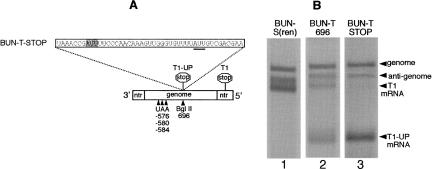
T1-UP termination ability is influenced by position of the upstream stop codon. (A) Model BUNV segment BUN-T697 was modified by inserting a stop codon 121 nt upstream to generate BUN-T-STOP. (B) Direct analysis of RNAs synthesized by BUN-T697 and BUN-T-STOP using agarose-urea gel electrophoresis showed T1-UP activity was increased when ribosome translocation was blocked upstream.

References

    1. Abraham, G., Pattnaik, A.K. Early RNA synthesis in Bunyamwera virus-infected cells. J. Gen. Virol. 1983;64:1277–1290. - PubMed
    1. Barr, J.N., Elliott, R.M., Dunn, E.F., Wertz, G.W. Segment-specific terminal sequences of Bunyamwera bunyavirus regulate genome replication. Virology. 2003;311:326–338. - PubMed
    1. Barr, J.N., Rodgers, J.W., Wertz, G.W. Identification of the Bunyamwera bunyavirus transcription termination signal. J. Gen. Virol. 2006;87:189–198. - PubMed
    1. Bellocq, C., Kolakofsky, D. Translational requirement for La Crosse virus S-mRNA synthesis: A possible mechanism. J. Virol. 1987;61:3960–3967. - PMC - PubMed
    1. Bellocq, C., Raju, R., Patterson, J., Kolakofsky, D. Translational requirement of La Crosse virus S-mRNA synthesis: In vitro studies. J. Virol. 1987;61:87–95. - PMC - PubMed

Publication types

LinkOut - more resources