


The California Tobacco Control Program's effect on adult smokers: (1) Smoking cessation
- PMID: 17400944
- PMCID: PMC2598468
- DOI: 10.1136/tc.2006.016873
The California Tobacco Control Program's effect on adult smokers: (1) Smoking cessation
Abstract
Objectives: To estimate national population trends in long-term smoking cessation by age group and to compare cessation rates in California (CA) with those of two comparison groups of states.
Setting: Retrospective smoking history of a population sample from the US: from CA, with a comprehensive tobacco-control programme since 1989 with the goal of denormalising tobacco use; from New York and New Jersey (NY & NJ), with similar high cigarette prices but no comprehensive programme; and from the tobacco-growing states (TGS), with low cigarette prices, no tobacco-control programme and social norms relatively supportive of tobacco use.
Participants: Respondents to the Current Population Survey-Tobacco Use Supplements (1992-2002; n = 57 918 non-Hispanic white ever-smokers).
Main outcome measures: The proportion of recent ever-smokers attaining long-term abstinence (quit > or = 1 year) and the successful-quit ratio (the proportion of all ever-smokers abstinent > or = 1 year).
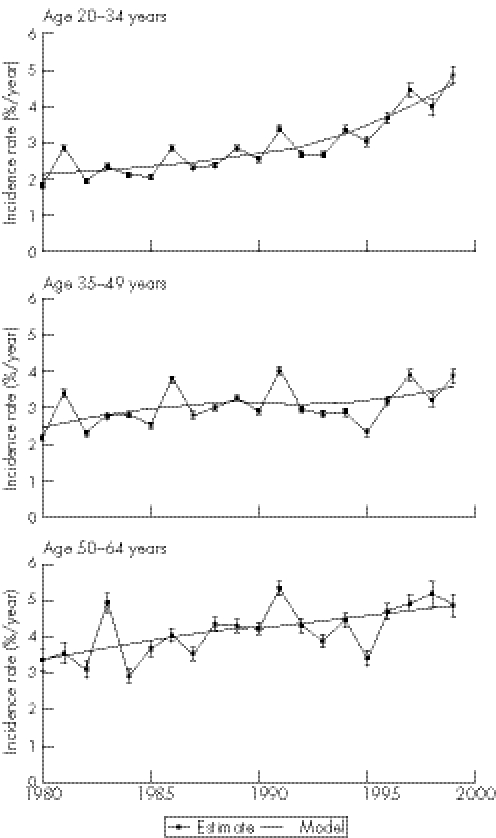
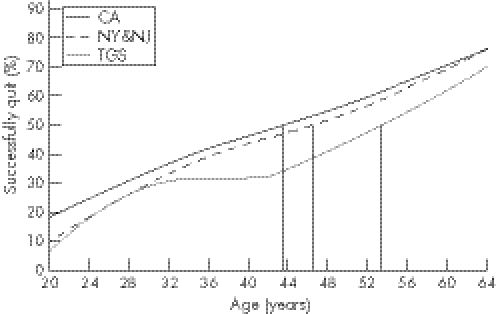
Results: Nationally, long-term cessation rates increased by 25% from the 1980s to the 1990s, averaging 3.4% per year in the 1990s. Cessation increased for all age groups, and by > 40% (p<0.001) among smokers aged 20-34 years. For smokers aged < 50 years, higher cigarette prices were associated with higher quitting rates. For smokers aged < 35 years, quitting rates in CA were higher than in either comparison group (p<0.05). Half of the ever-smokers had quit smoking by age 44 years in CA, 47 years in NY & NJ, and by age 54 years in TGS.
Conclusion: Successful smoking cessation increased by 25% during the 1990s in the US. Comprehensive tobacco-control programmes were associated with greater cessation success than were with high cigarette prices alone, although both effects were limited to younger adults.
Conflict of interest statement
Competing interests: The granting agency (Tobacco‐Related Disease Research Program) did not have any role in design of or conduct of the study, or preparation, review or approval of the manuscript.
References
-
- US Department of Health and Human Services The health consequences of smoking: a report of the Surgeon General, 2004. Atlanta, GA: US Department of Health and Human Services, Centers for Disease Control and Prevention, National Center for Chronic Disease Prevention and Health Promotion, Office on Smoking and Health,
-
- Centers for Disease Control US Department of Health and Human Services, Public Health Service. Annual Smoking‐Attributable Mortality, Years of Potential Life Lost, and Productivity Losses—United States, 1997—2001. Morb Mortal Wkly Rep 200554625–668. - PubMed
-
- Chaloupka F J, Warner K E. The economics of smoking. In: Newhouse, Culyer, eds. Handbook of health economics. Vol 1B. Amsterdam, Holland: Elsevier, 20001539–1627.
-
- US Department of Health and Human Services Reducing tobacco use: a report of the Surgeon General. 2000. US Department of Health and Human Services, Centers for Disease Control and Prevention, National Center for Chronic Disease Prevention and Health Promotion, Office on Smoking and Health 2000
Publication types
MeSH terms
LinkOut - more resources
Full Text Sources
Medical
