L-citrulline inhibits [3H]acetylcholine release from rat motor nerve terminals by increasing adenosine outflow and activation of A1 receptors
- PMID: 17401439
- PMCID: PMC2013966
- DOI: 10.1038/sj.bjp.0707242
L-citrulline inhibits [3H]acetylcholine release from rat motor nerve terminals by increasing adenosine outflow and activation of A1 receptors
Abstract
Background and purpose: Nitric oxide (NO) production and depression of neuromuscular transmission are closely related, but little is known about the role of L-citrulline, a co-product of NO biosynthesis, on neurotransmitter release.
Experimental approach: Muscle tension recordings and outflow experiments were performed on rat phrenic nerve-hemidiaphragm preparations stimulated electrically.
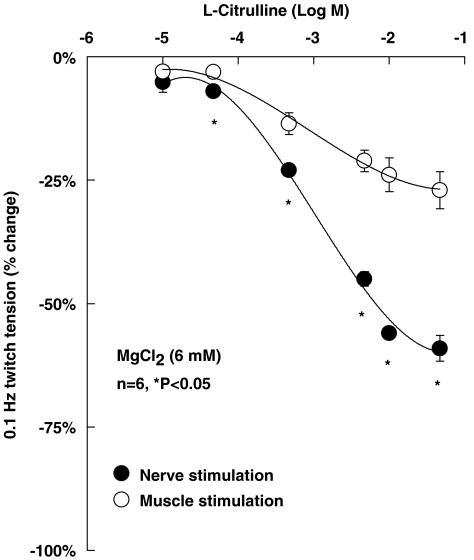
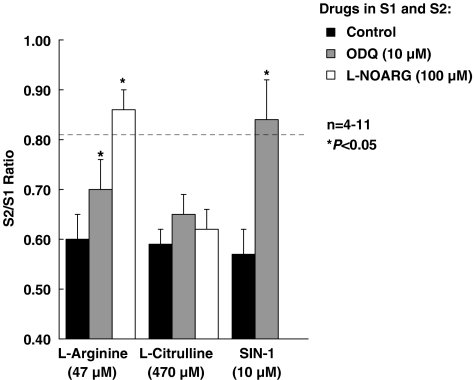
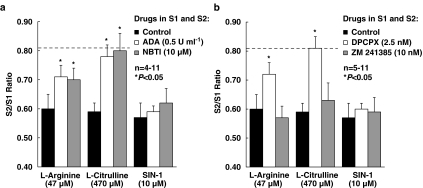
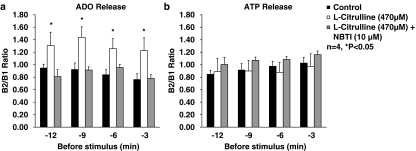
Key results: L-citrulline concentration-dependently inhibited evoked [(3)H]ACh release from motor nerve terminals and depressed nerve-evoked muscle contractions. The NO synthase (NOS) substrate, L-arginine, and the NO donor, 3-morpholinosydnonimine chloride (SIN-1), also inhibited [(3)H]ACh release with a potency order of SIN-1>L-arginine>L-citrulline. Co-application of L-citrulline and SIN-1 caused additive effects. NOS inactivation with N(omega)-nitro-L-arginine prevented L-arginine inhibition, but not that of L-citrulline. The NO scavenger, haemoglobin, abolished inhibition of [(3)H]ACh release caused by SIN-1, but not that caused by L-arginine. Inactivation of guanylyl cyclase with 1H-[1,2,4]oxadiazolo[4,3-a]quinoxalin-1-one (ODQ) fully blocked SIN-1 inhibition, but only partially attenuated the effects of L-arginine. Reduction of extracellular adenosine accumulation with adenosine deaminase or with the nucleoside transport inhibitor, S-(p-nitrobenzyl)-6-thioinosine, attenuated the effects of L-arginine and L-citrulline, while not affecting inhibition by SIN-1. Similar results were obtained with the selective adenosine A(1) receptor antagonist, 1,3-dipropyl-8-cyclopentylxanthine. L-citrulline increased the resting extracellular concentration of adenosine, without changing that of the adenine nucleotides.
Conclusions and implications: NOS catalyses the formation of two neuronally active products, NO and L-citrulline. While, NO may directly reduce transmitter release through stimulation of soluble guanylyl cyclase, the inhibitory action of L-citrulline may be indirect through increasing adenosine outflow and subsequently activating inhibitory A(1) receptors.
Figures


References
-
- Barton ER, Morris L, Kawana M, Bish LT, Toursel T. Systemic administration of L-arginine benefits mdx skeletal muscle function. Muscle Nerve. 2005;32:751–760. - PubMed
-
- Blottner D, Lück G. Just in time and place: NOS/NO system assembly in neuromuscular junction formation. Microsc Res Tech. 2001;55:171–180. - PubMed
-
- Bon CLM, Garthwaite J. Adenosine acting on A1 receptors protects NO-triggered rebound potentiation and LTP in rat hippocampal slices. J Neurophysiol. 2002;87:1781–1798. - PubMed
-
- Boulton CL, Irving AJ, Southam E, Potier B, Garthwaite J, Collingridge GL. The nitric oxide-cyclic GMP pathway and synaptic depression in rat hippocampal slices. Eur J Neurosci. 1994;6:1528–1535. - PubMed
-
- Broad RM, Fallahi N, Fredholm BB. Nitric oxide interacts with oxygen free radicals to evoke the release of adenosine and adenine nucleotides from rat hippocampal slices. J Auton Nerv Sys. 2000;81:82–86. - PubMed
Publication types
MeSH terms
Substances
LinkOut - more resources
Full Text Sources
Research Materials