


Gestational weight gain and child adiposity at age 3 years
- PMID: 17403405
- PMCID: PMC1899090
- DOI: 10.1016/j.ajog.2006.11.027
Gestational weight gain and child adiposity at age 3 years
Abstract
Objective: The purpose of this study was to examine the associations of gestational weight gain with child adiposity.
Study design: Using multivariable regression, we studied associations of total gestational weight gain and weight gain according to 1990 Institute of Medicine guidelines with child outcomes among 1044 mother-child pairs in Project Viva.
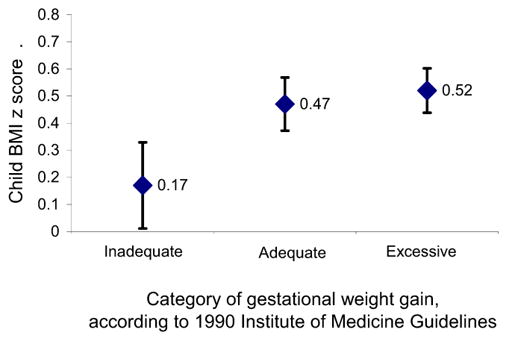
Results: Greater weight gain was associated with higher child body mass index z-score (0.13 units per 5 kg [95% CI, 0.08, 0.19]), sum of subscapular and triceps skinfold thicknesses (0.26 mm [95% CI, 0.02, 0.51]), and systolic blood pressure (0.60 mm Hg [95% CI, 0.06, 1.13]). Compared with inadequate weight gain (0.17 units [95% CI, 0.01, 0.33]), women with adequate or excessive weight gain had children with higher body mass index z-scores (0.47 [95% CI, 0.37, 0.57] and 0.52 [95% CI, 0.44, 0.61], respectively) and risk of overweight (odds ratios, 3.77 [95% CI: 1.38, 10.27] and 4.35 [95% CI: 1.69, 11.24]).
Conclusion: New recommendations for gestational weight gain may be required in this era of epidemic obesity.
Figures
References
-
- Institute of Medicine. Nutrition during pregnancy. Washington (DC): National Academy Press; 1990.
-
- Johnson JW, Yancey MK. A critique of the new recommendations for weight gain in pregnancy. Am J Obstet Gynecol. 1996;174:254–8. - PubMed
-
- Martin JA, Hamilton BE, Sutton PD, Ventura SJ, Menacker F, Munson ML. Births: final data for 2003. Natl Vital Stat Rep. 2005;54:1–116. Also available at: http://www.cdc.gov/nchs/data/nvsr/nvsr54/nvsr54_02.pdf. - PubMed
-
- Schieve LA, Cogswell ME, Scanlon KS. Trends in pregnancy weight gain within and outside ranges recommended by the Institute of Medicine in a WIC population. Matern Child Health J. 1998;2:111–6. - PubMed
-
- Luke B, Hediger ML, Scholl TO. Point of diminishing returns: When does gestational weight gain cease benefiting birthweight and begin adding to maternal obesity? J Matern Fetal Med. 1996;5:168–73. - PubMed
Publication types
MeSH terms
Grants and funding
LinkOut - more resources
Full Text Sources
Other Literature Sources
Medical
