Comparative Study
. 2007 Apr 10;104(15):6299-304.
doi: 10.1073/pnas.0701687104. Epub 2007 Apr 2.

Rat Mcs5a is a compound quantitative trait locus with orthologous human loci that associate with breast cancer risk

Affiliations
Comparative Study

Rat Mcs5a is a compound quantitative trait locus with orthologous human loci that associate with breast cancer risk

David J Samuelson et al. Proc Natl Acad Sci U S A. .

Abstract

Breast cancer risk is a polygenic trait. To identify breast cancer modifier alleles that have a high population frequency and low penetrance we used a comparative genomics approach. Quantitative trait loci (QTL) were initially identified by linkage analysis in a rat mammary carcinogenesis model followed by verification in congenic rats carrying the specific QTL allele under study. The Mcs5a locus was identified by fine-mapping Mcs5 in a congenic model. Here we characterize the Mcs5a locus, which when homozygous for the Wky allele, reduces mammary cancer risk by 50%. The Mcs5a locus is a compound QTL with at least two noncoding interacting elements: Mcs5a1 and Mcs5a2. The resistance phenotype is only observed in rats carrying at least one copy of the Wky allele of each element on the same chromosome. Mcs5a1 is located within the ubiquitin ligase Fbxo10, whereas Mcs5a2 includes the 5' portion of Frmpd1. Resistant congenic rats show a down-regulation of Fbxo10 in the thymus and an up-regulation of Frmpd1 in the spleen. The association of the Mcs5a1 and Mcs5a2 human orthologs with breast cancer was tested in two population-based breast cancer case-control studies (approximately 12,000 women). The minor alleles of rs6476643 (MCS5A1) and rs2182317 (MCS5A2) were independently associated with breast cancer risk. The minor allele of rs6476643 increases risk, whereas the rs2182317 minor allele decreases risk. Both alleles have a high population frequency and a low penetrance toward breast cancer risk.


Conflict of interest statement

The authors declare no conflict of interest.

Figures

Fig. 1.
Fig. 1.
Positional mapping of interacting loci within the rat Mcs5a compound QTL. Mcs5a (≈116 kb, pink) is a compound QTL located on rat chromosome 5. Adjacent Mcs5a1 (32 kb, black) and Mcs5a2 (84 kb, gray) are interacting loci within Mcs5a and were identified by using congenic lines. Rat transcripts are displayed as exons connected by the intronic sequence, with arrows indicating the direction of transcription. Mammary carcinoma susceptibility phenotypes of congenic lines with different segments of the Mcs5a WKy allele contained in line O were determined by using female rats administered DMBA (65 mg/kg) at 50–55 days of age. The congenic lines had the same pedigree at the N12 generation. Tumor multiplicity phenotypes are presented as the average number of mammary carcinomas ≥3 × 3 mm per rat ± SD after 15 weeks of initiation. Phenotypes for each genotype were compared within the congenic line by using the Mann–Whitney nonparametric test. Percent reduction in mammary carcinomas per rat compared with WF/WF littermates is shown at the center for lines determined to be significantly different (P < 0.05) than the WF/WF rats. The resistant (orange) and susceptible (yellow) congenic lines that define Mcs5a are shown. The relevant end of the WKy sequence in each line is indicated by a genetic marker and a dashed vertical line. Polymorphisms SNP-61634906, SNP-61666918, SNP-61667232, and gUwm23–29 mark the ends of congenic lines and are at base positions 61,634,906; 61,666,918; 61,667,232; and 61,751,595–61,751,793, respectively. The x axis represents rat chromosome 5 and the designated marks are SNPs (red), indels (purple), microsatellites (blue), CpG islands (green), and the UCSC Genome Browser June 2003 rat assembly base position (black). The 36.4-kb Mcs5a2 subregion marked by brackets contains the segment in which the human/rat CNS (60% identity over 90 bp) was resequenced.
Fig. 2.
Fig. 2.
Mcs5a1 and Mcs5a2 elements interact only in a cis-chromosomal configuration. Heterozygous rats (n = 38 rats and 456 mammary glands) having both Mcs5a1 and Mcs5a2 WKy elements in cis developed fewer mammary carcinomas per rat ± SD 15 weeks after initiation than both the WF (n = 35 rats and 420 mammary glands, P = 0.005) and transchromosomal heterozygotes (n = 43 rats and 516 mammary glands, P = 0.048). Heterozygous rats with Mcs5a1 and Mcs5a2 WKy alleles in trans developed a similar number of mammary carcinomas as WF rats (P = 0.334). Bars in the graph that are marked with different lowercase letters are significantly different. Trans females were F1 offspring from a B3 × LL reciprocal cross. Cis animals were line O heterozygous F1 females from a line O × WF.WKy reciprocal cross. P values are from Conver–Inman multiple comparisons following a significant Kruskal–Wallis nonparametric test (P = 0.018).
Fig. 3.
Fig. 3.
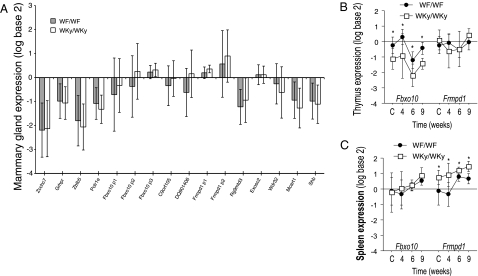
Organ-specific differential expression of Mcs5a genes. (A) Similar transcript levels of genes within and flanking (±500 kb) the Mcs5a1 and Mcs5a2 loci were measured in mammary glands of Mcs5a resistant (WKy/WKy) and susceptible (WF/WF) female congenic rats by using QPCR. (B and C) Differential expression between resistant and susceptible rats (P < 0.05) was found in rat thymus and spleen tissues for the Mcs5a candidate genes, Fbxo10 (B) and Frmpd1 (C), respectively. The differences in Fbxo10 (thymus) and Frmpd1 (spleen) expression levels were in 12-week-old virgin female rats (C = control) and tissues collected after initiation with carcinogen (time: 4, 6, and 9 weeks). Expression levels are presented as the log2 ± SD of the gene transcript level determined by real-time QPCR adjusted for Gapdh expression. Mann–Whitney comparisons with P < 0.05 are marked with asterisks.
Fig. 4.
Fig. 4.
Human MCS5A1 (30.1 kb) and MCS5A2 (63.4 kb) loci contain breast-cancer-associated polymorphisms. The genomic regions shown on human chromosome 9 are orthologous to the rat Mcs5a1 (black) and Mcs5a2 (gray) regions. MCS5A transcripts are mapped as exons connected by the intronic sequence. Arrows indicate the direction of transcription. Haplotype blocks (blue horizontal bars) that overlap MCS5A contain the breast cancer risk-associated polymorphisms SNP-A1 (rs6476643) in MCS5A1 and SNP-3 (rs2182317) in MCS5A2. Association of these SNPs to breast cancer risk was determined by using two population-based samplings that evaluated ≈12,000 women. The minor allele frequency of SNP-A1 (MCS5A1) is 0.25. SNP-A1 associates with a 19% increased risk of breast cancer for women that are homozygous for the minor allele. The minor allele frequency of SNP-3 (MCS5A2) is 0.13. SNP-3 associates with a 14% decreased risk of breast cancer for the 24% of women that carry at least one minor allele. The three polymorphisms that correlated with SNP-A1 are in the 5.7-kb region marked by brackets within the MCS5A1 region. The SNPs correlated with SNP-3 lie within the human/rat MCS5A2 orthologous region and are within a 16.8-kb region (marked by brackets). The x axis is the human chromosome 9 base position based on the May 2004 UCSC human genome assembly. The x axis marks designate SNPs (red), indels (purple), CpG islands (green), and base positions (black).

References

    1. Reich DE, Lander ES. Trends Genet. 2001;17:502–510. - PubMed
    1. Smith P, McGuffog L, Easton DF, Mann GJ, Pupo GM, Newman B, Chenevix-Trench G, Szabo C, Southey M, Renard H, et al. Genes Chrom Cancer. 2006;45:646–655. - PMC - PubMed
    1. Pharoah PD, Antoniou A, Bobrow M, Zimmern RL, Easton DF, Ponder BA. Nat Genet. 2002;31:33–36. - PubMed
    1. Ponder BAJ, Cebrian A, Dunning AM, Easton DF, Lesueur F, Luccarini C, Pharoah PDP. Breast Cancer Res. 2005;7(Suppl 2):S14. - PMC - PubMed
    1. Russo J, Russo IH. J Mammary Gland Biol Neoplasia. 2000;5:187–200. - PubMed

Publication types

MeSH terms

Substances

Associated data