


The role of lubricin in the mechanical behavior of synovial fluid
- PMID: 17404241
- PMCID: PMC1851076
- DOI: 10.1073/pnas.0608558104
The role of lubricin in the mechanical behavior of synovial fluid
Abstract
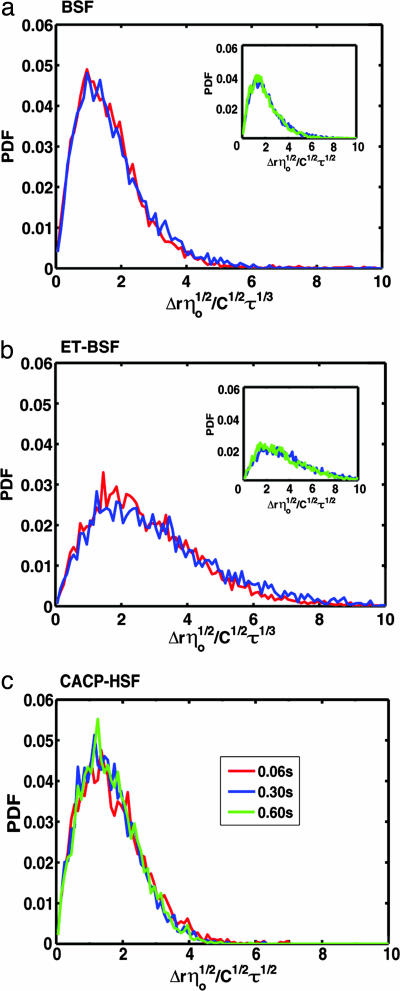
Synovial fluid is a semidilute hyaluronate (HA) polymer solution, the rheology of which depends on HA-protein interactions, and lubricin is a HA-binding protein found in synovial fluid and at cartilage surfaces, where it contributes to boundary lubrication under load. Individuals with genetic deficiency of lubricin develop precocious joint failure. The role of lubricin in synovial fluid rheology is not known. We used a multiple-particle-tracking microrheology technique to study the molecular interactions between lubricin and HA in synovial fluid. Particles (200 nm mean diameter) embedded in normal and lubricin-deficient synovial fluid samples were tracked separately by using multiple-particle-tracking microrheology. The time-dependent ensemble-averaged mean-squared displacements of all of the particles were measured over a range of physiologically relevant frequencies. The mean-squared displacement correlation with time lag had slopes with values of unity for simple HA solutions and for synovial fluid from an individual who genetically lacked lubricin, in contrast to slopes with values less than unity (alpha approximately 0.6) for normal synovial fluid. These data correlated with bulk rheology studies of the same samples. We found that the subdiffusive and elastic behavior of synovial fluid, at physiological shear rates, was absent in fluid from a patient who lacks lubricin. We conclude that lubricin provides synovial fluid with an ability to dissipate strain energy induced by mammalian locomotion, which is a chondroprotective feature that is distinct from boundary lubrication.
Conflict of interest statement
The authors declare no conflict of interest.
Figures




References
-
- Schurz J, Ribitsch V. Biorheology. 1987;24:385–399. - PubMed
-
- Mow VC, Sugalski MT. In: Physiological Basis of Rehabilitation Medicine. Gonzalez EG, Myers SJ, Edelstein JE, Downey JA, Darling RC, Edelstein J, editors. New York: Butterworth-Heinemann; 2001. p. 138.
-
- Tadmor R, Chen N, Israelachvilli J. Macromolecules. 2003;36:9519–9526.
-
- McCutchen CW. New Sci. 1962;15:412–415.
-
- Jay GD, Lane BP, Sokoloff L. Connect Tissue Res. 1992;28:245–255. - PubMed
Publication types
MeSH terms
Substances
Grants and funding
LinkOut - more resources
Full Text Sources
Other Literature Sources
