. 2007 Jul;130(Pt 7):1861-72.
doi: 10.1093/brain/awm035. Epub 2007 Apr 2.

Locomotor adaptation on a split-belt treadmill can improve walking symmetry post-stroke

Affiliations

Locomotor adaptation on a split-belt treadmill can improve walking symmetry post-stroke

Darcy S Reisman et al. Brain. 2007 Jul.

Abstract

Human locomotion must be flexible in order to meet varied environmental demands. Alterations to the gait pattern occur on different time scales, ranging from fast, reactive adjustments to slower, more persistent adaptations. A recent study in humans demonstrated that the cerebellum plays a key role in slower walking adaptations in interlimb coordination during split-belt treadmill walking, but not fast reactive changes. It is not known whether cerebral structures are also important in these processes, though some studies of cats have suggested that they are not. We used a split-belt treadmill walking task to test whether cerebral damage from stroke impairs either type of flexibility. Thirteen individuals who had sustained a single stroke more than 6 months prior to the study (four females) and 13 age- and gender-matched healthy control subjects were recruited to participate in the study. Results showed that stroke involving cerebral structures did not impair either reactive or adaptive abilities and did not disrupt storage of new interlimb relationships (i.e. after-effects). This suggests that cerebellar interactions with brainstem, rather than cerebral structures, comprise the critical circuit for this type of interlimb control. Furthermore, the after-effects from a 15-min adaptation session could temporarily induce symmetry in subjects who demonstrated baseline asymmetry of spatiotemporal gait parameters. In order to re-establish symmetric walking, the choice of which leg is on the fast belt during split-belt walking must be based on the subject's initial asymmetry. These findings demonstrate that cerebral stroke survivors are indeed able to adapt interlimb coordination. This raises the possibility that asymmetric walking patterns post-stroke could be remediated utilizing the split-belt treadmill as a long-term rehabilitation strategy.


Figures
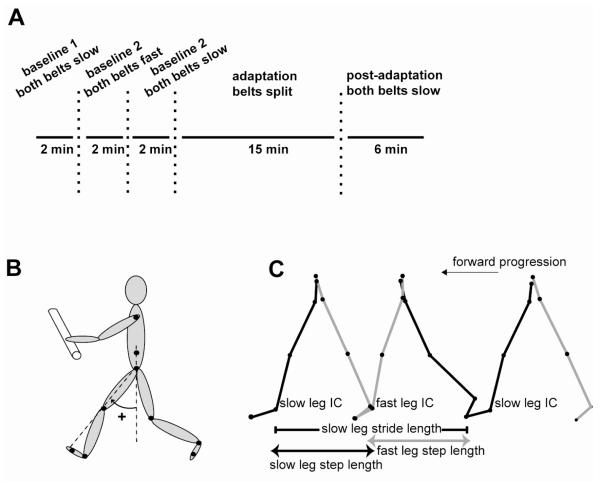
Figure 1
Figure 1
A. Time course for the experimental paradigm showing Baseline, Adaptation, and Post-adaptation periods. B. Illustration of marker locations and the method used to calculate limb angle. C. Illustration of parameter calculations. Stride and step length depicted in over ground walking with forward progression. IC = initial contact.
Figure 2
Figure 2
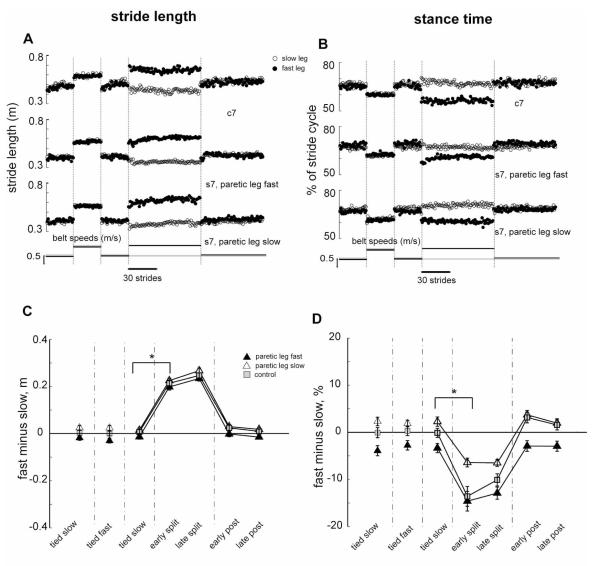
Rapidly changing parameters. A, B. Stride length (A) and stance time (B) values for sequential strides on the treadmill from a typical control (top row) and matched stroke (bottom 2 rows) subject across all testing periods. For the stroke subject the middle row is from the session with the paretic leg on the fast belt and vice versa for the bottom row. Open and filled circles indicate values for the slow and fast legs, respectively. C, D. Average stride length (C) and stance time (D) differences for the stroke subjects in the paretic leg slow session (open triangles), the paretic leg fast session (filled triangles) and for the control (squares) group. Each data point represents values averaged over the first five strides from the early or late portions of each testing period for each control and stroke subject individually and then averaged across all subjects in a group. Error bars indicate ± 1 SE.
Figure 3
Figure 3
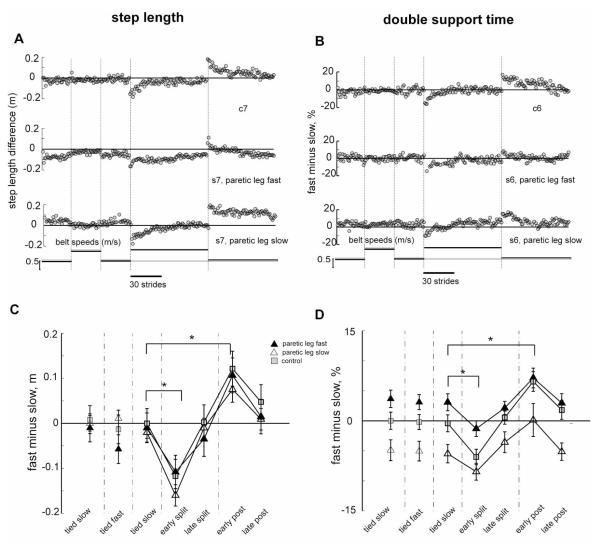
Slowly adapting parameters. A, B. Step length (A) and double support time (B) values for sequential strides on the treadmill from a typical control (top row) and matched stroke (bottom 2 rows) subject across all testing periods. For the stroke subject the middle row is from the session with the paretic leg on the fast belt and vice versa for the bottom row. Filled grey circles indicate the difference between the legs (fast leg minus slow leg) in step length and double support time values. C, D. Average step length (C) and double support time (D) differences for the stroke subjects in the paretic leg slow session (open triangles), the paretic leg fast session (filled triangles) and for the control (squares) group. Each data point represents values averaged over the first five strides from the early or late portions of each testing period for each control and stroke subject individually and then averaged across all subjects in a group. Error bars indicate ± 1 SE.
Figure 4
Figure 4
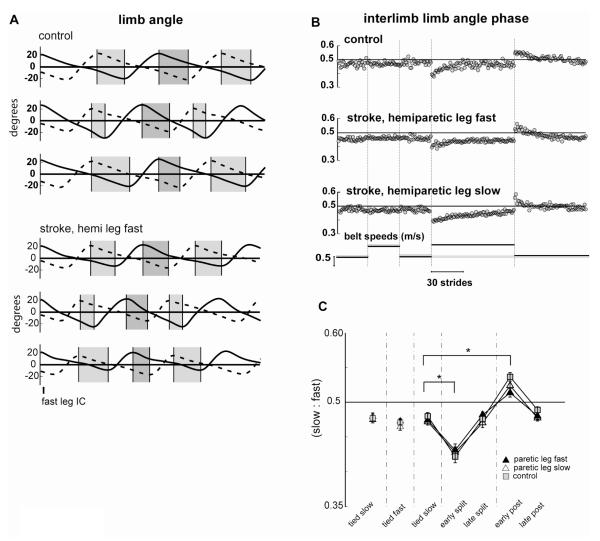
Limb angle interlimb phase. A. Limb angles on the slow (dashed line) and fast (solid line) legs plotted over two successive strides from a typical control (top 3 pairs of traces) and stroke (bottom 3 pairs of traces) subject. Pairs of strides are from the Baseline (top), early Adaptation period (middle) and the early Post-adaptation period (bottom). All strides are aligned on the first initial contact (IC) on the fast leg. Light grey bars show the duration from peak limb flexion on the slow leg to peak limb extension on the fast leg; dark grey bars show the duration from peak limb flexion on the fast leg to peak limb extension on the slow leg. During symmetric walking, these two durations are equal (top trace); note the clear temporal shift in limb angles that occurs during the early Adaptation (middle trace) and early Post-adaptation (bottom trace) periods. These phase shifts are quantified over the duration of the limb angle cycle in the cross-correlation measures. B. Limb angle interlimb phasing values for sequential strides on the treadmill from the same control and stroke subject shown in A above. C. Average limb angle interlimb phasing values for the stroke subjects in the paretic leg slow session (open triangles), the paretic leg fast session (filled triangles) and for the control (squares) group. Each data point represents values averaged over the first five strides from the early or late portions of each testing period for each control and stroke subject individually and then averaged across all subjects in a group. Error bas indicate ± 1 SE.
Figure 5
Figure 5
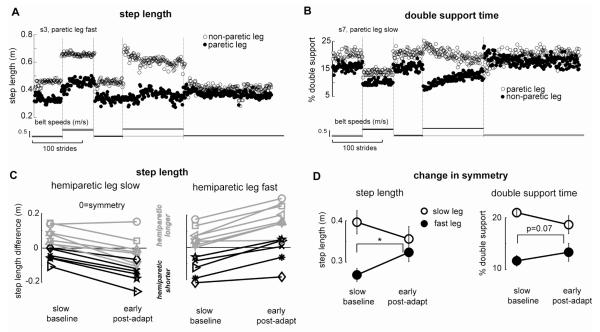
Changes in asymmetry. A. Step length of a stroke subject. Step length on the paretic (solid circles) and non-paretic (open circles) legs shown for consecutive strides in all periods. Note the marked baseline asymmetry when the belts are tied, the increase in asymmetry when the belts are split (because the paretic leg is on the fast belt, thus exaggerating the baseline asymmetry) and the symmetry when the belts are tied in Post-adaptation. B. Double support times for a stroke subject. Double support at the end of paretic stance is indicated with open circles and double support at the end of non-paretic leg stance indicated with solid circles. Note the marked baseline asymmetry when the belts are tied, the increase in asymmetry when the belts are split and the symmetry when the belts are tied in Post-adaptation. C. Step length difference for individual subjects in the Baseline and Post-adaptation periods when the paretic leg is on the slow (left figure) or fast (right figure) belt during the split-belt period. Grey lines represent subjects who at baseline take a longer step on the paretic leg and black lines represent subjects who take a shorter step on the paretic leg at baseline. Note that the after-effects in Post-adaptation serve to either increase or decrease step length asymmetry, depending on the direction of the asymmetry at baseline. D. Changes in step length and double support from Baseline to Post-adaptation periods for subjects who demonstrated significant (see Methods) baseline asymmetry. Slow leg indicated by open circles and fast leg indicated by closed circles. Note the improvement in asymmetry from the Baseline to Post-adaptation period. Each data point represents values averaged over the first five strides from the Baseline or Post-adaptation period. Error bas indicate ± 1 SE.

References

    1. Armstrong DM. Supraspinal contributions to the initiation and control of locomotion in the cat. Prog Neurobiol. 1986;26:273–361. - PubMed
    1. Beer RF, Dewald JP, Dawson ML, Rymer WZ. Target-dependent differences between free and constrained arm movements in chronic hemiparesis. Exp Brain Res. 2004;156:458–470. - PubMed
    1. Brandstater ME, de Bruin H, Gowland C, Clark BM. Hemiplegic gait: analysis of temporal variables. Arch Phys Med Rehabil. 1983;64:583–587. - PubMed
    1. Brown DA, Kautz SA, Dairaghi CA. Muscle activity patterns altered during pedaling at different body orientations. J Biomech. 1996;29:1349–1356. - PubMed
    1. Chambers WW, Sprague JM. Functional localization in the cerebellum. I. Organization in longitudinal cortico-nuclear zones and their contribution to the control of posture, both extrapyramidal and pyramidal. J Comp Neurol. 1955;103:105–129. - PubMed

Publication types