


Co-culturing human prostate carcinoma cells with hepatocytes leads to increased expression of E-cadherin
- PMID: 17406365
- PMCID: PMC2360137
- DOI: 10.1038/sj.bjc.6603700
Co-culturing human prostate carcinoma cells with hepatocytes leads to increased expression of E-cadherin
Abstract
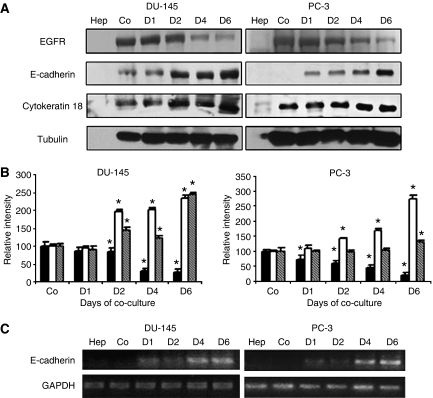
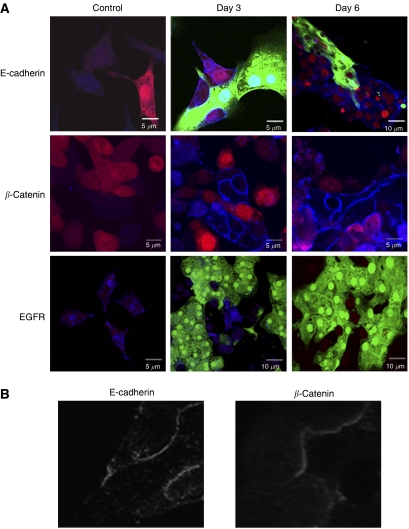
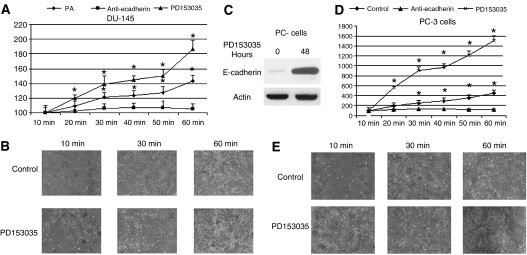
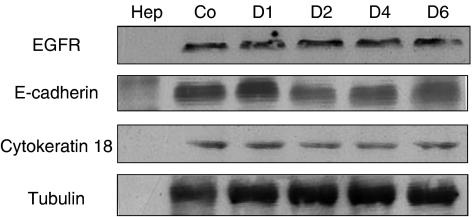
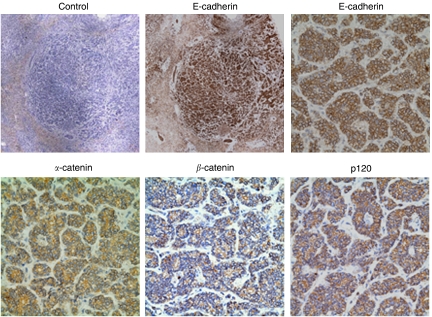
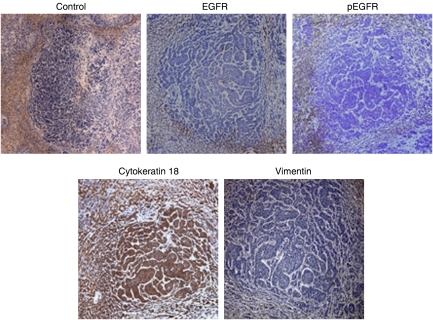
Metastasis is a multi-step process wherein tumour cells detach from the primary mass, migrate through barrier matrices, gain access to conduits to disseminate, and subsequently survive and proliferate in an ectopic site. During the initial invasion stage, prostate carcinoma cells undergo epithelial-mesenchymal-like transition with gain of autocrine signalling and loss of E-cadherin, hallmarks that appear to enable invasion and dissemination. However, some metastases express E-cadherin, and we found close connections between prostate carcinoma cells and hepatocytes in a liver microtissue bioreactor. We hypothesise that phenotypic plasticity occurs late in prostate cancer progression at the site of ectopic seeding. Immunofluorescence staining for E-cadherin in co-cultures of hepatocytes and DU-145 prostate cancer cells revealed E-cadherin upregulation at peripheral sites of contact by day 2 of co-culture; E-cadherin expression also increased in PC-3 cells in co-culture. These carcinoma cells bound to hepatocytes in an E-cadherin-dependent manner. Although the signals by which the hepatocytes elicited E-cadherin expression remain undetermined, it appeared related to downregulation of epidermal growth factor receptor (EGFR) signalling. Inhibition of autocrine EGFR signalling increased E-cadherin expression and cell-cell heterotypic adhesion; further, expression of a downregulation-resistant EGFR variant prevented E-cadherin upregulation. These findings were supported by finding E-cadherin and catenins but not activated EGFR in human prostate metastases to the liver. We conclude that the term epithelial-mesenchymal transition only summarises the transient downregulation of E-cadherin for invasion with re-expression of E-cadherin being a physiological consequence of metastatic seeding.
Figures
References
-
- Ackland ML, Newgreen DF, Fridman M, Waltham MC, Arvanitis A, Minichiello J, Price JT, Thompson EW (2003) Epidermal growth factor-induced epithelio–mesenchymal transition in human breast carcinoma cells. Lab Invest 83: 435–448 - PubMed
-
- Angelucci A, Gravina GL, Rucci N, Millimaggi D, Festuccia C, Muzi P, Teti A, Vicentini C, Bologna M (2006) Suppression of EGF-R signaling reduces the incidence of prostate cancer metastasis in nude mice. Endocr Relat Cancer 13: 197–210 - PubMed
-
- Bates RC, Mercurio AM (2005) The epithelial–mesenchymal transition (EMT) and colorectal cancer progression. Cancer Biol Ther 4: 365–370 - PubMed
-
- Bryden AA, Hoyland JA, Freemont AJ, Clarke NW, Schembri-Wismayer D, George NJ (2002) E-cadherin and beta catenin are down-regulated in prostatic bone mestatases. BJU Intl 89: 400–403 - PubMed
Publication types
MeSH terms
Substances
LinkOut - more resources
Full Text Sources
Medical
Research Materials
Miscellaneous
