. 2006;1(5):2457-64.
doi: 10.1038/nprot.2006.385.

High-throughput knockout screen in fission yeast

Affiliations

High-throughput knockout screen in fission yeast

Juraj Gregan et al. Nat Protoc. 2006.

Abstract

We have designed the most efficient strategy to knock out genes in fission yeast Schizosaccharomyces pombe on a large scale. Our technique is based on knockout constructs that contain regions homologous to the target gene cloned into vectors carrying dominant drug-resistance markers. Most of the steps are carried out in a 96-well format, allowing simultaneous deletion of 96 genes in one batch. Based on our knockout technique, we designed a strategy for cloning knockout constructs for all predicted fission yeast genes, which is available in a form of a searchable database http://mendel.imp.ac.at/Pombe_deletion/. We validated this technique in a screen where we identified novel genes required for chromosome segregation during meiosis. Here, we present our protocol with detailed instructions. Using this protocol, one person can knock out 96 S. pombe genes in 8 days.


Figures
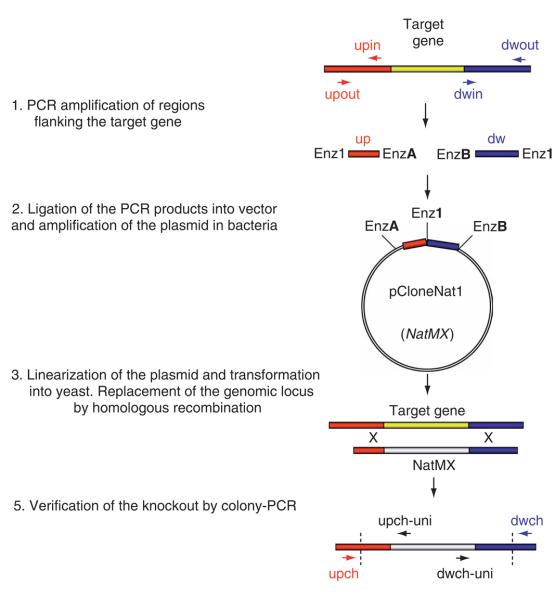
Figure 1
Figure 1
Flowchart of the knockout strategy. Regions flanking the target gene upstream of the start codon and downstream of the stop codon are designated as “up” and “dw”, respectively. PCR primers were designed in silico so that 150–700 bp of up and dw regions are amplified. Combination of primers upout + upin and primers dwout + dwin is used to PCR amplify regions upstream and downstream of the target gene, respectively. These are the homology regions used to knock out the target gene. Primers encode restriction sites, which are used to clone the homology regions into the pCloneNat1 or pCloneHyg1 vector. The vector containing homology regions is linearized (linearization in the homology region increases efficiency of the targeting) and transformed into yeast. Homologous recombination is used to replace the target gene with the knockout construct. The knockout is verified in yeast transformants by colony PCR using combination of primers upch and upch-uni and primers dwch and dwch-uni.
Figure 2
Figure 2
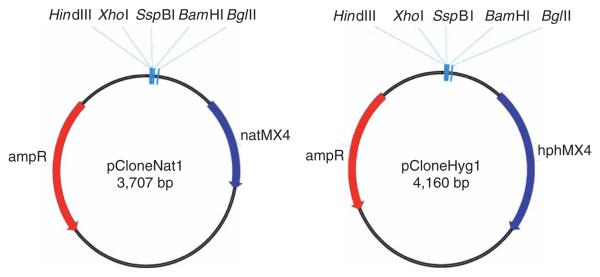
Maps of cloning vectors pCloneNat1 and pCloneHyg1. Restriction sites used for cloning of the homology regions are indicated. Nucleotide sequence of pCloneNat1 (EF101285) and pCloneHyg1 (EF101286) can be found in GenBank.
Figure 3
Figure 3
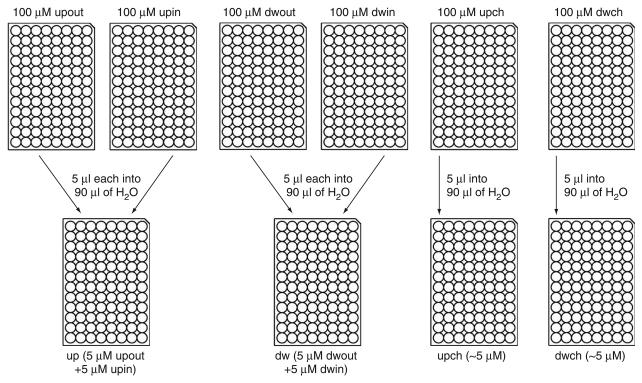
Dilution of primers. Upon receipt of the primers, add 5 μl of 100× TE to each well. Dispense 90 μl of sterile water into four fresh PCR microtiter plates. To the first plate, add 5 μl of upout and 5 μl of upin primers (this is referred to as the up plate). To the second plate, add 5 μl of dwout and 5 μl of dwin primers (this is referred to as the dw plate). To the third plate, add 5 μl of 100 μM upch primer (this is referred to as the upch plate). To the fourth plate, add 5 μl of 100 μM dwch oligo (this is referred to as the dwch plate).
Figure 4
Figure 4
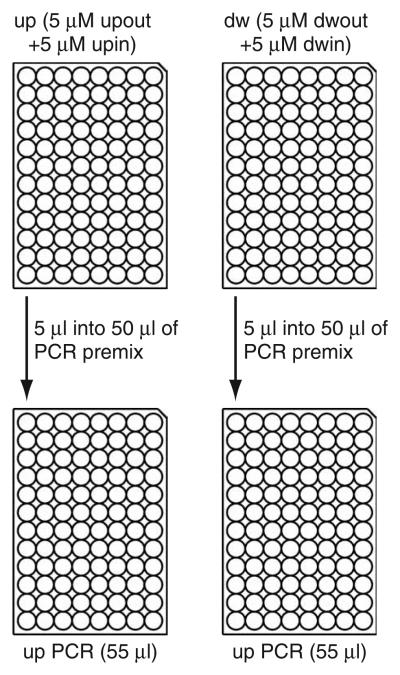
Amplification of homology regions by PCR. Dispense 50 μl of the PCR premix per well into two PCR microtiter plates. Into the first plate, add 5 μl from up plate containing 5 μM upout and 5 μM upin primers (this is referred to as the up PCR plate). To the second plate, add 5 μl from dw plate containing 5 μM dwout and 5 μM dwin primers (this is referred to as the dw PCR plate).
Figure 5
Figure 5
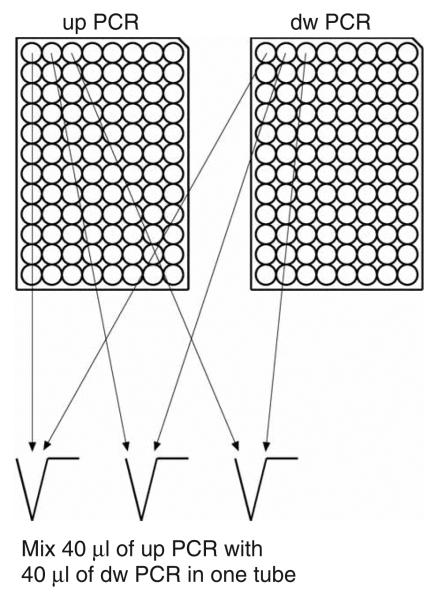
Pooling of PCR-amplified homology regions—preparation for cloning. Mix 40 μl of the PCR reactions from the up plate with 40 μl of PCR reactions from the dw plate in a 1.5 ml microfuge tube.
Figure 6
Figure 6
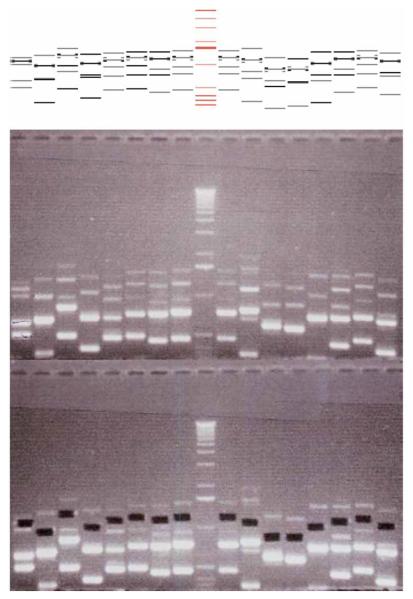
Comparison of ligated homology regions with the gel preview at http://mendel.imp.ac.at/Pombe_deletion/. Bands highlighted on the gel preview represent correctly ligated homology regions. These bands are cut out of the gel and cloned into the vector.
Figure 7
Figure 7
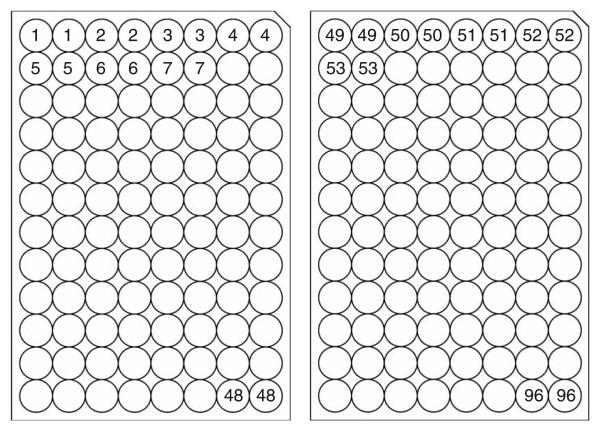
E. coli transformants ordered in 96-well plates. Prepare two 96-well tissue culture microtiter plates. Dispense 100 μl of 2× TY + ampicillin medium into each well. Inoculate two E. coli colonies for each construct.
Figure 8
Figure 8
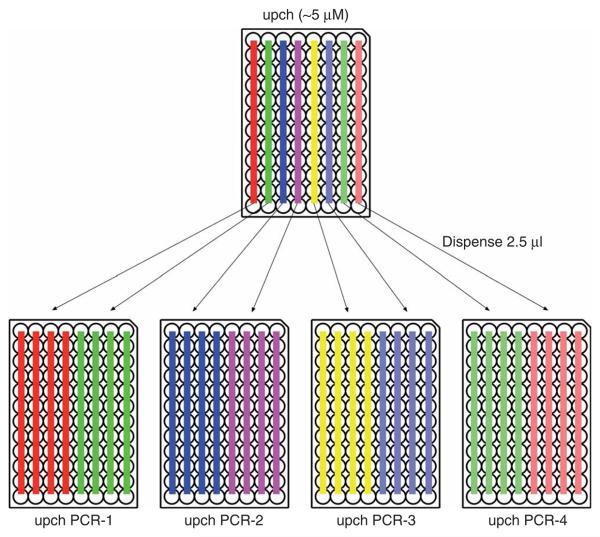
PCR checking of yeast transformants. Dispense 2.5 μl of upch primer into four 96-well PCR plates (referred to as upch PCR plates) and 2.5 μl of dwch primer into four 96-well PCR plates (referred to as dwch PCR plates). Dispense 15 μl of upch PCR premix into four upch PCR plates and 15 μl of dwch PCR premix into four dwch PCR plates and add the cell suspensions.

References

    1. Bahler J, et al. Heterologous modules for efficient and versatile PCR-based gene targeting in Schizosaccharomyces pombe. Yeast. 1998;14:943–951. - PubMed
    1. Decottignies A, Sanchez-Perez I, Nurse P. Schizosaccharomyces pombe essential genes: a pilot study. Genome Res. 2003;13:399–406. - PMC - PubMed
    1. Martin-Castellanos C, et al. A large-scale screen in S. pombe identifies seven novel genes required for critical meiotic events. Curr. Biol. 2005;15:2056–2062. - PMC - PubMed
    1. Rabitsch KP, et al. Two fission yeast homologs of Drosophila Mei-S332 are required for chromosome segregation during meiosis I and II. Curr. Biol. 2004;14:287–301. - PubMed
    1. Sato M, Dhut S, Toda T. New drug-resistant cassettes for gene disruption and epitope tagging in Schizosaccharomyces pombe. Yeast. 2005;22:583–591. - PubMed

Publication types

Substances