


Clinical utilization of chemokines to combat cancer: the double-edged sword
- PMID: 17408375
- PMCID: PMC2262932
- DOI: 10.1586/14760584.6.2.267
Clinical utilization of chemokines to combat cancer: the double-edged sword
Abstract
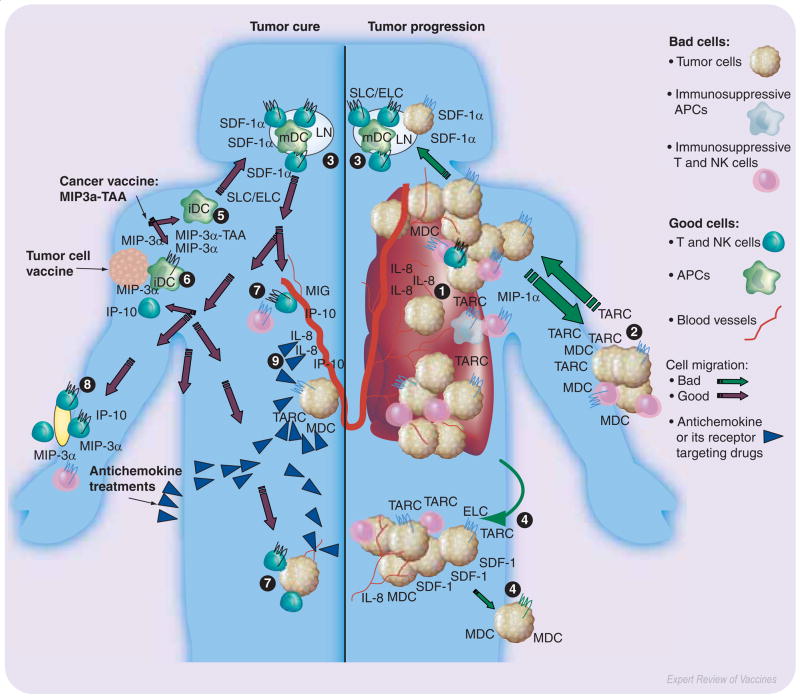
Chemokines are a small group of related chemo-attractant peptides that play an essential role in the homeostatic maintenance of the immune system. They control the recruitment of cells needed for the induction and activation of innate and adaptive immune responses. However, tumors also utilize chemokines to actively progress and evade immunosurveillance. In fact, chemokines are involved directly or indirectly in almost every aspect of tumorigenesis. They mediate survival and metastatic spread of tumors, promote new blood vessel formation (neovascularization) and induce an immunosuppressive microenvironment via recruitment of immunosuppressive cells. As a result, a number of therapeutic strategies have been proposed to target almost every step of the chemokine/chemokine receptor involvement in tumors. Yet, despite occasional success stories, most of them appear to be ineffective or impractical, presumably due to 'nonspecific' harm of cells needed for the elimination of tumor escapees and maintenance of immunological memory. The strategy would only be effective if it also promoted antitumor adaptive immune responses capable of combating a residual disease and tumor relapse.
Figures
References
-
- Muller A, Homey B, Soto H, et al. Involvement of chemokine receptors in breast cancer metastasis. Nature. 2001;410:50–56. - PubMed
-
- Balkwill F. Cancer and the chemokine network. Nat Rev Cancer. 2004;4:540–550. Review on the crucial role of chemokine (C-X-C motif) receptor 4 (CXCR4) in cancer metastases. - PubMed
-
- Moser B, Loetscher P. Lymphocyte traffic control by chemokines. Nat Immunol. 2001;2:123–128. - PubMed
-
- Varney ML, Johansson SL, Singh RK. Tumour-associated macrophage infiltration, neovascularization and aggressiveness in malignant melanoma, role of monocyte chemotactic protein-1 and vascular endothelial growth factor-A. Melanoma Res. 2005;15:417–425. - PubMed
-
- Strieter RM, Polverini PJ, Kunkel SL, et al. The functional role of the ELR motif in CXC chemokine-mediated angiogenesis. J Biol Chem. 1995;270:27348–27357. - PubMed
Publication types
MeSH terms
Substances
Grants and funding
LinkOut - more resources
Full Text Sources
Other Literature Sources
Research Materials
