. 2007 Jan 29:1:9.
doi: 10.1186/1752-0509-1-9.

Decision tree modeling predicts effects of inhibiting contractility signaling on cell motility

Affiliations

Decision tree modeling predicts effects of inhibiting contractility signaling on cell motility

Sourabh Kharait et al. BMC Syst Biol. .

Abstract

Background: Computational models of cell signaling networks typically are aimed at capturing dynamics of molecular components to derive quantitative insights from prior experimental data, and to make predictions concerning altered dynamics under different conditions. However, signaling network models have rarely been used to predict how cell phenotypic behaviors result from the integrated operation of these networks. We recently developed a decision tree model for how EGF-induced fibroblast cell motility across two-dimensional fibronectin-coated surfaces depends on the integrated activation status of five key signaling nodes, including a proximal regulator of transcellular contractile force generation, MLC (myosin light chain) [Hautaniemi et al, Bioinformatics 21: 2027 {2005}], but we have not previously attempted predictions of new experimental effects from this model.

Results: In this new work, we construct an improved decision tree model for the combined influence of EGF and fibronectin on fibroblast cell migration based on a wider spectrum of experimental protein signaling and cell motility measurements, and directly test a significant and non-intuitive a priori prediction for the outcome of a targeted molecular intervention into the signaling network: that partially reducing activation of MLC would increase cell motility on moderately adhesive surfaces. This prediction was indeed confirmed experimentally: partial inhibition of the activating MLC kinase (MLCK) upstream using the pharmacologic agent ML-7 resulted in increased motility of NR6 fibroblasts. We further extended this exciting finding by showing that partial reduction of MLC activation similarly enhanced the transmigration of the human breast carcinoma cell line MDA-213 through a Matrigel barrier.

Conclusion: These findings specifically highlight a central regulatory role for transcellular contractility in governing cell motility, while at the same time demonstrating the value of a decision tree approach to a systems "signal-response" model in discerning non-intuitive behavior arising from integrated operation a cell signaling network.


Figures
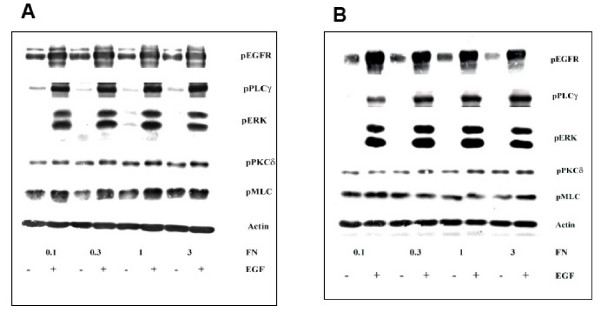
Figure 1
Figure 1
Immunoblotting data for EGF treatment of 5 minutes (A) and 1 hour (B) across different fibronectin concentration of surfaces. Tissue culture plates were coated with different fibronectin (FN) concentrations. NR6WT cells were grown on these surfaces for 24 hours in complete growth medium and quiesced for another 24 hours in medium containing 0.5% dialyzed FBS. EGF was added for a period of 1 hour, cells washed once with PBS and lysed. Cell lysates were resolved using SDS-PAGE and immunoblotted using specific antibodies for various phosphorylated proteins. At least 5 replicates for each signaling protein were created for polynomial modeling. Actin served as a loading control.
Figure 2
Figure 2
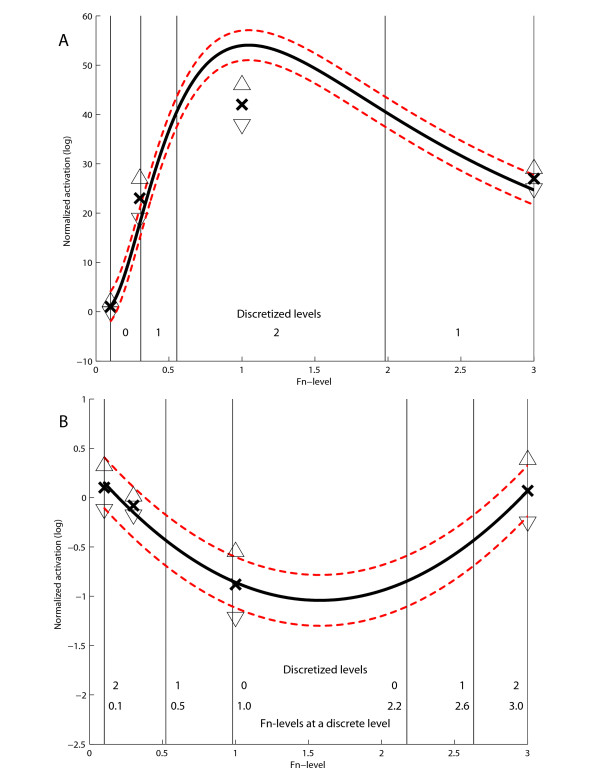
Polynomial interpolation data for cell speed (A) and activated MLC (B) under EGF stimulation. Crosses are actual measurements, upper and lower triangles are individual standard deviations, red lines denotes squared pooled standard deviation and the vast majority of the simulated cases fall between these lines. Cell speed is biphasic whereas activated MLC is inversely biphasic across fibronectin. Each variable is discretized into low, medium and high in accordance with the degree of polynomial.
Figure 3
Figure 3
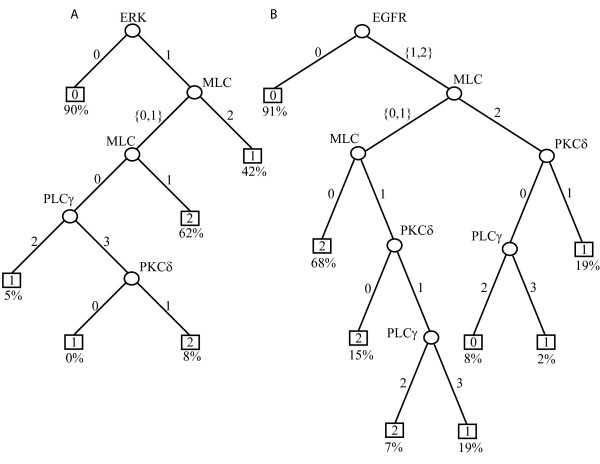
Decision tree models from 5 minute (A) and 1 hour (B) EGF stimulation data set across fibronectin. Round nodes denote (signaling proteins) whereas square nodes denote migration speed categories. Integers attached to the arc correspond to the split of the parent nodes. Under each migration speed category the fraction of cases explained by that classification rule is given. For example from (B), if EGFR is medium or high (1 or 2) and MLC is low (0), the migration speed category is 2 (high) and 68% of the observations (in the training set) for the high migration speed category can be explained by this rule.
Figure 4
Figure 4
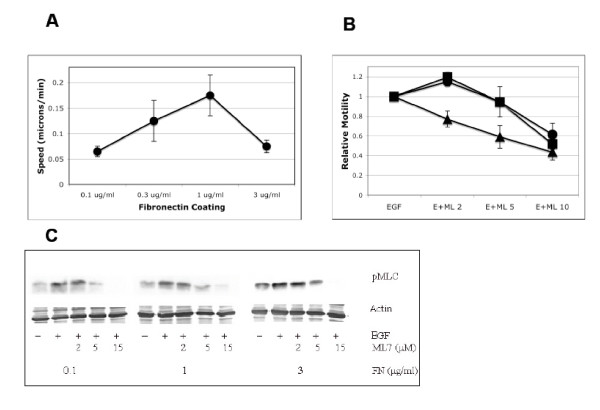
Subtotal inhibition of myosin light chain kinase increase cell migration via single-cell tracking. NR6WT fibroblasts were grown on fibronectin-coated surfaces coated and quiesced in serum-restricted conditions for 16 hours. After drug inhibition and/or EGF stimulation, single cells were tracked for up to 20 hours and their migration speeds analyzed using Visible, developed by Reify Corporation. Each experimental condition is the average ± SEM of 15–20 cells. (A) Four concentrations of fibronectin were used (0.1, 0.3, 1, 3 μg/ml) and the biphasic relationship between speed and fibronectin was indeed reproduced via our single-tracking setup and analysis. (B) Under higher fibronectin conditions (1 and 3 μg/ml), partially inhibitory ML-7 concentrations increases migration speed while further inhibition reduces the closure of the in vitro wound. At low fibronection concentrations (0.1 μg/ml) further reduction of MLC activation reduced wound closure. Shown are mean ± SEM of four experiments performed in triplicate and normalized within run to no ML-7 control speeds. In comparison to no ML-7 treatment, P < 0.05 for 2 μM ML-7 treatments on 1 and 3 μg/ml fibronectin; the decreases in speed were also statistically significant at higher ML-7 concentrations for all three surfaces. 0.1 μg/ml FN are triangles, 1 μg/ml FN are circles and 3 μg/ml FN are squares. (C) Attenuation of MLC activity using graded concentrations of MLCK inhibitor, ML-7. MLC activity is completely abrogated at concentrations greater than 15 μM. Three FN levels (low, medium and high concentrations) are shown for simplicity. Shown is one of three representative experiments.
Figure 5
Figure 5
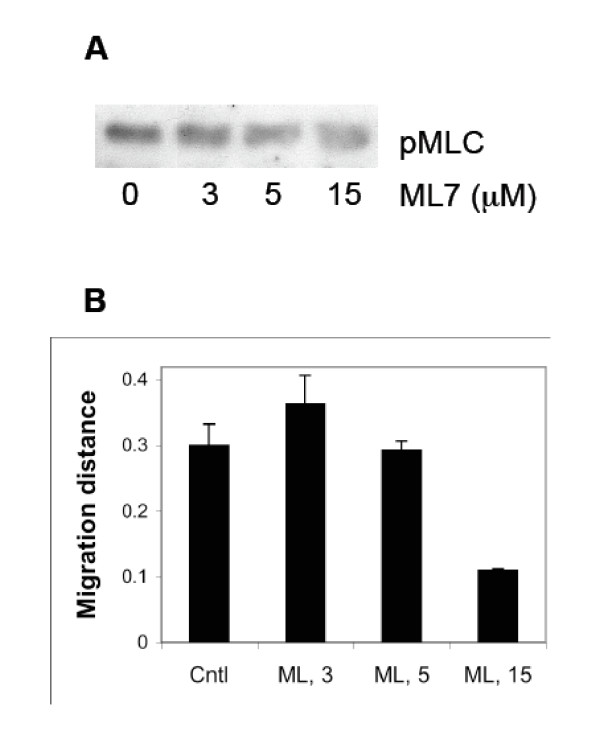
Subtotal inhibition of myosin light chain activation increases migration of cancer cells. (A) MDA-MB-231 breast cancer cells were grown in complete medium, quiesced for 24 hours in serum deprived medium (with 0.5% dialyzed FBS) and incubated with varying concentrations of MLCKinase inhibitor, ML-7. Cells were lysed and immunoblotting of lysates was carried out using SDS-PAGE to detect activated levels of MLC. Shown are one of three similar blots.(B) MDA-MB-231 cells were grown in complete medium until they formed a confluent monolayer. The medium was then replaced by 0.5% dialyzed FBS containing quiescent medium for 24 hours. The monolayer was scraped using a sterile pipet tip, washed three times with PBS and migration of cells in the denuded area was assessed over a period of 24 hours in the presence of increasing doses of MLCKinase inhibitor, ML-7. Shown are mean ± SEM of three experiments each performed in triplicate. In comparison to no ML-7 treatment, P < 0.05 for 3 and 15 μM ML-7 treatments.

References

    1. Hautaniemi S, Kharait S, Iwabu A, Wells A, Lauffenburger DA. Modeling and prediction of signal transduction cascades using decision trees. Bioinformatics. 2005;21:2027–2035. doi: 10.1093/bioinformatics/bti278. - DOI - PubMed
    1. Janes KA, Lauffenburger DA. A biological approach to computational models of proteomic networks. Current Opinion in Chemical Biology. 2006;10:73–80. doi: 10.1016/j.cbpa.2005.12.016. - DOI - PubMed
    1. Wells A, Kassis J, Solava J, Turner T, Lauffenburger DA. Growth factor-induced cell motility in tumor invasion. Acta Oncologica. 2002;41:124–130. doi: 10.1080/028418602753669481. - DOI - PubMed
    1. Wells A. Tumor invasion: role of growth factor-induced cell motility. Advances in Cancer Research. 2000;78:31–101. - PubMed
    1. Barrett JC, Bennett LM, Fleming LK, Linehan WM, Liotta LA, Rosenberg SA, Petricoin EF, 3rd, Staudt LM, Thompson TE, Yang JC. Linking laboratory and clinical research: the development of molecularly targeted therapeutics inside the national cancer institute center for cancer research. Clin Adv Hematol Oncol. 2003;1:302–306. - PubMed

Publication types

MeSH terms