


Mathematical model of network dynamics governing mouse sleep-wake behavior
- PMID: 17409167
- PMCID: PMC2259448
- DOI: 10.1152/jn.01184.2006
Mathematical model of network dynamics governing mouse sleep-wake behavior
Abstract
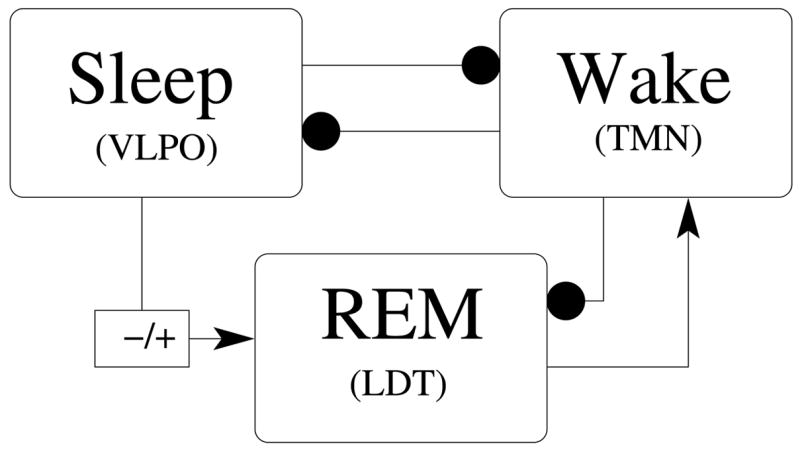
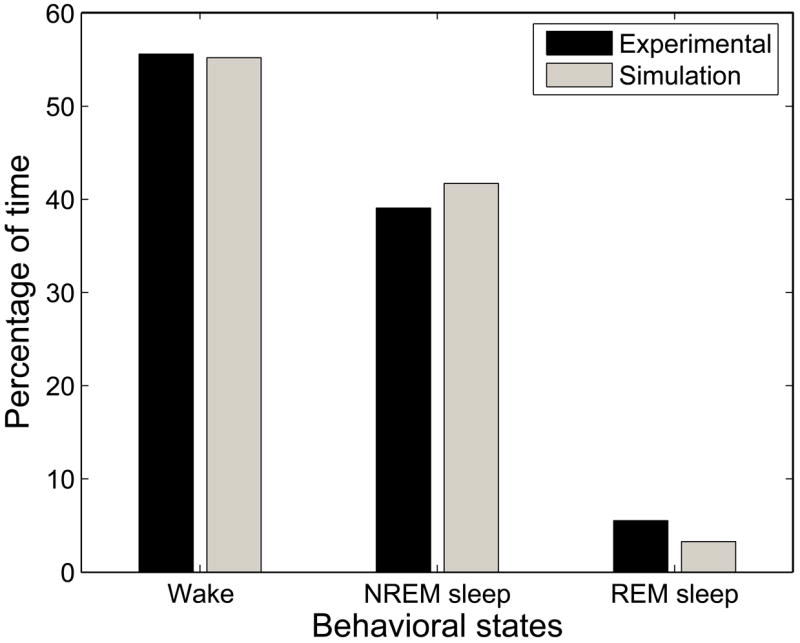
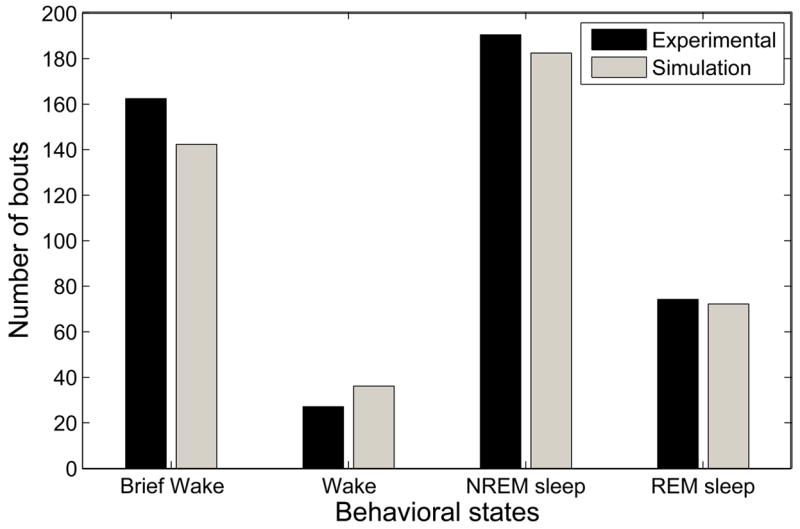
Recent work in experimental neurophysiology has identified distinct neuronal populations in the rodent brain stem and hypothalamus that selectively promote wake and sleep. Mutual inhibition between these cell groups has suggested the conceptual model of a sleep-wake switch that controls transitions between wake and sleep while minimizing time spent in intermediate states. By combining wake- and sleep-active populations with populations governing transitions between different stages of sleep, a "sleep-wake network" of neuronal populations may be defined. To better understand the dynamics inherent in this network, we created a model sleep-wake network composed of coupled relaxation oscillation equations. Mathematical analysis of the deterministic model provides insight into the dynamics underlying state transitions and predicts mechanisms for each transition type. With the addition of noise, the simulated sleep-wake behavior generated by the model reproduces many qualitative and quantitative features of mouse sleep-wake behavior. In particular, the existence of simulated brief awakenings is a unique feature of the model. In addition to capturing the experimentally observed qualitative difference between brief and sustained wake bouts, the model suggests distinct network mechanisms for the two types of wakefulness. Because circadian and other factors alter the fine architecture of sleep-wake behavior, this model provides a novel framework to explore dynamical principles that may underlie normal and pathologic sleep-wake physiology.
Figures








References
-
- Aston-Jones G, Ennis M, Pieribone V, Nickell WT, Shipley M. The brain nucleus locus coeruleus: Restricted afferent control of a broad efferent network. Science. 1986 November;234(4777):734–737. - PubMed
-
- Borbely AA, Achermann P. Principles and Practice in Sleep Medicine. 4. chapter 14. Saunders/Elsevier; 2005. pp. 787–856.
-
- Chamberlin N, Arrigoni E, Chou TC, Scammell T, Greene R, Saper C. Effects of adenosine on GABAergic synaptic inputs to identified ventrolateral preoptic neurons. Neuroscience. 2003;119:913–918. - PubMed
-
- Datta S, Siwek DF. Excitation of the brain stem pedunculopontine tegmentum cholinergic cells induces wakefulness and REM sleep. Journal of Neurophysiology. 1997;77:2975–2988. - PubMed
-
- Datta S, Siwek DF. Single cell activity patterns of pedunculopontine tegmentum neurons across the sleep-wake cycle in the freely moving rats. Journal of Neuroscience Research. 2002;70:611–621. - PubMed
Publication types
MeSH terms
Grants and funding
LinkOut - more resources
Full Text Sources
Other Literature Sources
