Influence of computer-aided detection on performance of screening mammography
- PMID: 17409321
- PMCID: PMC3182841
- DOI: 10.1056/NEJMoa066099
Influence of computer-aided detection on performance of screening mammography
Abstract
Background: Computer-aided detection identifies suspicious findings on mammograms to assist radiologists. Since the Food and Drug Administration approved the technology in 1998, it has been disseminated into practice, but its effect on the accuracy of interpretation is unclear.
Methods: We determined the association between the use of computer-aided detection at mammography facilities and the performance of screening mammography from 1998 through 2002 at 43 facilities in three states. We had complete data for 222,135 women (a total of 429,345 mammograms), including 2351 women who received a diagnosis of breast cancer within 1 year after screening. We calculated the specificity, sensitivity, and positive predictive value of screening mammography with and without computer-aided detection, as well as the rates of biopsy and breast-cancer detection and the overall accuracy, measured as the area under the receiver-operating-characteristic (ROC) curve.
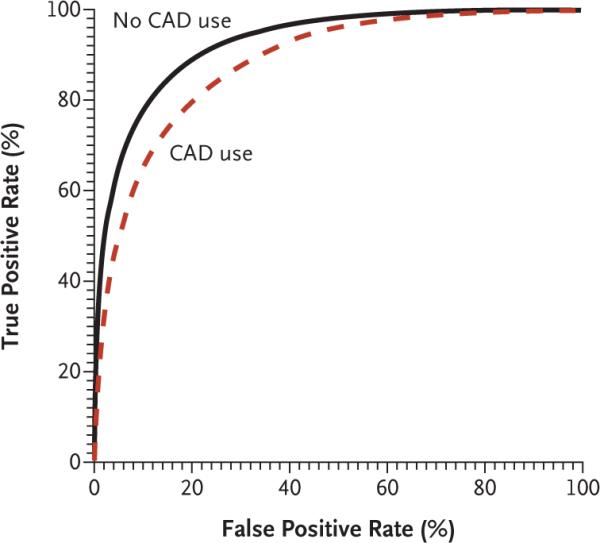
Results: Seven facilities (16%) implemented computer-aided detection during the study period. Diagnostic specificity decreased from 90.2% before implementation to 87.2% after implementation (P<0.001), the positive predictive value decreased from 4.1% to 3.2% (P=0.01), and the rate of biopsy increased by 19.7% (P<0.001). The increase in sensitivity from 80.4% before implementation of computer-aided detection to 84.0% after implementation was not significant (P=0.32). The change in the cancer-detection rate (including invasive breast cancers and ductal carcinomas in situ) was not significant (4.15 cases per 1000 screening mammograms before implementation and 4.20 cases after implementation, P=0.90). Analyses of data from all 43 facilities showed that the use of computer-aided detection was associated with significantly lower overall accuracy than was nonuse (area under the ROC curve, 0.871 vs. 0.919; P=0.005).
Conclusions: The use of computer-aided detection is associated with reduced accuracy of interpretation of screening mammograms. The increased rate of biopsy with the use of computer-aided detection is not clearly associated with improved detection of invasive breast cancer.
Copyright 2007 Massachusetts Medical Society.
Figures
Comment in
-
Breast imaging and computer-aided detection.N Engl J Med. 2007 Apr 5;356(14):1464-6. doi: 10.1056/NEJMe078028. N Engl J Med. 2007. PMID: 17409329 No abstract available.
-
Computer-aided screening mammography.N Engl J Med. 2007 Jul 5;357(1):83; author reply 85. doi: 10.1056/NEJMc071248. N Engl J Med. 2007. PMID: 17611212 No abstract available.
-
Computer-aided screening mammography.N Engl J Med. 2007 Jul 5;357(1):84; author reply 85. N Engl J Med. 2007. PMID: 17615628 No abstract available.
-
Computer-aided screening mammography.N Engl J Med. 2007 Jul 5;357(1):84; author reply 85. N Engl J Med. 2007. PMID: 17615629 No abstract available.
-
Computer-aided screening mammography.N Engl J Med. 2007 Jul 5;357(1):84; author reply 85. N Engl J Med. 2007. PMID: 17615630 No abstract available.
-
Computer-aided screening mammography.N Engl J Med. 2007 Jul 5;357(1):83-4; author reply 85. N Engl J Med. 2007. PMID: 17615631 No abstract available.
-
Does computer-aided detection increase the accuracy of interpretation of mammograms?Nat Clin Pract Oncol. 2007 Nov;4(11):630-1. doi: 10.1038/ncponc0963. Nat Clin Pract Oncol. 2007. PMID: 17909550 No abstract available.
References
-
- Chan HP, Doi K, Galhotra S, Vyborny CJ, MacMahon H, Jokich PM. Image feature analysis and computer-aided diagnosis in digital radiography. I. Automated detection of microcalcifications in mammography. Med Phys. 1987;14:538–48. - PubMed
-
- Doi K, Giger ML, Nishikawa RM, Schmidt RA. Computer-aided diagnosis of breast cancer on mammograms. Breast Cancer. 1997;4:228–33. - PubMed
-
- Brem RF, Baum J, Lechner M, et al. Improvement in sensitivity of screening mammography with computer-aided detection: a multiinstitutional trial. AJR Am J Roentgenol. 2003;181:687–93. - PubMed
-
- Warren Burhenne LJ, Wood SA, D'Orsi CJ, et al. Potential contribution of computer-aided detection to the sensitivity of screening mammography. Radiology. 2000;215:554–62. Erratum, Radiology 2000:216:306. - PubMed
-
- Birdwell RL, Ikeda DM, O'Shaughnessy KF, Sickles EA. Mammographic characteristics of 115 missed cancers later detected with screening mammography and the potential utility of computer-aided detection. Radiology. 2001;219:192–202. - PubMed
Publication types
MeSH terms
Grants and funding
LinkOut - more resources
Full Text Sources
Other Literature Sources
Medical