


Simple tools for assessment of ovarian reserve (OR): individual ovarian dimensions are reliable predictors of OR
- PMID: 17412332
- PMCID: PMC2000481
- DOI: 10.1016/j.fertnstert.2006.11.175
Simple tools for assessment of ovarian reserve (OR): individual ovarian dimensions are reliable predictors of OR
Abstract
Objective: To determine the association between individual ovarian dimensions, advancing age, and declining ovarian reserve (OR) in an infertile population.
Design: An ongoing prospective observational study.
Setting: Academic infertility practice.
Patient(s): Sixty-nine premenopausal women presenting for the evaluation and management of infertility.
Intervention(s): Transvaginal ultrasound assessment of the ovarian dimensions (length, width, and overall diameter in cm) and evaluation of the OR status by measuring serum levels of FSH and E(2) in the early follicular phase of the menstrual cycle.
Main outcome measure(s): Relationship of the individual ovarian dimensions to age (years) and OR (reflected by historical maximal FSH levels).
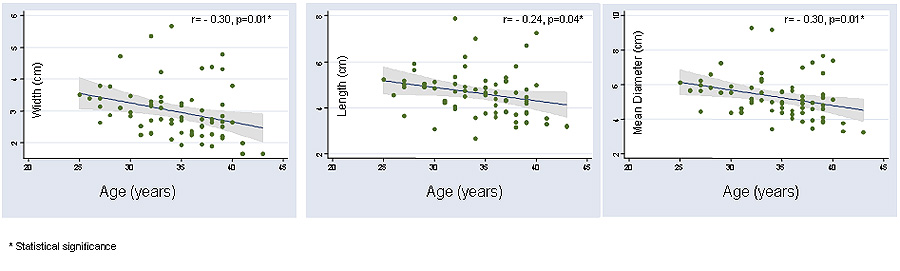
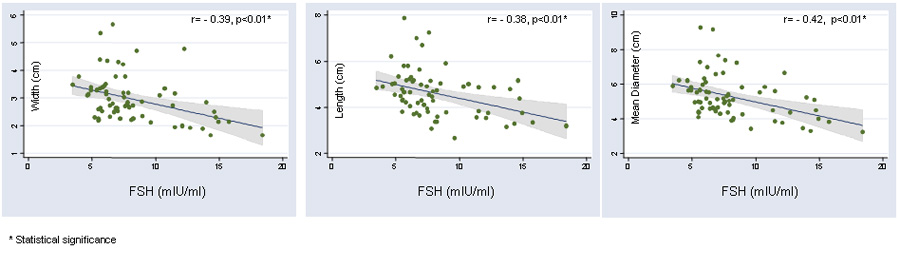
Result(s): A statistically significant decrease in three ovarian size parameters accompanied advancing age (ovarian width, r = -0.30; ovarian length, r = -0.24; and the mean overall ovarian diameter, r = -0.30). Levels of FSH demonstrated a significant and linear correlation with age (r = 0.39). Increasing levels of FSH (and hence declining OR) were associated with statistically significant declines in the mean ovarian width (r = -0.39), length (r = -0.38), and overall mean ovarian diameter (r = -.42), Patients with a known diagnosis of diminished OR demonstrated significantly reduced ovarian dimensions compared with patients with other infertility etiologies. Multivariate linear regression analysis confirmed individual ovarian measurements (width, length, and overall diameter) as independent predictors of OR (FSH levels) after adjusting for parameters that are known to influence ovarian size, i.e., age, smoking status, body mass index, and anovulation history. Ovarian width emerged as the strongest predictor of OR (largest beta coefficient and hence the strongest association with OR status), compared with ovarian length and the mean ovarian diameter.
Conclusion(s): Single ovarian dimensions are reliable predictors of advancing age and declining OR status in premenopausal infertile women. The magnitude of this association is most robust for the ovarian width.
Figures
References
-
- Menken J, Trussell J, Larsen U. Age and Infertility. Science. 1986;233:1389–1394. - PubMed
-
- Speroff L. The effect of aging on fertility. Curr Opin Obstet Gynecol. 1994;6:115–120. - PubMed
-
- Buyalos RP, Daneshmand S, Brzechffa PR. Basal estradiol and follicle stimulating hormone predict fecundity in women of advanced reproductive age undergoing ovulation induction therapy. Fertil Steril. 1997;68:272–277. - PubMed
-
- Creus M, Penarrubia J, Fabregues F, Vidal E, Carmona F, Casamitjana R, Vanrell JA, Balasch J. Day 3 serum inhibin B and FSH and age as predictors of assisted reproduction treatment outcome. Human Reproduction. 2000;15:2341–2346. - PubMed
-
- Galey-Fontaine J, Cedrin-Durnerin I, Chaibi R, Massin N, Hugues JN. Age and ovarian reserve are distinct predictive factors of cycle outcome in low responders. Reprod Biomed Online. 2005;10:94–99. - PubMed
Publication types
MeSH terms
Substances
Grants and funding
LinkOut - more resources
Full Text Sources
Medical
