Trauma and stress response among Hurricane Katrina evacuees
- PMID: 17413068
- PMCID: PMC1854990
- DOI: 10.2105/AJPH.2006.086678
Trauma and stress response among Hurricane Katrina evacuees
Abstract
Objectives: Hurricane Katrina's impact on public health has been significant and multifaceted, with trauma-related psychological sequelae likely to result in a sizable burden of disease. Data were collected that assessed acute stress disorder (ASD) prevalence and factors related to ASD symptomatology among sheltered evacuees.
Methods: On days 12 to 19 after Katrina, evacuees at a major emergency shelter completed surveys that assessed demographics, Katrina-specific experiences, and ASD symptomatology.
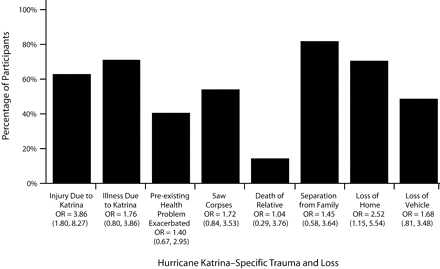
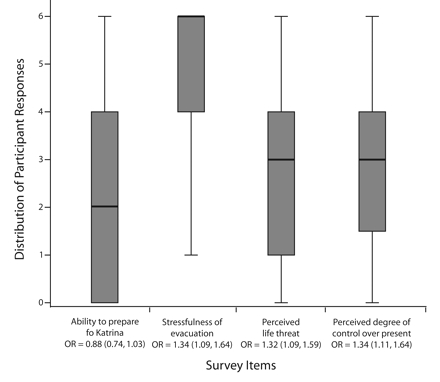
Results: Sixty-two percent of the sample met ASD threshold criterion. Projections based on the predictive power of ASD to posttraumatic stress disorder (PTSD) suggest that 38% to 49% of the sample will meet PTSD criteria 2 years post-disaster. Female gender (odds ratio [OR] = 4.08), positive psychiatric history (OR=5.84), injury (OR=2.75), increased life-threat perception (OR=1.37), and decreased sense of personal control (OR=1.56) were significantly related to ASD. Black race was associated with greater symptom severity (B=7.85, SE[B]=3.50).
Conclusions: Katrina-related trauma and its psychological sequelae will remain a significant public health issue for years to come. The identification of several vulnerability factors related to ASD and PTSD provides a brief sketch of those at greatest risk.
Figures
References
-
- American Red Cross. One week after Katrina’s Gulf Coast assault, the American Red Cross is setting a record relief pace. Available at: http://www.redcross.org/pressrelease/0,1077,0_489_4553,00.html. Accessed October 10, 2005.
-
- American Red Cross. American Red Cross projects Hurricane Katrina most costly relief effort in history. Available at: http://www.redcross.org/pressrelease/0,1077,0_314_4640,00.html. Accessed November 4, 2005.
-
- Department of Homeland Security. Government response activities during the first three weeks of the recovery effort. Available at: http://www.dhs.gov/interweb/assetlibrary/katrina.htm. Accessed October 10, 2005.
-
- Shariat S, Mallonee S, Kruger E, Farmer K, North C. A prospective study of long-term health outcomes among Oklahoma City bombing survivors. J Oklahoma State Med Assoc. 1999;92:178–186. - PubMed
-
- Inoue-Sakurai C, Maruyama S, Morimoto K. Post-traumatic stress and lifestyles are associated with natural killer cell activity in victims of the Hanshin-Awaji earthquake in Japan. Prev Med. 2000;31:467–473. - PubMed
MeSH terms
LinkOut - more resources
Full Text Sources
Other Literature Sources
Medical
Miscellaneous