


A controlled trial of reduced meal frequency without caloric restriction in healthy, normal-weight, middle-aged adults
- PMID: 17413096
- PMCID: PMC2645638
- DOI: 10.1093/ajcn/85.4.981
A controlled trial of reduced meal frequency without caloric restriction in healthy, normal-weight, middle-aged adults
Abstract
Background: Although consumption of 3 meals/d is the most common pattern of eating in industrialized countries, a scientific rationale for this meal frequency with respect to optimal health is lacking. A diet with less meal frequency can improve the health and extend the lifespan of laboratory animals, but its effect on humans has never been tested.
Objective: A pilot study was conducted to establish the effects of a reduced-meal-frequency diet on health indicators in healthy, normal-weight adults.
Design: The study was a randomized crossover design with two 8-wk treatment periods. During the treatment periods, subjects consumed all of the calories needed for weight maintenance in either 3 meals/d or 1 meal/d.
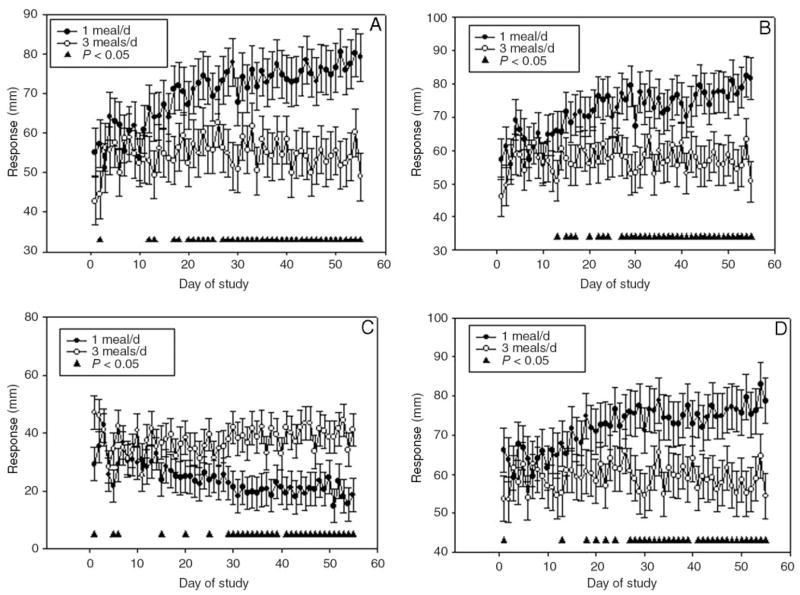
Results: Subjects who completed the study maintained their body weight within 2 kg of their initial weight throughout the 6-mo period. There were no significant effects of meal frequency on heart rate, body temperature, or most of the blood variables measured. However, when consuming 1 meal/d, subjects had a significant increase in hunger; a significant modification of body composition, including reductions in fat mass; significant increases in blood pressure and in total, LDL-, and HDL-cholesterol concentrations; and a significant decrease in concentrations of cortisol.
Conclusions: Normal-weight subjects are able to comply with a 1 meal/d diet. When meal frequency is decreased without a reduction in overall calorie intake, modest changes occur in body composition, some cardiovascular disease risk factors, and hematologic variables. Diurnal variations may affect outcomes.
Figures
Comment in
-
A controlled trial of reduced meal frequency without caloric restriction in healthy, normal-weight, middle-aged adults.Am J Clin Nutr. 2007 Oct;86(4):1254-5. doi: 10.1093/ajcn/86.4.1254. Am J Clin Nutr. 2007. PMID: 17921414 No abstract available.
References
-
- Haslam DW, James WP. Obesity. Lancet. 2005;366:1197–209. - PubMed
-
- Wing RR. Use of very-low-calorie diets in the treatment of obese persons with non-insulin-dependent diabetes mellitus. J Am Diet Assoc. 1995;95:569–72. - PubMed
-
- Mattison JA, Lane MA, Roth GS, Ingram DK. Calorie restriction in rhesus monkeys. Exp Gerontol. 2003;38:35–46. - PubMed
-
- Mattson MP, Wan R. Beneficial effects of intermittent fasting and caloric restriction on the cardiovascular and cerebrovascular systems. J Nutr Biochem. 2005;16:129–37. - PubMed
Publication types
MeSH terms
Substances
Grants and funding
LinkOut - more resources
Full Text Sources
Medical
