Comparative Study
. 2007 Jun;189(12):4418-24.
doi: 10.1128/JB.01967-06. Epub 2007 Apr 6.

Flagellar motility is critical for Listeria monocytogenes biofilm formation

Affiliations
Comparative Study

Flagellar motility is critical for Listeria monocytogenes biofilm formation

Katherine P Lemon et al. J Bacteriol. 2007 Jun.

Abstract

The food-borne pathogen Listeria monocytogenes attaches to environmental surfaces and forms biofilms that can be a source of food contamination, yet little is known about the molecular mechanisms of its biofilm development. We observed that nonmotile mutants were defective in biofilm formation. To investigate how flagella might function during biofilm formation, we compared the wild type with flagellum-minus and paralyzed-flagellum mutants. Both nonmotile mutants were defective in biofilm development, presumably at an early stage, as they were also defective in attachment to glass during the first few hours of surface exposure. This attachment defect could be significantly overcome by providing exogenous movement toward the surface via centrifugation. However, this centrifugation did not restore mature biofilm formation. Our results indicate that it is flagellum-mediated motility that is critical for both initial surface attachment and subsequent biofilm formation. Also, any role for L. monocytogenes flagella as adhesins on abiotic surfaces appears to be either minimal or motility dependent under the conditions we examined.


Figures
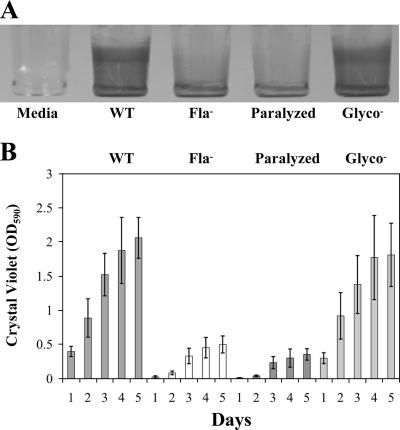
FIG. 1.
FIG. 1.
Motile strains form greater amounts of surface-adhered biofilm than nonmotile strains. (A) CV-stained L. monocytogenes biofilms formed on wells of a 96-well PVC plate. The first well has medium alone (Media), followed by the wild type (WT), flagellum-minus mutant (Fla), paralyzed-flagellum mutant (Paralyzed), and nonglycosylated-flagellum mutant (Glyco). (B) Graph of surface-adhered biofilm (quantified by measuring the OD590 of solubilized CV after biofilm staining) from four independent experiments with seven replicates of each strain per experiment. Error bars represent standard errors of the means. Analysis using one-way ANOVA followed by Tukey's multiple comparison test (set at 5%) indicated that there was a statistically significant difference between the amounts of biofilm formed by motile and nonmotile strains on each of five days.
FIG. 2.
FIG. 2.
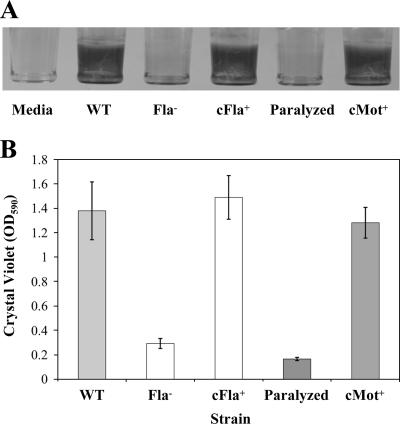
In a 10403S background, motile strains form greater amounts of surface-adhered biofilm than nonmotile strains. (A) CV stained 3-day-old L. monocytogenes biofilms formed on wells of a 96-well PVC plate. The wild-type strain is 10403S. The first well has medium alone (Media), followed by wild-type 10403S (WT), flagellum-minus mutant (Fla), the flagellum-minus mutant complemented with the wild-type flaA allele (cFla+), paralyzed-flagellum mutant (Paralyzed), and the paralyzed mutant complemented with the wild-type motB allele (cMot+). Biofilm assays were performed as described in Materials and Methods, except that standing cultures were incubated at 36°C, where the WT, cFla+, and cMot+ strains are still motile. (B) Graph of surface-adhered biofilm (quantified by measuring the OD590 of solubilized CV after biofilm staining) from three independent experiments with seven replicates of each strain per experiment. Error bars represent standard errors of the means.
FIG. 3.
FIG. 3.
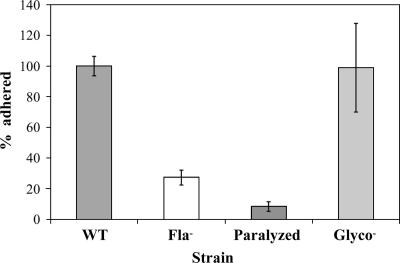
Motile strains of L. monocytogenes attached better to glass than nonmotile mutants. The number of cells attached per hpf to glass coverslips (MatTek dish) between 30 to 200 min after surface exposure was normalized such that the average number of cells/hpf for the wild-type strain for each experiment was set at 100%. Strains are the wild type (WT), flagellum-minus mutant (Fla), paralyzed-flagellum mutant (Paralyzed), and nonglycosylated-flagellum mutant (Glyco). Using one-way ANOVA followed by Tukey's multiple comparison (set at 5%), the difference between the motile and nonmotile strains was statistically significant, but the possible difference between the flagellum-minus and paralyzed-flagellum mutant was not statistically significant. Five microscope experiments from three independent sets of room-temperature overnight cultures (see Materials and Methods) were done on three different days, and 5 hpf of each strain were captured per experiment, such that 25 hpf were examined for each strain. Error bars represent standard errors of the means. Each strain was inoculated at an OD600 of ∼0.01, and for two of the three experiments we confirmed that at OD600 there was a comparable number of CFU per milliliter in the initial inoculum of each strain. All strains were inoculated into MatTek dishes within minutes of each other, and we performed microscopy on the wild type first followed by flagellum-minus mutant, paralyzed-flagellum mutant, and, finally, the nonglycosylated-flagellum mutant. Most adhered cells were either single cells or part of a pair of cells. As we could not determine if adherence had occurred before or after septation in these pairs, we chose to count each pair as a single cell.
FIG. 4.
FIG. 4.
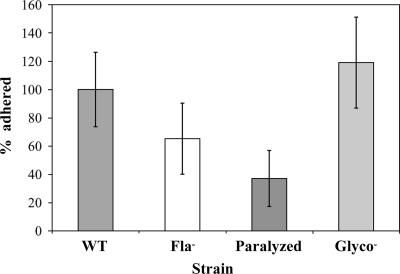
Paralyzed-flagellum mutants and flagellum-minus mutants are comparably defective in adherence to stainless steel. The number of cells attached per hpf to stainless steel coupons after 3 h of surface exposure was visualized using DAPI staining of nucleoids, and each nucleoid was counted as one cell. The data were normalized such that the average number of cells/hpf for the wild-type strain for each experiment was set at 100%. Strains are the wild type (WT), flagellum-minus mutant (Fla), paralyzed-flagellum mutant (Paralyzed), and nonglycosylated-flagellum mutant (Glyco). The difference in the percentage of cells adhered to stainless steel between the motile and nonmotile strains was statistically significant at the 95% confidence interval as determined by one-way ANOVA followed by Tukey's multiple comparison test (set at 5%). In contrast, there was no statistical difference between the two motile strains or between the two nonmotile strains. Data are from three independent experiments, in each of which two steel coupons were analyzed per strain, with 5 hpf captured per coupon.
FIG. 5.
FIG. 5.
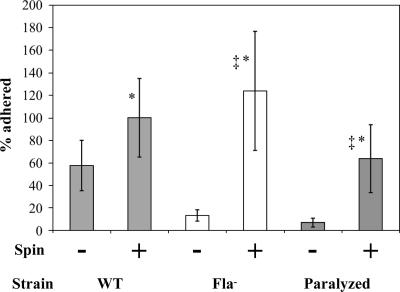
Centrifugation restored surface attachment of nonmotile mutants. Initial surface attachment of the flagellum-minus (Fla) and paralyzed-flagellum (Paralyzed) mutants was restored to wild-type levels by exogenously supplying surface-directed motion via centrifugation (∼1,900 × g) for 1 h. Also shown are the data for the adherence of the different strains when left in standing culture for 1 h. When the level of adherence by the spun wild-type strain is compared to that of either the spun flagellum-minus mutant or the spun paralyzed-flagellum mutant, it is not significantly different at the 95% confidence interval as determined by one-way ANOVA followed by Tukey's multiple comparison test (set at 5%), as denoted by the asterisk. In contrast, when the adherence of the spun flagella-minus mutant and the spun paralyzed-flagella mutant are compared using the same statistical analysis, the level of adherence is statistically different at the 95% confidence interval, as denoted by the double dagger. Cells/hpf were counted after glass coverslips were washed. The number of cells attached per hpf to glass coverslips was normalized such that the average number of cells/hpf for the wild type for each experiment was set at 100%. Data are from four independent experiments, each using one coverslip per strain and condition, and 5 hpf were analyzed per coverslip. Error bars represent standard errors of the means.

References

    1. Ayebah, B., Y. C. Hung, and J. F. Frank. 2005. Enhancing the bactericidal effect of electrolyzed water on Listeria monocytogenes biofilms formed on stainless steel. J. Food Prot. 68:1375-1380. - PubMed
    1. Bigot, A., H. Pagniez, E. Botton, C. Frehel, I. Dubail, C. Jacquet, A. Charbit, and C. Raynaud. 2005. Role of FliF and FliI of Listeria monocytogenes in flagellar assembly and pathogenicity. Infect. Immun. 73:5530-5539. - PMC - PubMed
    1. Borucki, M. K., J. D. Peppin, D. White, F. Loge, and D. R. Call. 2003. Variation in biofilm formation among strains of Listeria monocytogenes. Appl. Environ. Microbiol. 69:7336-7342. - PMC - PubMed
    1. Branda, S. S., J. E. Gonzalez-Pastor, S. Ben-Yehuda, R. Losick, and R. Kolter. 2001. Fruiting body formation by Bacillus subtilis. Proc. Natl. Acad. Sci. USA 98:11621-11626. - PMC - PubMed
    1. Costerton, J. W., P. S. Stewart, and E. P. Greenberg. 1999. Bacterial biofilms: a common cause of persistent infections. Science 284:1318-1322. - PubMed

Publication types

Substances

LinkOut - more resources