


High serum-free light chain levels and their rapid reduction in response to therapy define an aggressive multiple myeloma subtype with poor prognosis
- PMID: 17416735
- PMCID: PMC1924775
- DOI: 10.1182/blood-2007-01-067728
High serum-free light chain levels and their rapid reduction in response to therapy define an aggressive multiple myeloma subtype with poor prognosis
Abstract
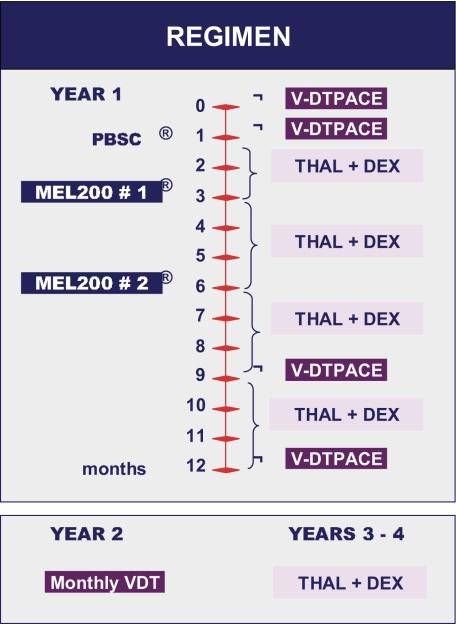
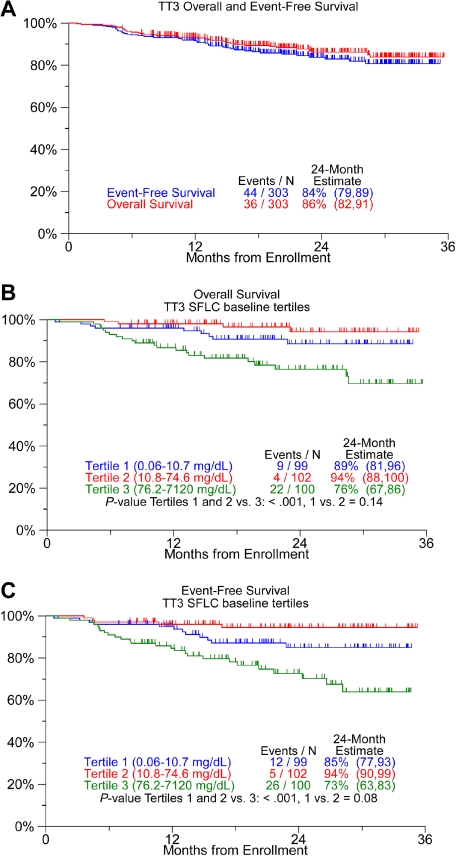
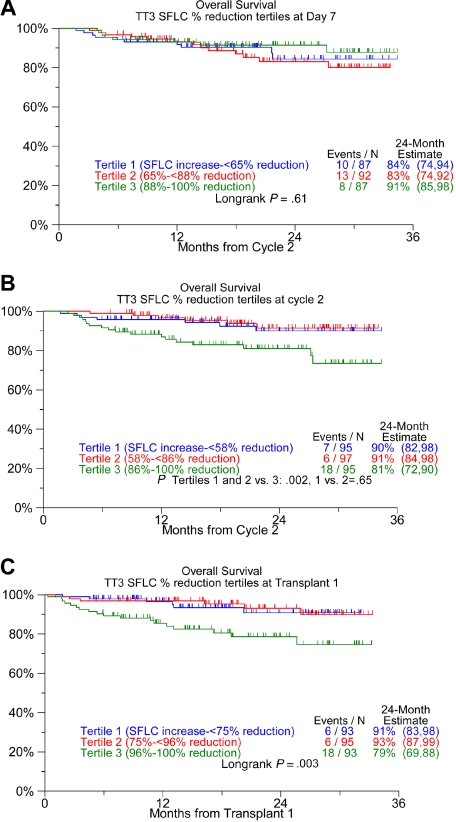
Serum-free light chain (SFLC) levels are useful for diagnosing nonsecretory myeloma and monitoring response in light-chain-only disease, especially in the presence of renal failure. As part of a tandem autotransplantation trial for newly diagnosed multiple myeloma, SFLC levels were measured at baseline, within 7 days of starting the first cycle, and before both the second induction cycle and the first transplantation. SFLC baseline levels higher than 75 mg/dL (top tertile) identified 33% of 301 patients with higher near-complete response rate (n-CR) to induction therapy (37% vs 20%, P = .002) yet inferior 24-month overall survival (OS: 76% vs 91%, P < .001) and event-free survival (EFS: 73% vs 90%, P < .001), retaining independent prognostic significance for both EFS (HR = 2.40, P = .008) and OS (HR = 2.43, P = .016). Baseline SFLC higher than 75 mg/dL was associated with light-chain-only secretion (P < .001), creatinine level 176.8 microM (2 mg/dL) or higher (P < .001), beta-2-microglobulin 297.5 nM/L (3.5 mg/L) or higher (P < .001), lactate dehydrogenase 190 U/L or higher (P < .001), and bone marrow plasmacytosis higher than 30% (P = .003). Additional independent adverse implications were conferred by top-tertile SFLC reductions before cycle 2 (OS: HR = 2.97, P = .003; EFS: HR = 2.56, P = .003) and before transplantation (OS: HR = 3.31, P = .001; EFS: HR = 2.65, P = .003). Unlike baseline and follow-up analyses of serum and urine M-proteins, high SFLC levels at baseline-reflecting more aggressive disease-and steeper reductions after therapy identified patients with inferior survival.
Figures
Comment in
-
Is early, deep free light chain response really an adverse prognostic factor?Blood. 2008 Feb 15;111(4):2490-1; author reply 2491. doi: 10.1182/blood-2007-11-125849. Blood. 2008. PMID: 18263791 Free PMC article. No abstract available.
References
Publication types
MeSH terms
Substances
Grants and funding
LinkOut - more resources
Full Text Sources
Other Literature Sources
Medical
Research Materials
