


Instability in the diagnosis of metabolic syndrome in adolescents
- PMID: 17420347
- PMCID: PMC2626638
- DOI: 10.1161/CIRCULATIONAHA.106.669994
Instability in the diagnosis of metabolic syndrome in adolescents
Abstract
Background: Factor analyses suggest that the structure underlying metabolic syndrome is similar in adolescents and adults. However, adolescence is a period of intense physiological change, and therefore stability of the underlying metabolic structure and clinical categorization based on metabolic risk is uncertain.
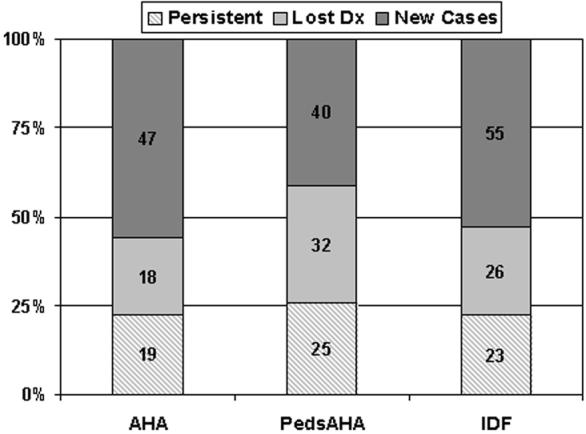
Methods and results: We analyzed data from 1098 participants in the Princeton School District Study, a school-based study begun in 2001-2002, who were followed up for 3 years. We performed factor analyses of 8 metabolic risks at baseline and follow-up to assess stability of factor patterns and clinical categorization of metabolic syndrome. Metabolic syndrome was defined using the current American Heart Association/National Heart, Lung, and Blood Institute definition for adults (AHA), a modified AHA definition used in prior pediatric metabolic syndrome studies (pediatric AHA), and the International Diabetes Federation (IDF) guidelines. We found that factor structures were essentially identical at both time points. However, clinical categorization was not stable. Approximately half of adolescents with baseline metabolic syndrome lost the diagnosis at follow-up regardless of the definitions used: pediatric AHA=56% (95% confidence interval [CI], 42% to 69%), AHA=49% (95% CI, 32% to 66%), IDF=53% (95% CI, 38% to 68%). In addition to loss of the diagnosis, new cases were identified. Cumulative incidence rates were as follows: pediatric AHA=3.8% (95% CI, 2.8% to 5.2%); AHA=4.4% (95% CI, 3.3% to 5.9%); IDF=5.2% (95% CI, 4.0% to 6.8%).
Conclusions: During adolescence, metabolic risk factor clustering is consistent. However, marked instability exists in the categorical diagnosis of metabolic syndrome. This instability, which includes both gain and loss of the diagnosis, suggests that the syndrome has reduced clinical utility in adolescence and that metabolic syndrome-specific pharmacotherapy for youth may be premature.
Figures
Comment in
-
Modifying cardiovascular risk in adolescent obesity.Circulation. 2007 May 1;115(17):2251-3. doi: 10.1161/CIRCULATIONAHA.107.696278. Circulation. 2007. PMID: 17470707 No abstract available.
References
-
- Smoak CG, Burke GL, Webber LS, Harsha DW, Srinivasan SR, Berenson GS. Relation of obesity to clustering of cardiovascular disease risk factors in children and young adults. The Bogalusa Heart Study. Am J Epidemiol. 1987;125:364–372. - PubMed
-
- Chen W, Bao W, Begum S, Elkasabany A, Srinivasan SR, Berenson GS. Age-related patterns of the clustering of cardiovascular risk variables of syndrome X from childhood to young adulthood in a population made up of black and white subjects: the Bogalusa Heart Study. Diabetes. 2000;49:1042–1048. - PubMed
-
- Meigs JB, D'Agostino RB, Sr., Wilson PW, Cupples LA, Nathan DM, Singer DE. Risk variable clustering in the insulin resistance syndrome. The Framingham Offspring Study. Diabetes. 1997;46:1594–1600. - PubMed
-
- Meigs JB, Wilson PW, Nathan DM, D'Agostino RB, Sr., Williams K, Haffner SM. Prevalence and characteristics of the metabolic syndrome in the San Antonio Heart and Framingham Offspring Studies. Diabetes. 2003;52:2160–2167. - PubMed
-
- Lakka HM, Laaksonen DE, Lakka TA, Niskanen LK, Kumpusalo E, Tuomilehto J, Salonen JT. The Metabolic Syndrome and Total and Cardiovascular Disease Mortality in Middle-aged Men. JAMA. 2002;288:2709–2716. - PubMed
Publication types
MeSH terms
Grants and funding
LinkOut - more resources
Full Text Sources
Medical
