. 2007 Apr 17;104(16):6550-5.
doi: 10.1073/pnas.0608998104. Epub 2007 Apr 9.

Combined climate and carbon-cycle effects of large-scale deforestation

Affiliations

Combined climate and carbon-cycle effects of large-scale deforestation

G Bala et al. Proc Natl Acad Sci U S A. .

Erratum in

  • Proc Natl Acad Sci U S A. 2007 Jun 5;104(23):9911

Abstract

The prevention of deforestation and promotion of afforestation have often been cited as strategies to slow global warming. Deforestation releases CO(2) to the atmosphere, which exerts a warming influence on Earth's climate. However, biophysical effects of deforestation, which include changes in land surface albedo, evapotranspiration, and cloud cover also affect climate. Here we present results from several large-scale deforestation experiments performed with a three-dimensional coupled global carbon-cycle and climate model. These simulations were performed by using a fully three-dimensional model representing physical and biogeochemical interactions among land, atmosphere, and ocean. We find that global-scale deforestation has a net cooling influence on Earth's climate, because the warming carbon-cycle effects of deforestation are overwhelmed by the net cooling associated with changes in albedo and evapotranspiration. Latitude-specific deforestation experiments indicate that afforestation projects in the tropics would be clearly beneficial in mitigating global-scale warming, but would be counterproductive if implemented at high latitudes and would offer only marginal benefits in temperate regions. Although these results question the efficacy of mid- and high-latitude afforestation projects for climate mitigation, forests remain environmentally valuable resources for many reasons unrelated to climate.


Conflict of interest statement

The authors declare no conflict of interest.

Figures
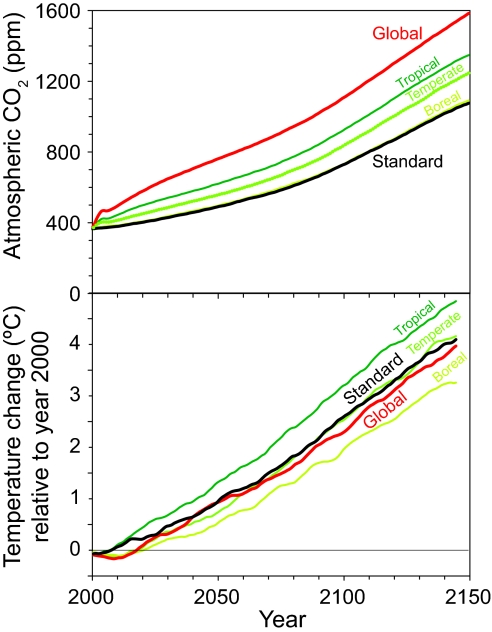
Fig. 1.
Fig. 1.
Simulated temporal evolution of atmospheric CO2 (Upper) and 10-year running mean of surface temperature change (Lower) for the period 2000–2150 in the Standard and deforestation experiments. Warming effects of increased atmospheric CO2 are more than offset by the cooling biophysical effects of global deforestation in the Global case, producing a cooling relative to the Standard experiment of ≈0.3 K around year 2100. The combined carbon-cycle and biophysical effects from Tropical, Temperate, and Boreal deforestation are net cooling, near-zero temperature change, and net warming, respectively. The sum of the temperature changes in the latitude-band experiments is approximately equal to the temperature change in the Global case, suggesting near-linearity.
Fig. 2.
Fig. 2.
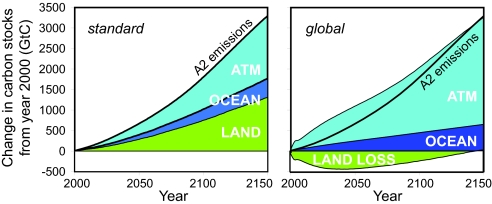
Simulated cumulative emissions and carbon stock changes in atmosphere, ocean, and land for the period 2000–2150 in Standard (A) and Global (B) deforestation experiments. In Standard, strong CO2 fertilization results in vigorous uptake and storage of carbon by land ecosystems. In the Global case, land ecosystem carbon is lost to the atmosphere as a result of global deforestation. Most of this carbon is ultimately reabsorbed by grasses and shrubs growing in a warmer CO2-fertilized climate at year 2100. Of the land ecosystem carbon in the Standard simulation that is not present in the land biosphere in the Global case at year 2100, 82% resides in the atmosphere and the remaining 18% in the oceans.
Fig. 3.
Fig. 3.
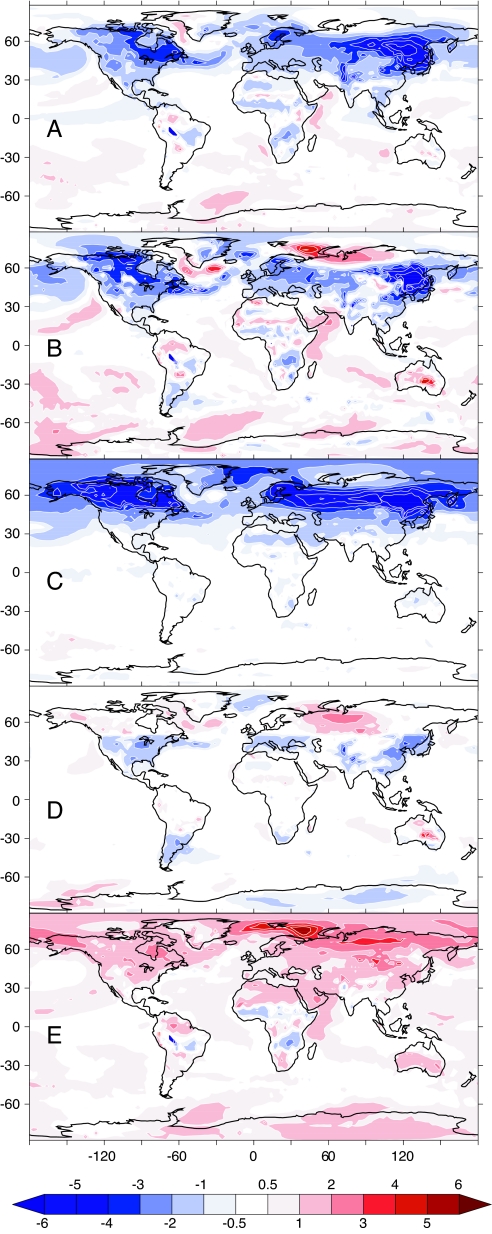
Simulated spatial surface temperature differences relative to the Standard experiment in the decade centered on year 2100 for the Global (A) and linear sum (B) of Boreal (C), Temperate (D), and Tropical (E) deforestation experiments. Cooling biophysical effects of deforestation overwhelm warming carbon-cycle effects over most of the land surface (including tropical regions), but are most pronounced in the Northern high latitudes. Comparison of A and B shows the near-linear behavior of the model climate system. Cooling biophysical effects of deforestation dominate the climate response in the Boreal deforestation case (C). In the Temperate deforestation case (D), there are strong local cooling responses, although the global-mean response is near zero. The carbon-cycle effects of warming overwhelm the biophysical effects in the Tropical deforestation case (E) with slight local cooling responses from the biophysical effects.
Fig. 4.
Fig. 4.
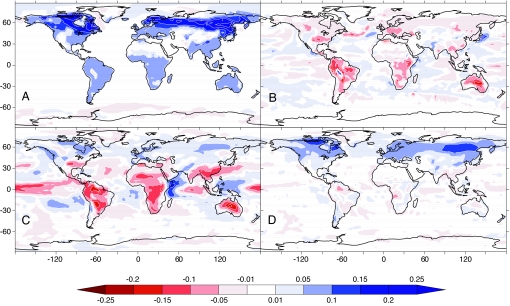
Simulated spatial pattern differences (Global minus Standard) in the decade centered on year 2100 for the surface albedo (fraction) (A), evapotranspiration rates (cm/day) (B), cloudiness (fraction) (C), and planetary albedo (fraction) (D) differences. Albedo effects dominate the Northern Hemisphere mid- and high-latitude climate change and produce a strong cooling in Global relative to Standard. In the tropics and Southern Hemisphere land areas, the warming due to higher atmospheric CO2 is largely offset by cooling biophysical effects, producing little net temperature change. In the tropics, removal of forests increases surface albedo (A) and decreases evapotranspiration (B). The reduction in evapotranspiration decreases cloudiness (C), which reduces albedo as seen from the top of the atmosphere (D), largely offsetting the effects of the increased surface albedo.

References

    1. Sud YC, Yang R, Walker GK. J Geophys Res Atmos. 1996;101:7095–7109.
    1. Lean J, Rowntree PR. J Climate. 1997;10:1216–1235.
    1. Hahmann AN, Dickinson RE. J Climate. 1997;10:1944–1964.
    1. Snyder PK, Foley JA, Hitchman MH, Delire C. J Geophys Res Atmos. 2004;109:D21102.
    1. Henderson-Sellers A, Dickinson RE, Durbidge TB, Kennedy PJ, Mcguffie K, Pitman AJ. J Geophys Res Atmos. 1993;98:7289–7315.

Publication types