


Negative pressure wound therapy via vacuum-assisted closure following partial foot amputation: what is the role of wound chronicity?
- PMID: 17425550
- PMCID: PMC7951344
- DOI: 10.1111/j.1742-481X.2006.00270.x
Negative pressure wound therapy via vacuum-assisted closure following partial foot amputation: what is the role of wound chronicity?
Abstract
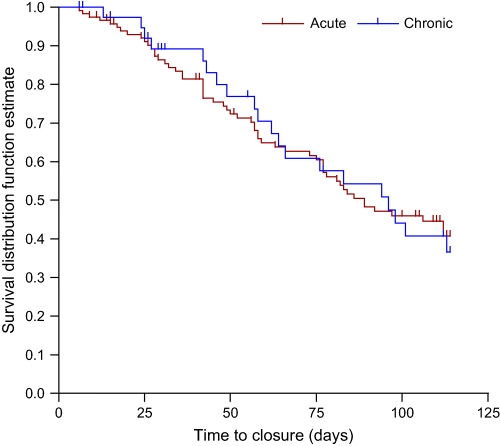
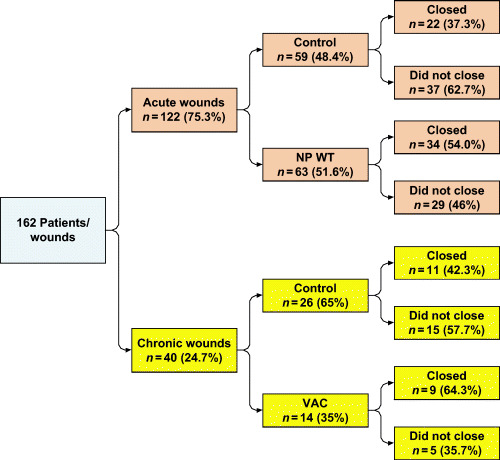
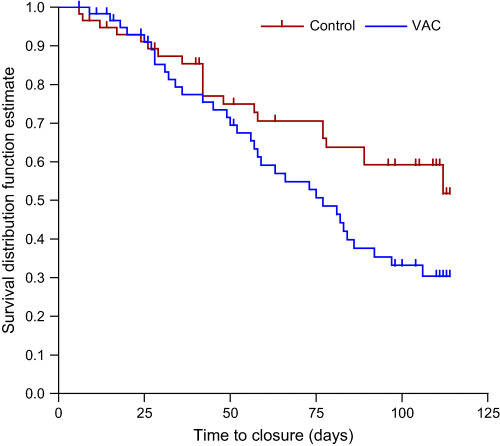
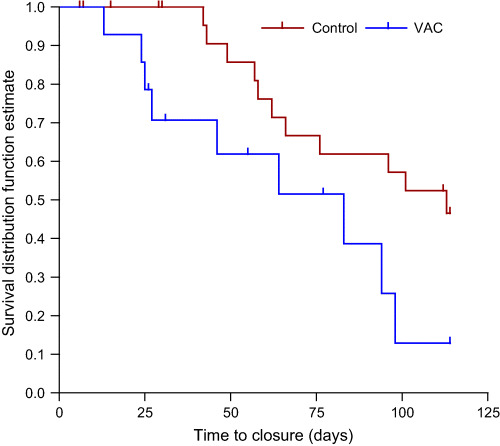
Randomised clinical trials (RCTs) to evaluate diabetic foot wound therapies have systematically eliminated large acute wounds from evaluation, focusing only on smaller chronic wounds. The purpose of this study was to evaluate the proportion and rate of wound healing in acute and chronic wounds after partial foot amputation in individuals with diabetes treated with negative pressure wound therapy (NPWT) delivered by the vacuum-assisted closure (VAC) device or with standard wound therapy (SWT). This study constitutes a secondary analysis of patients enrolled in a 16-week RCT of NPWT: 162 open foot amputation wounds (mean wound size = 20.7 cm(2)) were included. Acute wounds were defined as the wounds less than 30 days after amputation, whereas chronic wounds as the wounds greater than 30 days. Inclusion criteria consisted of individuals older than 18 years, presence of a diabetic foot amputation wound up to the transmetatarsal level and adequate perfusion. Wound size and healing were confirmed by independent, blinded wound evaluators. Analyses were done on an intent-to-treat basis. There was a significantly higher proportion of acute wounds (SWT = 59; NPWT = 63) than chronic wounds (SWT = 26; NPWT = 14), evaluated in this clinical trial (P = 0.001). There was no significant difference in the proportion of acute and chronic wounds achieving complete wound closure in either treatment group. Despite this finding, the Kaplan-Meier curves demonstrated statistically significantly faster healing in the NPWT group in both acute (P = 0.030) and chronic wounds (P = 0.033). Among the patients treated with NPWT via the VAC, there was not a significant difference in healing as a function of chronicity. In both the acute and the chronic wound groups, results for patients treated with NPWT were superior to those for the patients treated with SWT. These results appear to indicate that wound duration should not deter the clinician from using this modality to treat complex wounds.
Trial registration: ClinicalTrials.gov NCT00224796.
Figures
References
-
- Boulton AJ, Vileikyte L, Ragnarson‐Tennvall G, Apelqvist J. The global burden of diabetic foot disease. Lancet 2005;366:1719–24. - PubMed
-
- Singh N, Armstrong DG, Lipsky BA. Preventing foot ulcers in patients with diabetes. JAMA 2005;293:217–28. - PubMed
-
- Falanga V. Wound healing and its impairment in the diabetic foot. Lancet 2005;366:1736–43. - PubMed
-
- Gupta S, Cho T. A literature review of negative pressure wound therapy. Ostomy Wound Manage 2004;50 11A Suppl:2–4S. - PubMed
-
- Armstrong DG, Lavery LA. Negative pressure wound after partial diabetic foot amputation: a multicentre, randomised controlled trial. Lancet 2005;366:1704–10. - PubMed
Publication types
MeSH terms
Associated data
LinkOut - more resources
Full Text Sources
Medical
