


Diverse molecular data demonstrate that commercially available medicinal leeches are not Hirudo medicinalis
- PMID: 17426015
- PMCID: PMC2176162
- DOI: 10.1098/rspb.2007.0248
Diverse molecular data demonstrate that commercially available medicinal leeches are not Hirudo medicinalis
Abstract
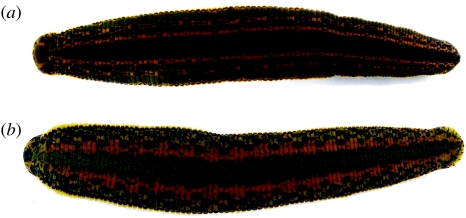
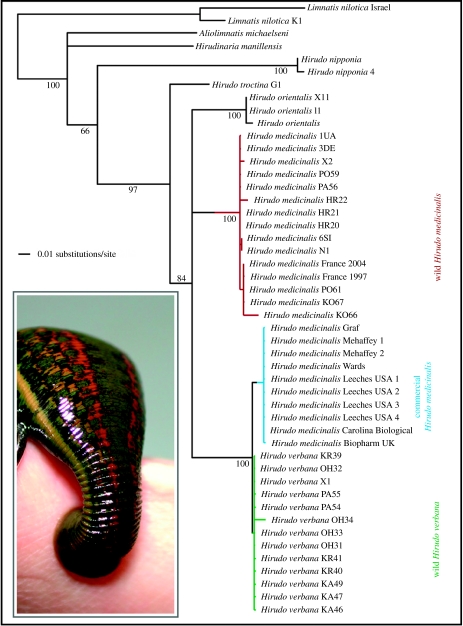
The European medicinal leech is one of vanishingly few animal species with direct application in modern medicine. In addition to the therapeutic potential held by many protease inhibitors purified from leech saliva, and notwithstanding the historical association with quackery, Hirudo medicinalis has been approved by the United States Food and Drug Administration as a prescription medical device. Accurate annotation of bioactive compounds relies on precise species determination. Interpretations of developmental and neurophysiological characteristics also presuppose uniformity within a model species used in laboratory settings. Here, we show, with mitochondrial sequences and nuclear microsatellites, that there are at least three species of European medicinal leech, and that leeches marketed as H. medicinalis are actually Hirudo verbana. Beyond the obvious need for reconsideration of decades of biomedical research on this widely used model organism, these findings impact regulatory statutes and raise concerns for the conservation status of European medicinal leeches.
Figures
References
-
- Baskova I.P, Zavalova L.L. Proteinase inhibitors from the medicinal leech Hirudo medicinalis. Biochemistry Mosc. 2001;66:703–717. doi:10.1023/A:1010223325313 - DOI - PubMed
-
- Baskova I.P, Zavalova L.L, Basanova A.V, Moshkovskii S.A, Zgoda V.G. Protein profiling of the medicinal leech salivary gland secretion by proteomic analytical methods. Biochemistry Mosc. 2004;69:770–775. doi:10.1023/B:BIRY.0000040202.21965.2a - DOI - PubMed
-
- Bely A.E, Weisblat D.A. Lessons from leeches: a call for DNA barcoding in the lab. Evol. Dev. 2006;8:491–501. doi:10.1111/j.1525-142X.2006.00122.x - DOI - PubMed
-
- Boutin-Ganache I, Raposo M, Raymond M, Deschepper C.F. M13-tailed primers improve the readability and usability of microsatellite analyses performed with two different allele-sizing methods. Biotechniques. 2001;31:24–27. - PubMed
-
- Budinoff R.B, Siddall A.M, Siddall M.E. Twelve variable microsatellite loci for the North American medicinal leech, Macrobdella decora. Mol. Ecol. Notes. 2004;4:491–493. doi:10.1111/j.1471-8286.2004.00723.x - DOI
Publication types
MeSH terms
Substances
LinkOut - more resources
Full Text Sources
Other Literature Sources
