


Rapid detection of Pfcrt and Pfmdr1 mutations in Plasmodium falciparum isolates by FRET and in vivo response to chloroquine among children from Osogbo, Nigeria
- PMID: 17428334
- PMCID: PMC1855061
- DOI: 10.1186/1475-2875-6-41
Rapid detection of Pfcrt and Pfmdr1 mutations in Plasmodium falciparum isolates by FRET and in vivo response to chloroquine among children from Osogbo, Nigeria
Abstract
Background: Chloroquine (CQ) has been in use in Africa for a long time. Because of misuse, this drug has now lost its efficacy due to the emergence of resistance strains in most parts of Africa. Recently, it was shown that after chloroquine has been withdrawn from the market, chloroquine-sensitive Plasmodium falciparum re-emerged and chloroquine could again be used successfully as an antimalarial. Surveillance of parasite populations is, therefore, important to decide whether chloroquine could be re-introduced.
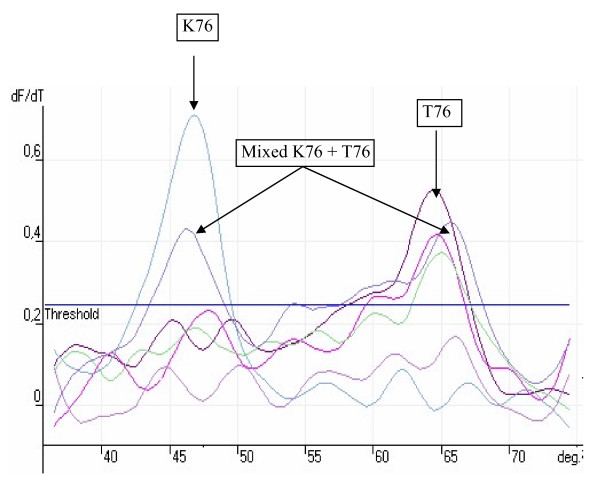
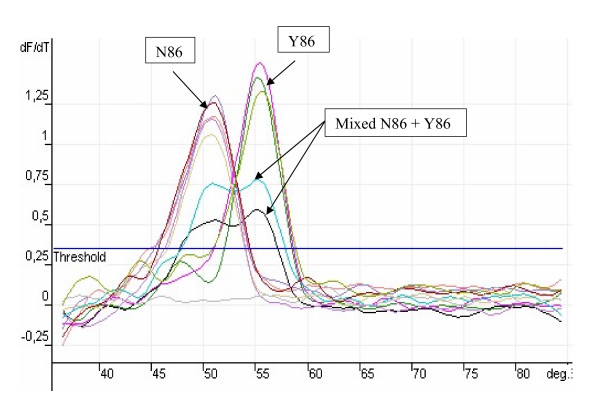
Methods: To estimate the prevalence of the most pivotal polymorphisms, including Pfcrt K76T, Pfmdr1 N86Y and Pfmdr1 Y184F mutations, and their contributions to the outcome of CQ treatment, isolates from Osogbo Western Nigeria were tested using the Fluorescence Resonance Energy Transfer (FRET) method on a real-time PCR instrument.
Results: 116 children with acute uncomplicated P. falciparum malaria infections were treated with the standard dosage of CQ and followed-up for 28 days. Blood samples were collected on filter paper at enrollment and during follow-up for identification of parasite carrying the chloroquine resistant transporter (pfcrt) and P. falciparum-multi drug resistance (pfmdr1) gene mutations. Parasitological assessment of response to treatment showed that 62% of the patients were cured and 38% failed the CQ treatment. The presence of single mutant pfcrt (T76) alleles (P = 0.003) and in combination with mutant pfmdr1 Y86 (P = 0.028) was significantly associated with in vivo CQR. No other mutation on its own or in combinations was significantly associated with treatment outcome. Mutant pfcrt was more prevalent in both pre- and post-treatment isolates. No association was observed between age or initial level of parasitaemia and chloroquine treatment outcome.
Conclusion: The result established the usefulness and accuracy of real time PCR in pfcrt and pfmdr1 mutation detection and also give further evidence to the reliability of the pfcrt T76 point mutation as a molecular marker for CQ resistance.
Figures
References
-
- Fidock DA, Nomura T, Talley AK, Cooper RA, Dzekunov SM, Ferdig MT, Ursos LM, Sidhu AB, Naude B, Deitsch KW, Su XZ, Wootton JC, Roepe PD, Wellems TE. Mutations in the P. falciparum digestive vacuole transmembrane protein PfCRT and evidence for their role in chloroquine resistance. Mol Cell. 2000;6:861–871. doi: 10.1016/S1097-2765(05)00077-8. - DOI - PMC - PubMed
-
- Severini C, Menegon M, Sannella AR, Paglia MG, Narciso P, Matteelli A, Gulletta M, Caramello P, Canta F, Xayavong MV, Moura IN, Pieniazek NJ, Taramelli D, Majori G. Prevalence of pfcrt point mutations and level of chloroquine resistance in Plasmodium falciparum isolates from Africa. Infect Genet Evol. 2006;6:262–268. doi: 10.1016/j.meegid.2005.07.002. - DOI - PubMed
-
- Babiker HA, Pringle SJ, Abdel-Muhsin A, Mackinnon M, Hunt P, Walliker D. High-level chloroquine resistance in Sudanese isolates of Plasmodium falciparum is associated with mutations in the chloroquine resistance transporter gene pfcrt and the multidrug resistance Gene pfmdr1. J Infect Dis. 2001;183:1535–1538. doi: 10.1086/320195. - DOI - PubMed
Publication types
MeSH terms
Substances
LinkOut - more resources
Full Text Sources
