


The clinical effect of a new infant formula in term infants with constipation: a double-blind, randomized cross-over trial
- PMID: 17428343
- PMCID: PMC1852321
- DOI: 10.1186/1475-2891-6-8
The clinical effect of a new infant formula in term infants with constipation: a double-blind, randomized cross-over trial
Abstract
Background: Nutrilon Omneo (new formula; NF) contains high concentration of sn-2 palmitic acid, a mixture of prebiotic oligosaccharides and partially hydrolyzed whey protein. It is hypothesized that NF positively affects stool characteristics in constipated infants.
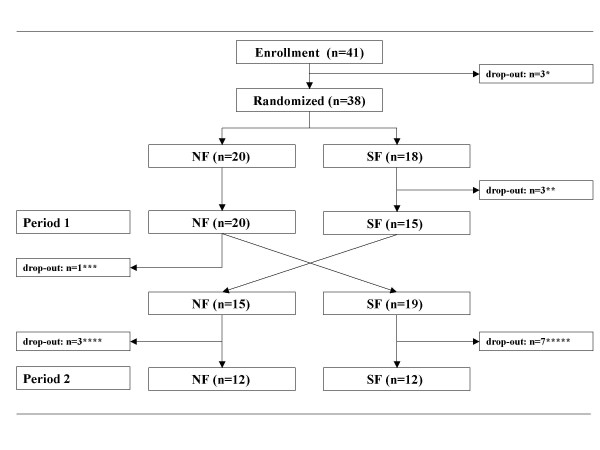
Methods: Thirty-eight constipated infants, aged 3-20 weeks, were included and randomized to NF (n = 20) or a standard formula (SF; n = 18) in period 1 and crossed-over after 3 weeks to treatment period 2. Constipation was defined by at least one of the following symptoms: 1) defecation frequency < 3/week; 2) painful defecation; 3) abdominal or rectal palpable mass.
Results: Period 1 was completed by 35 infants. A significant increase in defecation frequency (NF: 3.5 pre versus 5.6/week post treatment; SF 3.6 pre versus 4.9/week post treatment) was found in both groups, but was not significantly different between the two formulas (p = 0.36). Improvement of hard stool consistency to soft stool consistency was found more often with NF than SF, but did not reach statistical significance (90% versus 50%; RR, 1.8; 95% CI, 0.9-3.5; p = 0.14). No difference was found in painful defecation or the presence of an abdominal or rectal mass between the two groups. Twenty-four infants completed period 2. Only stool consistency was significantly different between the two formulas (17% had soft stools on NF and hard stools on SF; no infants had soft stools on SF and hard stools on NF, McNemar test p = 0.046).
Conclusion: The addition of a high concentration sn-2 palmitic acid, prebiotic oligosaccharides and partially hydrolyzed whey protein resulted in a strong tendency of softer stools in constipated infants, but not in a difference in defecation frequency. Formula transition to NF may be considered as treatment in constipated infants with hard stools.
Figures
References
-
- Issenman RM, Hewson S, Pirhonen D, Taylor W, Tirosh A. Are chronic digestive complaints the result of abnormal dietary patterns? Diet and digestive complaints in children at 22 and 40 months of age. American Journal of Diseases of Children. 1987;141:679–682. - PubMed
-
- Davidson M, Kugler MM, Bauer CH. Diagnosis and management in children with severe and protracted constiption. Medical Progress. 1963;62:261–275. - PubMed
-
- Loening-Baucke V. Chronic constipation in children. Gastroenterology. 1993;105:1557–1564. - PubMed
-
- Quinlan PT, Lockton S, Irwin J, Lucas AL. The relationship between stool hardness and stool composition in breast- and formula-fed infants. J Pediatr Gastroenterol Nutr. 1995;20:81–90. - PubMed
Publication types
MeSH terms
Substances
LinkOut - more resources
Full Text Sources
Other Literature Sources
Medical
