. 2007 Jul;98(1):99-109.
doi: 10.1093/toxsci/kfm085. Epub 2007 Apr 12.

Persistent binding of ligands to the aryl hydrocarbon receptor

Affiliations

Persistent binding of ligands to the aryl hydrocarbon receptor

Jessica E Bohonowych et al. Toxicol Sci. 2007 Jul.

Abstract

The aryl hydrocarbon receptor (AhR) is a ligand-activated transcription factor that mediates many of the biological and toxic effects of halogenated aromatic hydrocarbons (HAHs), polycyclic aromatic hydrocarbons (PAHs), and other structurally diverse ligands. While HAHs are several orders of magnitude more potent in producing AhR-dependent biochemical effects than PAHs or other AhR agonists, only the HAHs have been observed to produce AhR-dependent toxicity in vivo. Here we have characterized the dissociation of a prototypical HAH ligand ([(3)H] 2,3,7,8-tetrachlorodibenzo-p-dioxin [TCDD]) and PAH-like ligand ([(3)H] beta-naphthoflavone [betaNF]) from the guinea pig, hamster, mouse, and rat hepatic cytosolic AhR in order to elucidate the relationship between the apparent ligand-binding affinities and the divergent potency of these chemicals. Both compounds dissociated very slowly from the AhR with the amount of specific binding remaining at 96 h ranging from 53% to 70% for [(3)H]TCDD and 26% to 85% for [(3)H] betaNF, depending upon the species examined. The rate of ligand dissociation was unaffected by protein concentration or incubation temperature. Preincubation of cytosol with 2,3,7,8-tetrachlorodibenzofuran, carbaryl, or primaquine, prior to the addition of [(3)H]TCDD, shifted the apparent IC(50) of these compounds as competitive AhR ligands by approximately 10- to 50-fold. Our results support the need for reassessment of previous AhR ligand-binding affinity calculations and competitive binding analysis since these measurements are not carried out at equilibrium binding conditions. Our studies suggest that AhR binding affinity/occupancy has little effect on the observed differences in the persistence of gene expression by HAHs and PAHs.


Figures
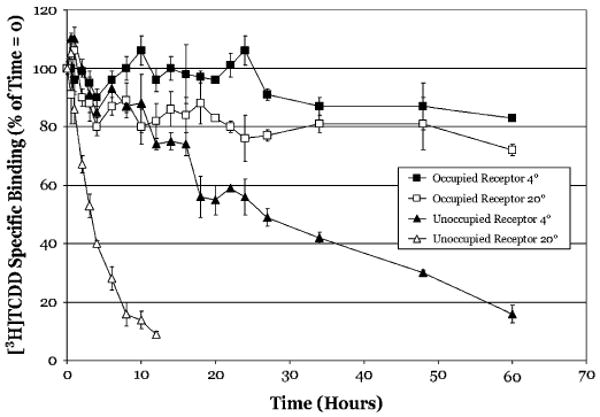
FIG. 1
FIG. 1
Ligand binding confers thermal stability to Sprague–Dawley rat hepatic cytosolic AhR. Unoccupied receptor: Rat hepatic cytosol (2 mg/ml) was incubated at the indicated temperature and aliquots (500 μl) were removed at the indicated times incubated with 2nM [3H]TCDD in the absence or presence of 200nM TCDF for 2 h. Occupied receptor: Rat hepatic cytosol (2 mg/ml) was incubated with 2nM [3H]TCDD in the absence or presence of 200nM TCDF for 2 h, stripped with DCC to remove free and loosely bound ligand, and then incubated with cold TCDF (to 200nM) for the indicated times at the indicated temperatures. For both unoccupied and occupied receptor incubations, specific binding of [3H]TCDD was determined using the HAP assay and data are presented as the mean ± SD of triplicate incubations.
FIG. 2
FIG. 2
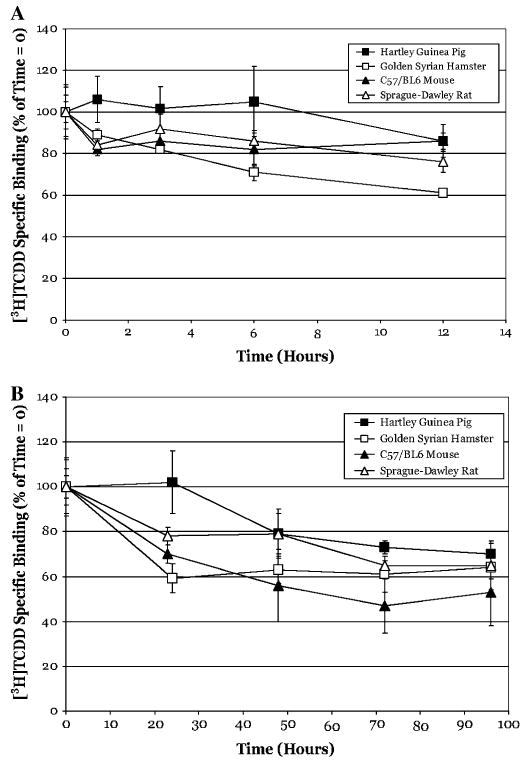
[3H]TCDD does not readily dissociate from the hepatic cytosolic AhR from various species. Hepatic cytosol (2 mg/ml) from the indicated species was incubated with 2nM [3H]TCDD in the absence or presence of 200nM TCDF for 2 h, charcoal stripped to remove free and loosely bound ligand and then further incubated with cold TCDF (to 200nM) at 20°C. Specific binding of [3H]TCDD was determined by the HAP assay at the indicated times out to 12 h (A) or 96 h (B). Data are presented as the mean ± SD of at least quadruple incubations.
FIG. 3
FIG. 3
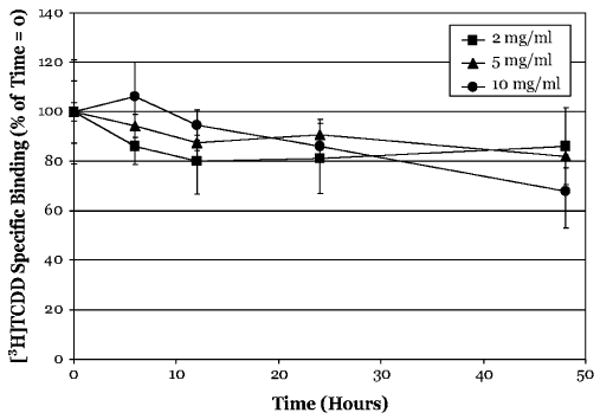
Protein concentration does not affect the persistence of [3H]TCDD binding to Hartley guinea pig hepatic cytosolic AhR. Guinea pig hepatic cytosol of increasing protein concentrations (2–10 mg/ml) was incubated with [3H]TCDD in the absence or presence of 100-fold excess TCDF for 2 h. The final concentration of [3H]TCDD was 2nM for the 2 mg/ml samples, and 10nM for the 5 and 10 mg/ml samples. After 2 h, incubation were charcoal stripped to remove free and loosely bound ligand and then incubated with 200nM TCDF (2 mg/ml samples) or 1μM TCDF (5–10 mg/ml samples) at 20°C. Specific binding of [3H]TCDD was determined by the HAP assay at the indicated times. Data are presented as the mean ± SD of at least triplicate incubations.
FIG. 4
FIG. 4
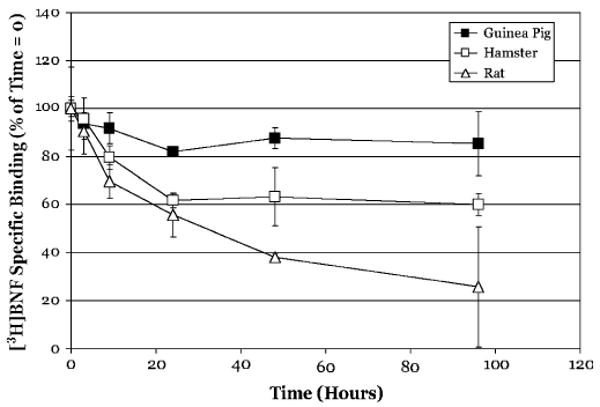
[3H]βNF does not readily dissociate from hepatic cytosolic AhR from various species. Hepatic cytosol (2 mg/ml) from the indicated species was incubated with 10nM [3H] βNF in the absence or presence of 1 μM TCDF for 2 h, charcoal stripped to remove free ligand and then incubated with cold TCDF (1 μM) at 20°C. Specific binding of [3H] βNF was determined by the HAP assay at the indicated times. Data are presented as the mean ± SD of at least triplicate incubations.
FIG. 5
FIG. 5
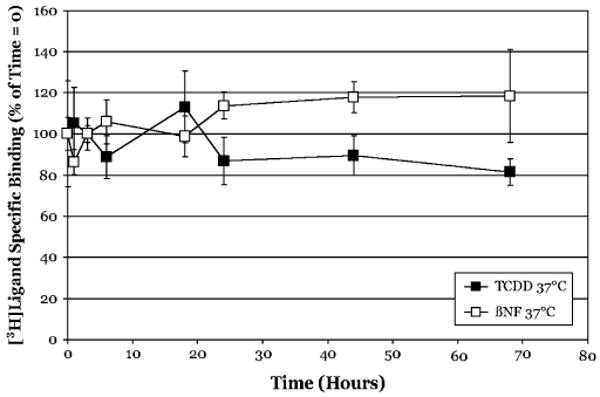
Persistent binding of [3H]TCDD and [3H]βNF to guinea pig hepatic cytosolic AhR is observed at 37°C. Guinea pig hepatic cytosol (2 mg/ml) was incubated with 2nM [3H]TCDD in the absence or presence of 200nM TCDF, or 10nM [3H]βNF in the absence or presence of 1μM TCDF for 2 h, charcoal stripped to remove free and loosely bound ligand and then incubated with TCDF (200nM or 1 μM, respectively, at 37°C). Specific binding of [3H]TCDD and [3H] βNF was determined by the HAP assay at the indicated times. Data are presented as the mean ± SD of at least triplicate incubations.
FIG. 6
FIG. 6
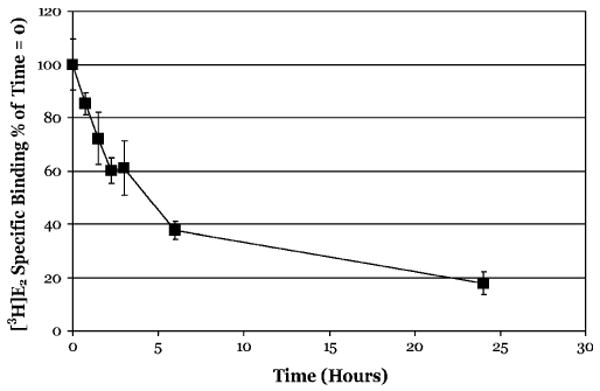
[3H]E2 dissociates relatively rapidly from bovine uterine cytosolic ER. Bovine calf uterine cytosol (2 mg/ml) was incubated with 2nM [3H]E2 in the absence or presence of 200nM DES for 2 h, charcoal stripped to remove free and loosely bound ligand and incubated with cold DES (200nM) at 20°C. Specific binding of [3H]E2 was determined at the indicated time using the DCC method as described under the “Materials and methods” section. Data are presented as the mean ± SD of at least triplicate incubations.
FIG. 7
FIG. 7
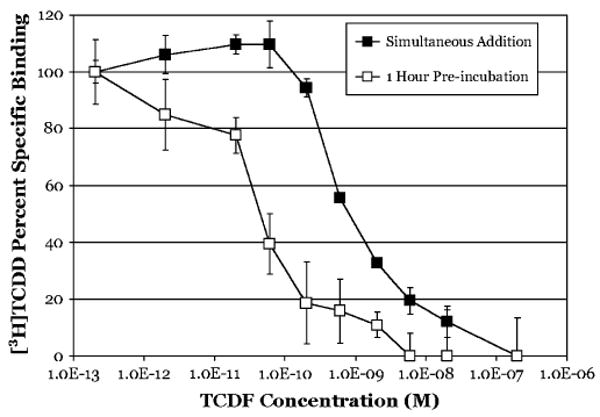
TCDF has a higher apparent binding affinity for guinea pig hepatic cytosolic AhR when incubated prior to [3H]TCDD addition. Simultaneous addition: Guinea pig hepatic cytosol (2 mg/ml) was incubated with 2nM [3H]TCDD in the absence or presence of TCDF at the indicated concentration for 3 h at 20°C. Preincubation: Guinea pig hepatic cytosol (2 mg/ml) was incubated in the absence or presence of the indicated concentration of TCDF for 1 h at 20°C followed by the addition of 2nM [3H]TCDD and further incubation for 2 h. Specific binding of [3H]TCDD was determined by the HAP assay at the indicated times. Data are presented as the mean ± SD of at least triplicate incubations.
FIG. 8
FIG. 8
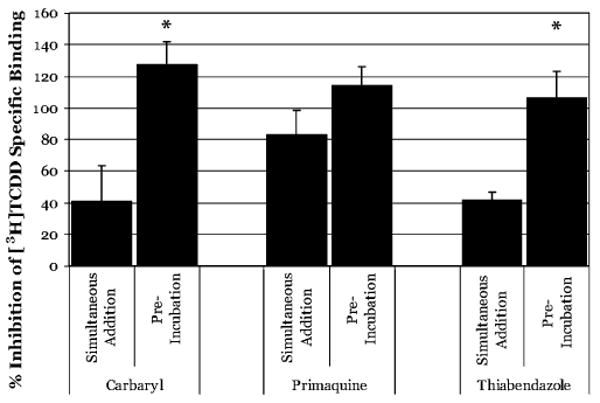
Binding of “ligand-independent” AhR activators to the guinea pig hepatic cytosolic AhR. Simultaneous addition: Guinea pig hepatic cytosol (2 mg/ml) was incubated with 2nM [3H]TCDD in the absence or presence of 100μM of the indicated compounds for 3 h at 20°C. Preincubation: Guinea pig hepatic cytosol (2 mg/ml) was incubated in the absence or presence of 100μM of the indicated compounds for 1 h at 20°C followed by the addition of 2nM [3H]TCDD and further incubation for 2 h. Specific binding of [3H]TCDD determined by the HAP assay. Data are presented as the mean ± SD of at least triplicate incubations. The asterisk (*) identifies those compounds for which significantly more [3H]TCDD-specific binding was inhibited by preincubation as compared to simultaneous addition, as determined by the Student's two-tailed t-test (p < 0.05).

References

    1. Backlund M, Ingelman-Sundberg M. Different structural requirements of the ligand binding domain of the aryl hydrocarbon receptor for high- and low-affinity ligand binding and receptor activation. Mol Pharmacol. 2004;65:416–425. - PubMed
    1. Bank PA, Yao EF, Phelps CL, Harper PA, Denison MS. Species-specific binding of transformed Ah receptor to a dioxin responsive transcriptional enhancer. Eur J Pharmacol. 1992;228:85–94. - PubMed
    1. Berghard A, Gradin K, Toftgard R. The stability of dioxin-receptor ligands influences cytochrome P450IA1 expression in human keratinocytes. Carcinogenesis. 1992;13:651–655. - PubMed
    1. Boctor AM, Band P, Grossman A. Analysis of binding of [3H]Estradiol to the cytosol fraction of rat pancreas: Comparison with sites in the cytosol of uterus. Endocrinology. 1983;113:453–462. - PubMed
    1. Bradfield CA, Kende AS, Poland A. Kinetic and equilibrium studies of Ah receptor-ligand binding: Use of [125I]2-iodo-7,8-dibromodibenzo-p-dioxin. Mol Pharmacol. 1988;34:229–237. - PubMed

Publication types