. 2007 Jun;97(6):1064-73.
doi: 10.1017/S000711450769196X. Epub 2007 Apr 12.

Induction of altered epigenetic regulation of the hepatic glucocorticoid receptor in the offspring of rats fed a protein-restricted diet during pregnancy suggests that reduced DNA methyltransferase-1 expression is involved in impaired DNA methylation and changes in histone modifications

Affiliations

Induction of altered epigenetic regulation of the hepatic glucocorticoid receptor in the offspring of rats fed a protein-restricted diet during pregnancy suggests that reduced DNA methyltransferase-1 expression is involved in impaired DNA methylation and changes in histone modifications

Karen A Lillycrop et al. Br J Nutr. 2007 Jun.

Abstract

Prenatal nutritional constraint induces an altered metabolic phenotype in the offspring which in humans confers an increased risk of non-communicable disease. Feeding a protein-restricted (PR) diet to pregnant rats causes hypomethylation of specific gene promoters in the offspring and alters the phenotype. We investigated how altered epigenetic regulation of the hepatic glucocorticoid receptor (GR) 1(10) promoter is induced in the offspring. Rats were fed a control (180 g casein/kg) or a PR (90 g casein/kg) diet throughout pregnancy, and chow during lactation. Offspring were killed at postnatal day 34 (n 5 per maternal dietary group). Methylation-sensitive PCR showed that GR1(10) promoter methylation was 33 % lower (P < 0.001) and GR expression 84 % higher (P < 0.05) in the PR offspring. Reverse transcription-PCR showed that DNA methyltransferase-1 (Dnmt1) expression was 17 % lower (P < 0.05) in PR offspring, while Dnmt3a/b and methyl binding domain protein-2 expression was not altered. Thus hypomethylation of the GR110 promoter may result from lower capacity to methylate hemimethylated DNA during mitosis. Histone modifications which facilitate transcription were increased at the GR1(10) promoter (147-921 %, P < 0.001), while those that suppress methylation were decreased (54 %, P < 0.01) or similar to controls. In human umbilical cord (n 15), there was a 2-fold difference between the highest and lowest level of GR1-CTotal promoter methylation. Dnmt1, but not Dnmt3a, expression predicted 49 % (P = 0.003) of the variation in GR1-CTotal promoter methylation. These findings suggest that induction in the offspring of altered epigenetic regulation of the hepatic GR1(10) promoter, and hence metabolic phenotype, may be due to reduced Dnmt1 expression.


Figures
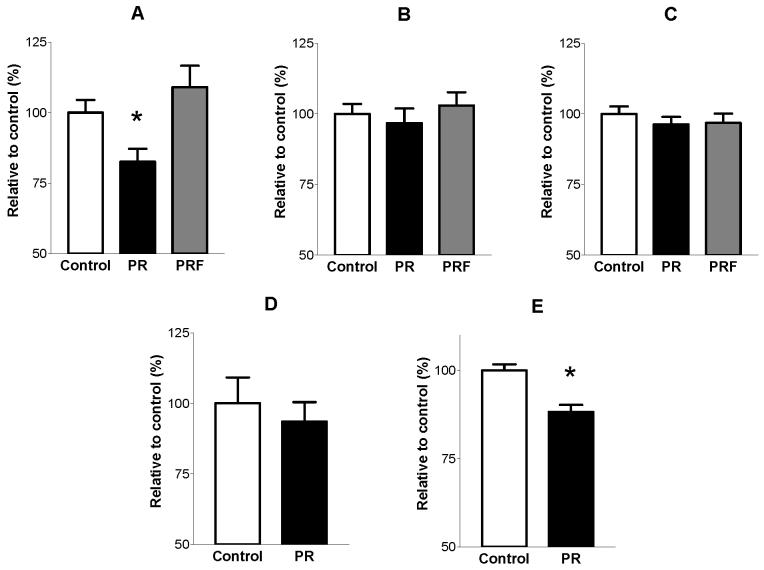
Fig. 1
Fig. 1
mRNA expression of DNA methyltransferases (Dnmt (s)) in liver from 34 day-old offspring of rats fed either a control or protein-restricted (PR), or the PR diet supplemented with folic acid (PRF) diet during pregnancy. Data from RT PCR analysis are mean (SEM) relative to the control group (n 5 per maternal dietary group). (A) Dnmt1 expression. (B) Dnmt3a expression. (C) Dnmt3b expression. Statistical comparisons were by 1-Way ANOVA with Bonferroni’s post hoc analysis. 1-Way ANOVA showed a significant difference (P<0.05) between groups for Dnmt1, but not for the other DNA methyltransferases. *P<0.05 compared to the control group. (D) Expression of the methyl binding domain protein-2 from 34 day-old offspring of rats fed either a control or PR diet. Data are mean (SEM) relative to the control group (n 5 per maternal dietary group). Statistical analysis was by Student’s unpaired t-test. (E) Binding of Dnmt1 at the glucocorticoid receptor 110 promoter in liver from 34 day-old offspring of rats fed either a control or PR diet measured by chromatin immunoprecipitation assay. Data are mean (SEM) relative to the control group (n 5 per maternal dietary group). Statistical analysis was by Student’s unpaired t-test. *P < 0.05 compared to the control group.
Fig. 2
Fig. 2
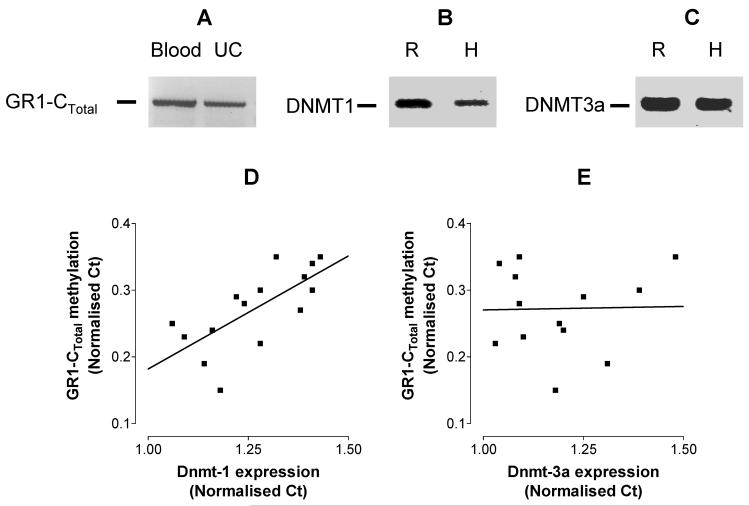
Methylation status and mRNA expression of glucocorticoid receptor (GR) 1-CTotal promoter and mRNA expression of DNA methyltransferase (Dnmt)-1 and Dnmt3a in human umbilical cord (UC). (A) Expression of the transcript of the GR1-CTotal in human UC by real-time RT-PCR using adult human blood as reference. The same primers were used to detect (B) Dnmt1 and (C) Dnmt3a in human (H) UC as used with rat (R) liver. Transcripts of appropriate size were identified by analysis of the RTPCR products by agarose gel electrophoresis. The methylation status of the GR1-CTotal promoter and the mRNA expression of Dnmt1 and Dnmt3a was measured in human UC samples from 15 pregnancies. The association between GR1-CTotal promoter methylation and Dnmt expression was analysed by calculation of Pearson’s correlation coefficient. (D) The relationship between Dnmt1 expression and GR1-CTotal promoter methylation, r = 0.70, P = 0.03. (E) The relationship between Dnmt3a expression and GR1-CTotal promoter methylation, r = 0.001, P = 0.89).
Fig. 3
Fig. 3
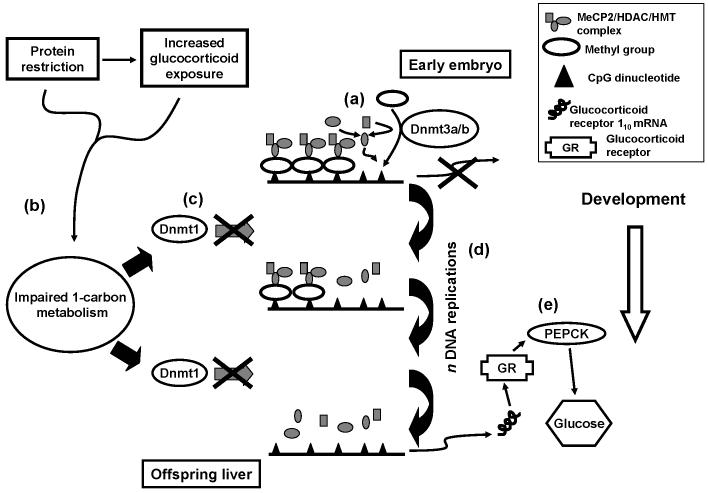
A diagram of the proposed pathway for induction of altered glucose homeostasis in the offspring of rats fed a protein-restricted (PR) diet during pregnancy. A full explanation is given in the text. (a) Glucocorticoid receptor (GR) expression is silenced in the early embryo in cells destined to become hepatocytes by the activities of DNA methyltransferases (Dnmt) 3a and 3b. (b) In the offspring of rats fed a PR diet, 1-carbon metabolism is impaired either as a direct consequence of the restricted diet or by increased glucocorticoid exposure. This down-regulates Dnmt1 expression (c). Lower Dnmt1 expression results in a impaired capacity to methylate hemimethylated DNA during mitosis (d). After sequential mitotic cycles, this results in hypomethylation of the GR promoter and loss of epigenetic memory of gene silencing, such that, in the liver of the adult offspring, expression of GR is induced in cells which do not express GR in control animals. The increased expression of GR is facilitated by lower binding and expression of methyl CpG binding protein (MeCP)-2 and reduced recruitment of the histone deactylase (HDAC) / histone methyltransferase (HMT) complex, resulting in higher levels of histone modifications which permit transcription. (e) This results in increased phosphoenolpyruvate carboxykinase (PEPCK) expression and increased gluconeogenesis.

References

    1. Armitage JA, Lakasing L, Taylor PD, Balachandran AA, Jensen RI, Dekou V, Ashton N, Nyengaard JR, Poston L. Developmental programming of aortic and renal structure in offspring of rats fed fat-rich diets in pregnancy. J Physiol. 2005;565:171–184. - PMC - PubMed
    1. Bateson P, Barker D, Clutton-Brock T, Deb D, D’Udine B, Foley RA, Gluckman P, Godfrey K, Kirkwood T, Lahr MM, McNamara J, Metcalfe NB, Monaghan P, Spencer HG, Sultan SE. Developmental plasticity and human health. Nature. 2004;430:419–421. - PubMed
    1. Benvenisty N, Mencher D, Meyuhas O, Razin A, Reshef L. Sequential changes in DNA methylation patterns of the rat phosphoenolpyruvate carboxykinase gene during development. Proc Natl Acad. Sci U S A. 1985;82:267–271. - PMC - PubMed
    1. Bertram C, Trowern AR, Copin N, Jackson AA, Whorwood CB. The maternal diet during pregnancy programs altered expression of the glucocorticoid receptor and type 2 11beta-hydroxysteroid dehydrogenase: potential molecular mechanisms underlying the programming of hypertension in utero. Endocrino. 2001;142:2841–2853. - PubMed
    1. Bird A. DNA methylation patterns and epigenetic memory. Genes Dev. 2001;16:6–21. - PubMed

Publication types

MeSH terms