


Linking the elements of change: Program and client responses to innovation
- PMID: 17433862
- PMCID: PMC1987382
- DOI: 10.1016/j.jsat.2006.12.022
Linking the elements of change: Program and client responses to innovation
Abstract
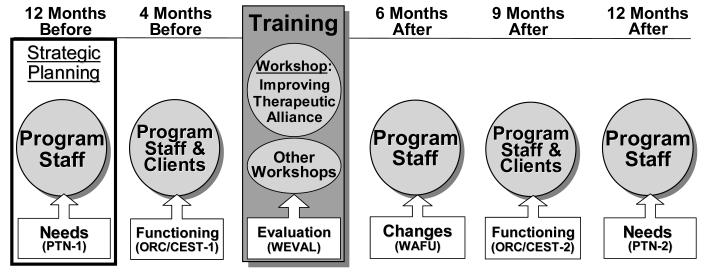
The process of innovation adoption was investigated using longitudinal records collected from a statewide network of almost 60 treatment programs over a 2-year period. Program-level measures of innovation adoption were defined by averaged counselor ratings of program training needs and readiness, organizational functioning, quality of a workshop training conference, and adoption indicators at follow-up. Findings showed that staff attitudes about training needs and past experiences are predictive of their subsequent ratings of training quality and progress in adopting innovations a year later. Organizational climate (clarity of mission, cohesion, openness to change) is also related to innovation adoption. In programs that lack an open atmosphere for adopting new ideas, it was found that counselor trial usage is likely to be attenuated. Most important was evidence that innovation adoption based on training for improving treatment engagement was significantly related to client self-reports of improved treatment participation and rapport recorded several months later.
Figures
References
-
- Cohen J. Statistical power analysis for the behavioral sciences. 2nd ed. Erlbaum; Hillsdale, NJ: 1988.
-
- Fixsen DL, Naoom SF, Blase KA, Friedman RM, Wallace F. Implementation research: A synthesis of the literature. University of South Florida; Tampa: 2005. (No. Louis de la Parte Florida Mental Health Publication #231).
Publication types
MeSH terms
Grants and funding
LinkOut - more resources
Full Text Sources
Medical
Miscellaneous
