


Educational differences in mobility: the contribution of physical workload, obesity, smoking and chronic conditions
- PMID: 17435206
- PMCID: PMC2465686
- DOI: 10.1136/jech.2006.048306
Educational differences in mobility: the contribution of physical workload, obesity, smoking and chronic conditions
Abstract
Background: In earlier studies, determinants of socioeconomic gradient in mobility have not been measured comprehensively.
Aim: To assess the contribution of chronic morbidity, obesity, smoking and physical workload to inequalities in mobility.
Methods: This was a cross-sectional study on 2572 persons (76% of a nationally representative sample of the Finnish population aged > or = 55 years). Mobility limitations were measured by self-reports and performance rates.
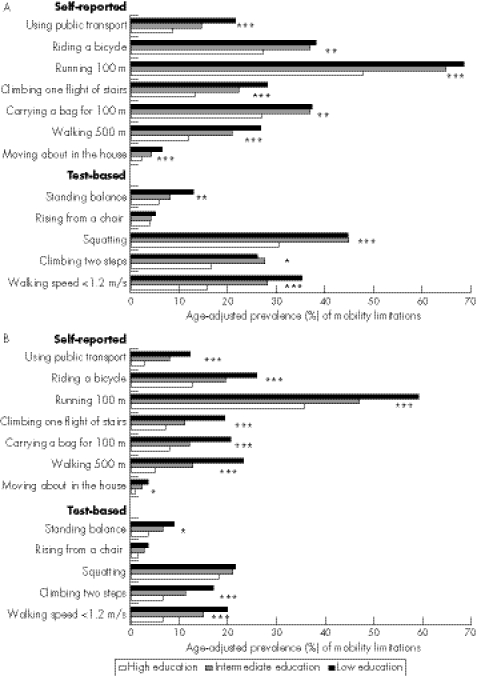
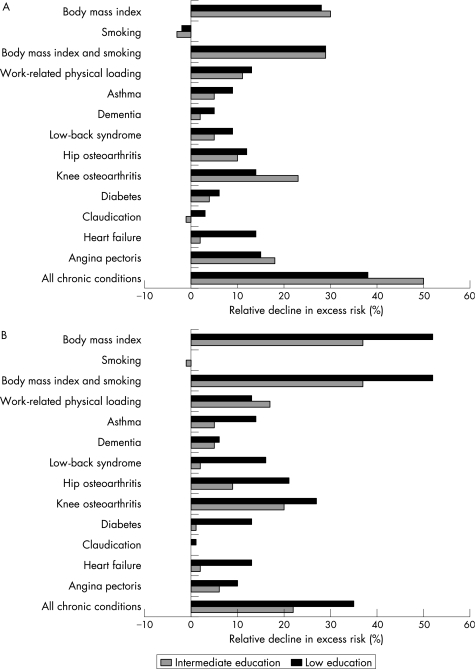
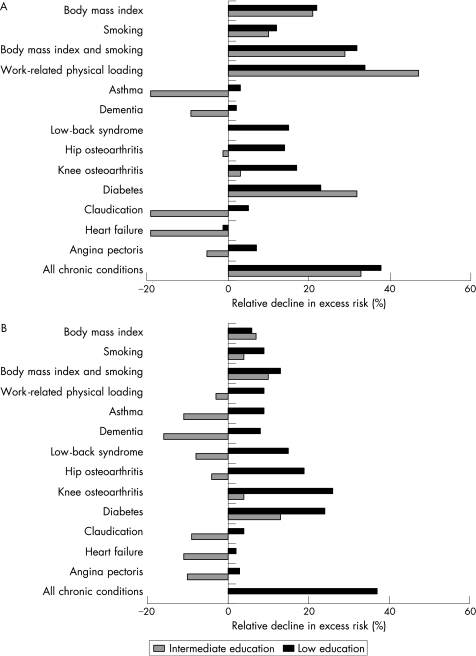
Results: According to a wide array of self-reported and test-based indicators, persons with a lower level of education showed more mobility limitations than those with a higher level. The age-adjusted ORs for limitations in stair climbing were threefold in the lowest-educational category compared with the highest one (OR 3.3 in men and 2.9 in women for self-reported limitations, and 3.5 in men and 2.2 in women for test-based limitations). When obesity, smoking, work-related physical loading and clinically diagnosed chronic diseases were simultaneously accounted for, the educational differences in stair-climbing limitations vanished or were greatly diminished. In women, obesity contributed most to the differences, followed by a history of physically strenuous work, knee and hip osteoarthritis and cardiovascular diseases. In men, diabetes, work-related physical loading, musculoskeletal diseases, obesity and smoking contributed substantially to the inequalities.
Conclusions: Great educational inequalities exist in various measures of mobility. Common chronic diseases, obesity, smoking and workload appeared to be the main pathways from low education to mobility limitations. General health promotion using methods that also yield good results in the lowest-educational groups is thus a good strategy to reduce the disparities in mobility.
Conflict of interest statement
Competing interests: None.
References
-
- WHO International classification of functioning, disability and health. Geneva: World Health Organization, 2001
-
- Ahacic K, Parker M G, Thorslund M. Mobility limitations in the Swedish population from 1968 to 1992: age, gender and social class differences. Aging (Milano) 200012190–198. - PubMed
-
- Sulander T T, Rahkonen O J, Uutela A K. Functional ability in the elderly Finnish population: time period differences and associations, 1985–99. Scand J Public Health 200331100–106. - PubMed
Publication types
MeSH terms
LinkOut - more resources
Full Text Sources
Medical
