


Results of tyrosine kinase inhibitor therapy followed by surgical resection for metastatic gastrointestinal stromal tumor
- PMID: 17435539
- PMCID: PMC1877004
- DOI: 10.1097/01.sla.0000236630.93587.59
Results of tyrosine kinase inhibitor therapy followed by surgical resection for metastatic gastrointestinal stromal tumor
Abstract
Introduction: Gastrointestinal stromal tumor (GIST) is the most common sarcoma of the intestinal tract. Nearly all tumors have an activating mutation in the KIT or, less often, PDGFRalpha, gene. Therapy with tyrosine kinase inhibitors benefits over 80% of patients with advanced GIST, but most patients eventually develop drug resistance.
Methods: Forty patients with metastatic GIST were treated with tyrosine kinase inhibitors and then underwent surgical resection. Based on the growth of their tumors by serial radiologic imaging, patients were categorized at the time of operation as having responsive disease, focal resistance (1 tumor growing), or multifocal resistance (more than 1 tumor growing). Patients were followed for a median of 15 months (range, 6-46 months) after surgery.
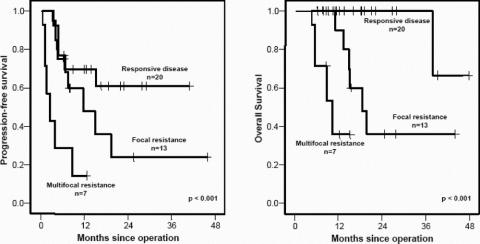
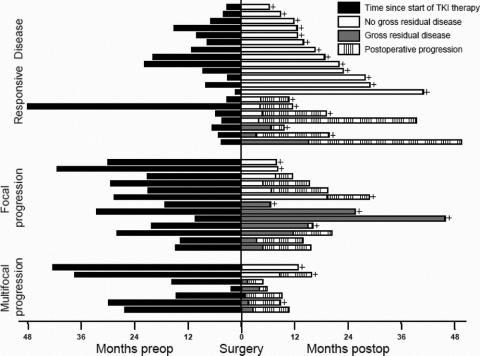
Results: Initially, molecular therapy achieved stable disease or a partial response in all but 1 patient. Surgery was performed after a median of 15 months, and there were no perioperative deaths. After operation, the 20 patients with responsive disease had a 2-year progression-free survival of 61% and 2-year overall survival of 100%. In contrast, the 13 patients with focal resistance progressed after surgery at a median of 12 months and the 2-year overall survival was 36%. There were 7 patients with multifocal resistance and they progressed postoperatively at a median of 3 months and had a 1-year overall survival of 36%.
Conclusion: Selected patients with metastatic GIST who have responsive disease or focal resistance to tyrosine kinase inhibitor therapy may benefit from elective surgical resection. Surgery for patients with metastatic GIST who have multifocal resistance is generally not indicated, and these patients should be considered for clinical trials of new systemic agents.
Figures
Comment in
-
Effective neoadjuvant therapy prior to metastasectomy: a new paradigm.Ann Surg. 2007 Mar;245(3):353-4. doi: 10.1097/01.sla.0000256393.24245.fc. Ann Surg. 2007. PMID: 17435540 Free PMC article. No abstract available.
References
-
- DeMatteo RP, Heinrich MC, El Rifai WM, et al. Clinical management of gastrointestinal stromal tumors: before and after STI-571. Hum Pathol. 2002;33:466–477. - PubMed
-
- Hirota S, Isozaki K, Moriyama Y, et al. Gain-of-function mutations of c-kit in human gastrointestinal stromal tumors. Science. 1998;279:577–580. - PubMed
-
- Rubin BP, Singer S, Tsao C, et al. KIT activation is a ubiquitous feature of gastrointestinal stromal tumors. Cancer Res. 2001;61:8118–8121. - PubMed
-
- Antonescu CR, Sommer G, Sarran L, et al. Association of KIT exon 9 mutations with nongastric primary site and aggressive behavior: KIT mutation analysis and clinical correlates of 120 gastrointestinal stromal tumors. Clin Cancer Res. 2003;9:3329–3337. - PubMed
Publication types
MeSH terms
Substances
Grants and funding
LinkOut - more resources
Full Text Sources
Medical
