. 2007 May;80(5):846-55.
doi: 10.1086/513520. Epub 2007 Mar 13.

The methylenetetrahydrofolate reductase 677C-->T polymorphism as a modulator of a B vitamin network with major effects on homocysteine metabolism

Affiliations

The methylenetetrahydrofolate reductase 677C-->T polymorphism as a modulator of a B vitamin network with major effects on homocysteine metabolism

Steinar Hustad et al. Am J Hum Genet. 2007 May.

Abstract

Folates are carriers of one-carbon units and are metabolized by 5,10-methylenetetrahydrofolate reductase (MTHFR) and other enzymes that use riboflavin, cobalamin, or vitamin B6 as cofactors. These B vitamins are essential for the remethylation and transsulfuration of homocysteine, which is an important intermediate in one-carbon metabolism. We studied the MTHFR 677C-->T polymorphism and B vitamins as modulators of one-carbon metabolism in 10,601 adults from the Norwegian Colorectal Cancer Prevention (NORCCAP) cohort, using plasma total homocysteine (tHcy) as the main outcome measure. Mean concentrations of plasma tHcy were 10.4 micromol/liter, 10.9 micromol/liter, and 13.3 micromol/liter in subjects with the CC (51%), CT (41%), and TT (8%) genotypes, respectively. The MTHFR 677C-->T polymorphism, folate, riboflavin, cobalamin, and vitamin B6 were independent predictors of tHcy in multivariate models (P<.001), and genotype effects were strongest when B vitamins were low (P<or=.006). Conversely, the MTHFR polymorphism influenced B vitamin effects, which were strongest in the TT group, in which the estimated tHcy difference between subjects with vitamin concentrations in the lowest compared with the highest quartile was 5.4 micromol/liter for folate, 4.1 micromol/liter for riboflavin, 3.2 micromol/liter for cobalamin, and 2.1 micromol/liter for vitamin B6. Furthermore, interactions between B vitamins were observed, and B vitamins were more strongly related to plasma tHcy when concentrations of other B vitamins were low. The study provides comprehensive data on the MTHFR-B vitamin network, which has major effects on the transfer of one-carbon units. Individuals with the TT genotype were particularly sensitive to the status of several B vitamins and might be candidates for personalized nutritional recommendations.


Figures
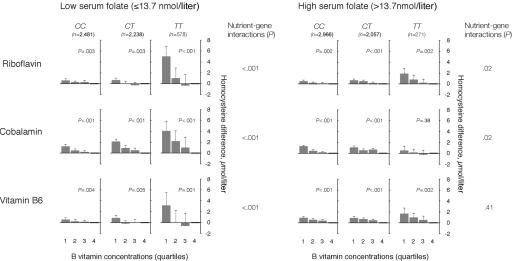
Figure  1.
Figure 1.
B vitamins as determinants of plasma tHcy according to folate concentrations and MTHFR 677C→T genotype. The population was stratified according to levels of serum folate (below and above the median) and MTHFR 677C→T genotype. The riboflavin-tHcy, cobalamin-tHcy, and vitamin B6–tHcy relationships were then studied in a regression model, which included these vitamins in addition to sex, age, creatinine, and study center. Means with upper limits of 95% CIs and P for trend across quartiles are shown in each panel. Nutrient-gene interaction terms were calculated as the product between MTHFR genotype and the various B vitamins.
Figure  2.
Figure 2.
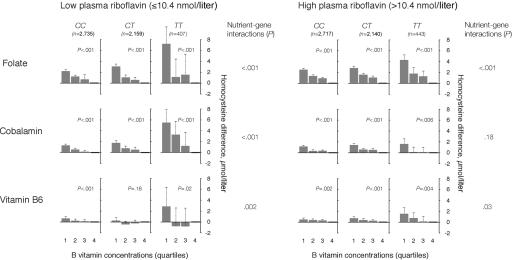
B vitamins as determinants of plasma tHcy according to riboflavin concentrations and MTHFR 677C→T genotype. The population was stratified according to levels of plasma riboflavin (below and above the median) and MTHFR 677C→T genotype. The folate-tHcy, cobalamin-tHcy, and vitamin B6–tHcy relationships were then studied in a regression model, which included these vitamins in addition to sex, age, creatinine, and study center. Means with upper limits of 95% CIs and P for trend across quartiles are shown in each panel. Nutrient-gene interaction terms were calculated as the product between MTHFR genotype and the various B vitamins.
Figure  3.
Figure 3.
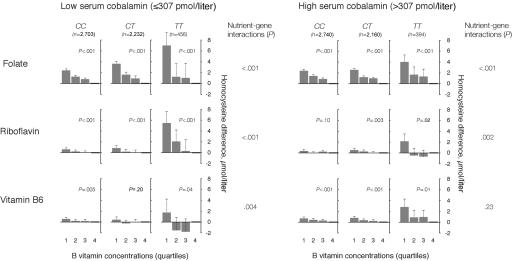
B vitamins as determinants of plasma tHcy according to cobalamin concentrations and MTHFR 677C→T genotype. The population was stratified according to levels of serum cobalamin (below and above the median) and MTHFR 677C→T genotype. The folate-tHcy, riboflavin-tHcy, and vitamin B6–tHcy relationships were then studied in a regression model, which included these vitamins in addition to sex, creatinine, and study center. Means with upper limits of 95% CIs and P for trend across quartiles are shown in each panel. Nutrient-gene interaction terms were calculated as the product between MTHFR genotype and the various B vitamins.
Figure  4.
Figure  4.
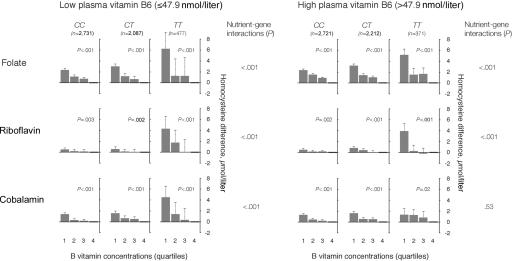
B vitamins as determinants of plasma tHcy according to vitamin B6 concentrations and MTHFR 677C→T genotype. The population was stratified according to levels of plasma vitamin B6 (below and above the median) and MTHFR 677C→T genotype. The folate-tHcy, riboflavin-tHcy, and cobalamin-tHcy relationships were then studied in a regression model, which included these vitamins in addition to sex, age, creatinine, and study center. Means with upper limits of 95% CIs and P for trend across quartiles are shown in each panel. Nutrient-gene interaction terms were calculated as the product between MTHFR genotype and the various B vitamins.

References

Web Resources

    1. dbSNP, http://www.ncbi.nlm.nih.gov/SNP/ (for MTHFR 677C→T)
    1. Online Mendelian Inheritance in Man (OMIM), http://www.ncbi.nlm.nih.gov/Omim/ (for MTHFR, neural tube defects, colorectal cancer, and hyperhomocysteinemia)

References

    1. Kutzbach C, Stokstad EL (1971) Mammalian methylenetetrahydrofolate reductase: partial purification, properties, and inhibition by S-adenosylmethionine. Biochim Biophys Acta 250:459–477 - PubMed
    1. Selhub J (1999) Homocysteine metabolism. Annu Rev Nutr 19:217–24610.1146/annurev.nutr.19.1.217 - DOI - PubMed
    1. Bagley PJ, Selhub J (1998) A common mutation in the methylenetetrahydrofolate reductase gene is associated with an accumulation of formylated tetrahydrofolates in red blood cells. Proc Natl Acad Sci USA 95:13217–1322010.1073/pnas.95.22.13217 - DOI - PMC - PubMed
    1. Lucock M (2000) Folic acid: nutritional biochemistry, molecular biology, and role in disease processes. Mol Genet Metab 71:121–13810.1006/mgme.2000.3027 - DOI - PubMed
    1. Finkelstein JD (2001) Regulation of homocysteine metabolism. In: Carmel R, Jacobsen DW (eds) Homocysteine in health and disease. Cambridge University Press, Cambridge, United Kingdom, pp 92–99

Publication types