. 2007 Apr 16:8:102.
doi: 10.1186/1471-2164-8-102.

An insight into the sialome of the oriental rat flea, Xenopsylla cheopis (Rots)

Affiliations

An insight into the sialome of the oriental rat flea, Xenopsylla cheopis (Rots)

John F Andersen et al. BMC Genomics. .

Abstract

Background: The salivary glands of hematophagous animals contain a complex cocktail that interferes with the host hemostasis and inflammation pathways, thus increasing feeding success. Fleas represent a relatively recent group of insects that evolved hematophagy independently of other insect orders.

Results: Analysis of the salivary transcriptome of the flea Xenopsylla cheopis, the vector of human plague, indicates that gene duplication events have led to a large expansion of a family of acidic phosphatases that are probably inactive, and to the expansion of the FS family of peptides that are unique to fleas. Several other unique polypeptides were also uncovered. Additionally, an apyrase-coding transcript of the CD39 family appears as the candidate for the salivary nucleotide hydrolysing activity in X.cheopis, the first time this family of proteins is found in any arthropod salivary transcriptome.

Conclusion: Analysis of the salivary transcriptome of the flea X. cheopis revealed the unique pathways taken in the evolution of the salivary cocktail of fleas. Gene duplication events appear as an important driving force in the creation of salivary cocktails of blood feeding arthropods, as was observed with ticks and mosquitoes. Only five other flea salivary sequences exist at this time at NCBI, all from the cat flea C. felis. This work accordingly represents the only relatively extensive sialome description of any flea species. Sialotranscriptomes of additional flea genera will reveal the extent that these novel polypeptide families are common throughout the Siphonaptera.


Figures
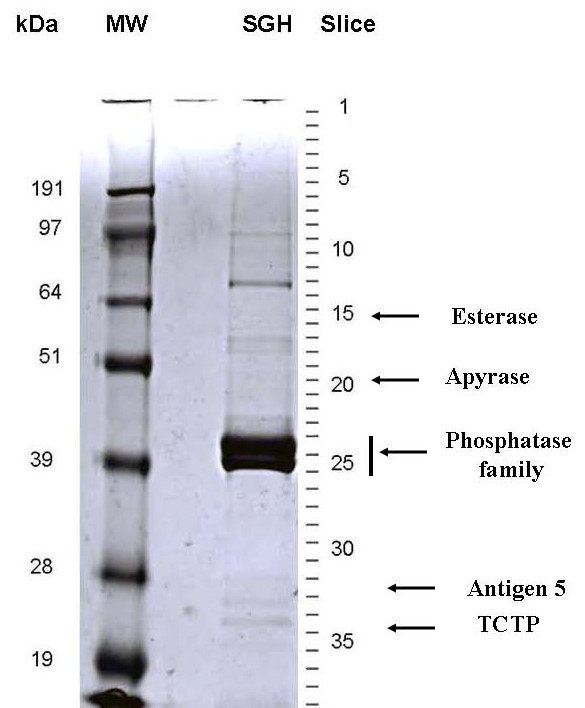
Figure 1
Figure 1
Gel electrophoresis of Xenopsylla cheopis salivary gland homogenates. The left portion of the gel shows molecular weight markers (MW) in kDaltons. The right portion shows the electrochromatogram of salivary gland homogenates, and the slices that were cut for tryptic digestion MS/MS experiments. The arrows point to the gel slices where the indicated enzymes and translationally controlled tumor protein (TCTP) were found. For more detail, see text.
Figure 2
Figure 2
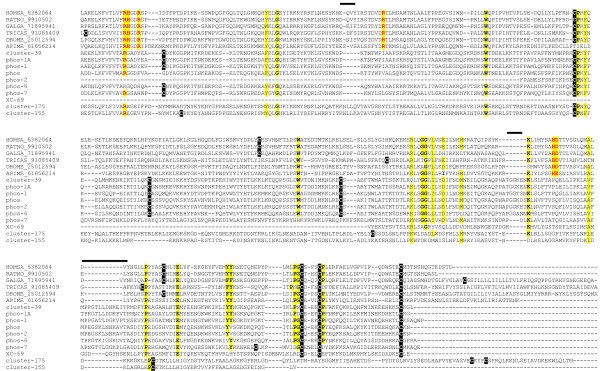
Alignment of human, rat, chicken, beetle (Triboleum castaneum), fly (Drosophila melanogaster), bee and flea acid phosphatase sequences. The red letters over yellow background indicate amino acids found in the active center of rat and human enzymes. Other yellow background indicated identical (in bold) or conserved amino acids. The bars indicate regions of insertion/deletion when the flea and remaining sequences are compared. Cysteines are shown in white font over black background.
Figure 3
Figure 3
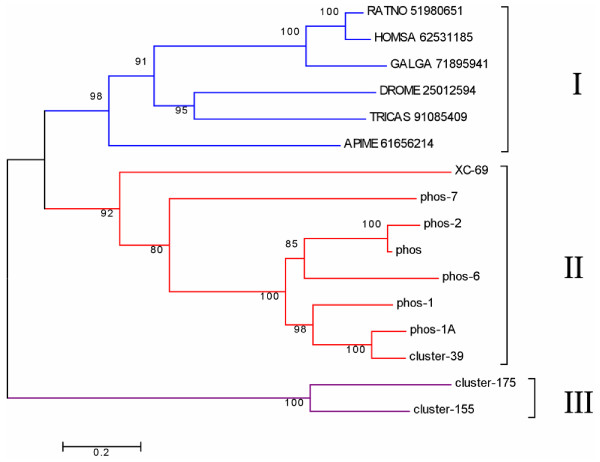
Phylogram of human, rat, chicken, beetle (Triboleum castaneum), fly (Drosophila melanogaster), bee and flea acid phosphatase sequences. The phylogram was deducted from the Clustal alignment from figure 2. The non flea sequences are indicated by 5 letters representing the first 3 letters of the genus and 2 letters of the species name, followed by the NCBI accession number. The numbers in the phylogram indicates the percentage of concordance in 10,000 bootstraps. The bar at the bottom indicates 20% amino acid distance.
Figure 4
Figure 4
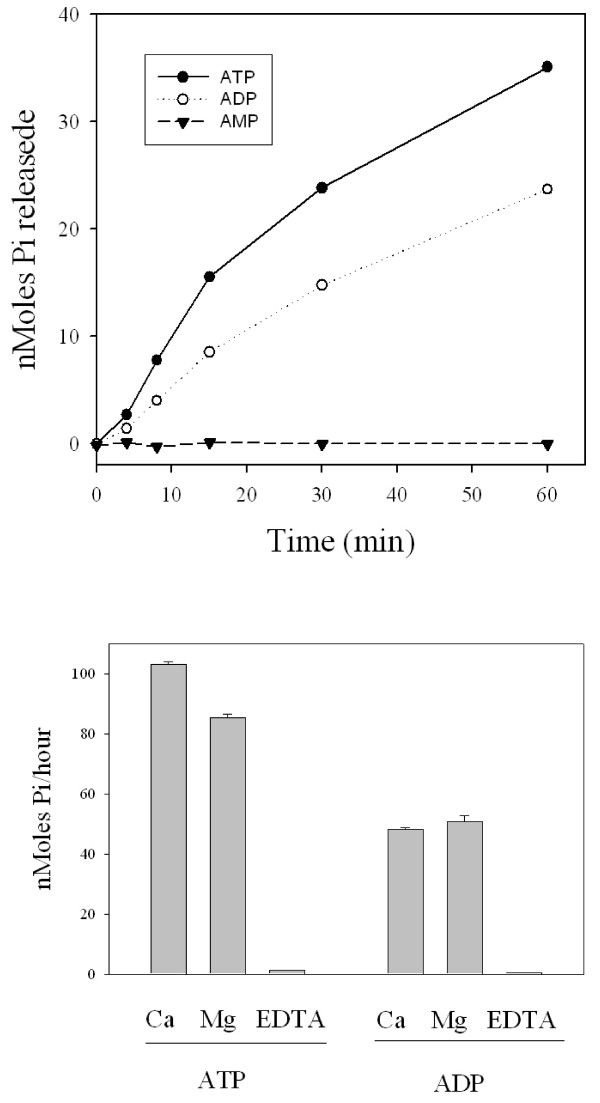
Apyrase activity of salivary homogenates of the flea, Xenopsylla cheopis. Reaction media contained 50 mM TrisCl pH 7.4, 150 mM NaCl, 2 mM indicated nucleotide in 100 μl. The reaction started with addition of salivary gland homogenate to give 2.5 pairs per ml. (A) 1 mM CaCl2 plus 1 mM MgCl2 were added to the media before starting the reaction. (B) Either 2 mM CaCl2, 2 mM MgCl2 or 2 mM EDTA were added to the media before starting the reaction. The bars represent the average ± SE of 3 determinations. All incubations were done at 37°C.
Figure 5
Figure 5
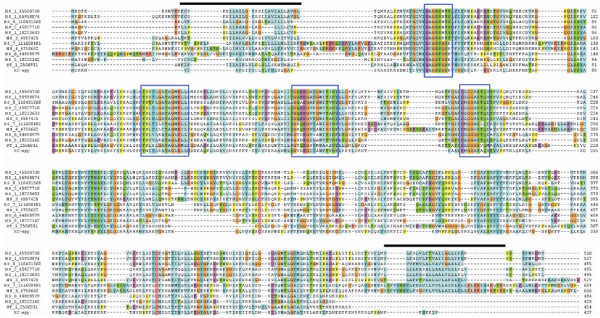
Alignment of human, potato and flea proteins of the apyrase/CD39 family. Human sequences are identified by HS_#_???? where # is the enzyme number and ???? refers to the NCBI gi accession number. The potato sequence is identified by ST_1 followed by the NCBI accession number. The flea sequence is indicated by the prefix XC. The boxes mark the 4 conserved domains identified by Wang et al [60]. The lines above the alignments indicate the regions of hydrophobic helices in the amino and terminal regions, the last of which is lacking in the four bottom sequences, representing the 2 human secreted enzymes, plus the potato and the flea enzymes.
Figure 6
Figure 6
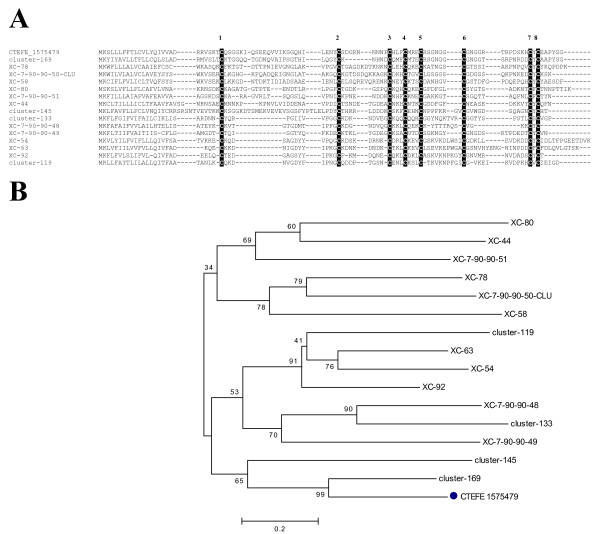
The FS peptide family expressed in the salivary glands of Xenopsylla cheopis. A) Clustal aligment of the Oriental rat flea sequences with the cat flea sequence with NCBI accession number 1575479. Conserved cysteines are shown in reverse black color, and the number above their locations B) Phylogram of the FS family displaying the divergence of the family, and the association of the cat flea sequence with the rat flea sequence annotated as cluster-169. The numbers represent the percent concordance of 10,000 bootstrap replicates. The bar at the bottom indicates 20% amino acid distance.
Figure 7
Figure 7
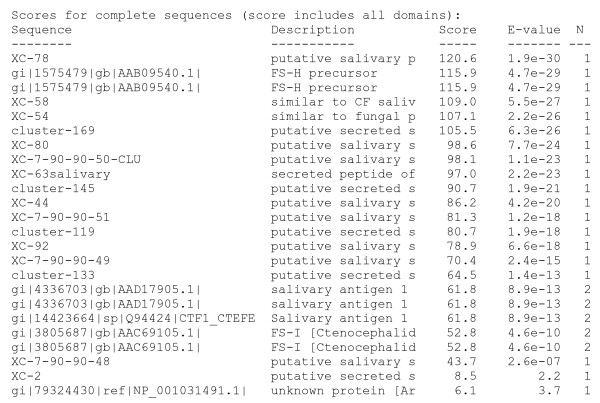
Search of the non-redundant NCBI protein database for proteins similar to flea sequences found in this work. A hidden Markov model was made from the alignment shown in Figure 6 (minus first 20 amino acids to exclude signal peptide) to search the non-redundant protein database.
Figure 8
Figure 8
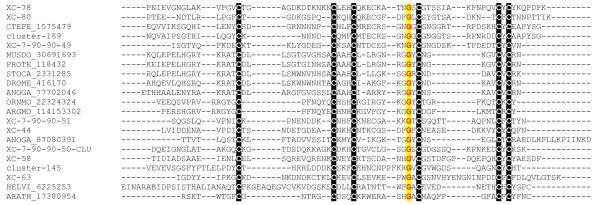
Alignment of selected Xenopsylla cheopis peptides of the FS family with defensin peptides. The conserved cysteine framework C...C-X-X-X-C...G-X-C ...C-X-C is indicated. Sequences from the present work start with XC or cluster; other sequences are from GenBank and consist of 5 letters and their gi¦ accession number. The five letters represent the genus name (first 3 letters) followed by 2 letters from the species name; Accordingly, CTEFE: Ctenocephalides felix, MUSDO: Musca domestica, PROTE: Protophormia terraenovae, STOCA: Stomoxys calcitrans, DROME: Drosophila melanogaster, ANOGA: Anopheles gambiae, ORNMO:Ornithodorus moubata, ARGMO: Argas monolakensis, HELVI:Heliothis virescens, ARATH: Arabidopsis thaliana. The aminoterminal part of the peptides is not shown.

References

    1. Ribeiro JMC. Blood-feeding arthropods: Live syringes or invertebrate pharmacologists? Infect Agents Dis. 1995;4:143–152. - PubMed
    1. Grimaldi D, Engel M. Evolution of the insects. New York: Cambridge University Press; 2005.
    1. Rothschild M. Recent advances in our knowledge of the order Siphonaptera. Annu Rev Entomol. 1975;20:241–259. doi: 10.1146/annurev.en.20.010175.001325. - DOI - PubMed
    1. Rai KS, Black WC., IV Mosquito genomes: Structure, organization, and evolution. Adv Genet. 1999;41:1–33. - PubMed
    1. Andersen JF, Weichsel A, Balfour CA, Champagne DE, Montfort WR. The crystal structure of nitrophorin 4 at 1.5 A resolution: transport of nitric oxide by a lipocalin-based heme protein. Structure. 1998;6:1315–1327. doi: 10.1016/S0969-2126(98)00131-2. - DOI - PubMed

Publication types

MeSH terms