


Body mass index is associated with reduced exhaled nitric oxide and higher exhaled 8-isoprostanes in asthmatics
- PMID: 17437645
- PMCID: PMC1855924
- DOI: 10.1186/1465-9921-8-32
Body mass index is associated with reduced exhaled nitric oxide and higher exhaled 8-isoprostanes in asthmatics
Abstract
Background: Recently, it has been shown that increasing body mass index (BMI) in asthma is associated with reduced exhaled NO. Our objective in this study was to determine if the BMI-related changes in exhaled NO differ across asthmatics and controls, and to determine if these changes are related to increased airway oxidative stress and systemic levels of leptin and adiponectin.
Methods: Observational study of the association of BMI, leptin, and adiponectin with exhaled nitric oxide (NO) and exhaled 8-isoprostanes in 67 non-smoking patients with moderate to severe persistent asthma during baseline conditions and 47 controls. Measurements included plasma levels of leptin, adiponectin, exhaled breath condensates for 8-isoprostanes, exhaled NO, pulmonary function tests, and questionnaires regarding asthma severity and control.
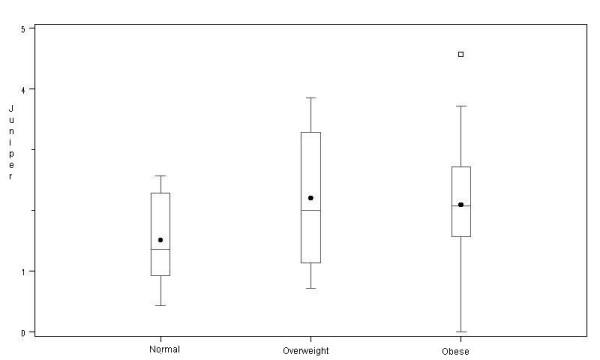
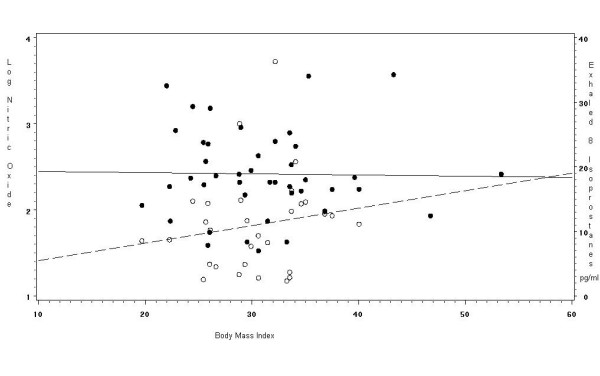
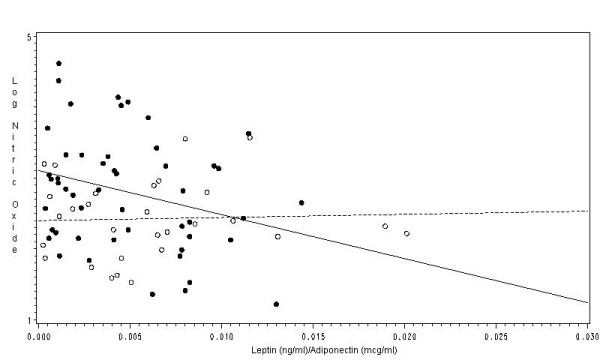
Results: In asthmatics, BMI and the ratio of leptin to adiponectin were respectively associated with reduced levels of exhaled NO (beta = -0.04 [95% C.I. -0.07, -0.1], p < 0.003) and (beta = -0.0018 [95% C.I. -0.003, -0.00034], p = 0.01) after adjusting for confounders. Also, BMI was associated with increased levels of exhaled 8-isoprostanes (beta = 0.30 [95% C.I. 0.003, 0.6], p = 0.03) after adjusting for confounders. In contrast, we did not observe these associations in the control group of healthy non-asthmatics with a similar weight distribution.
Conclusion: In adults with stable moderate to severe persistent asthma, but not in controls, BMI and the plasma ratio of leptin/adiponectin is associated with reduced exhaled NO. Also, BMI is associated with increased exhaled 8-isoprostanes. These results suggest that BMI in asthmatics may increase airway oxidative stress and could explain the BMI-related reductions in exhaled NO.
Figures

References
-
- Cassol V, Rizzato TM, Teche SP, Basso DF, Centenaro DF, Maldonado M, Moraes EZ, Hirakata VN, Sole D, Menna-Barreto SS. Obesity and its relationship with asthma prevalence and severity in adolescents from southern Brazil. J Asthma. 2006;43:57–60. - PubMed
-
- Celedon JC, Palmer LJ, Litonjua AA, Weiss ST, Wang B, Fang Z, Xu X. Body mass index and asthma in adults in families of subjects with asthma in Anqing, China. Am J Respir Crit Care Med. 2001;164:1835–1840. - PubMed
MeSH terms
Substances
LinkOut - more resources
Full Text Sources
Other Literature Sources
Medical
