


Invasion pathways and malaria severity in Kenyan Plasmodium falciparum clinical isolates
- PMID: 17438038
- PMCID: PMC1932858
- DOI: 10.1128/IAI.00249-07
Invasion pathways and malaria severity in Kenyan Plasmodium falciparum clinical isolates
Abstract
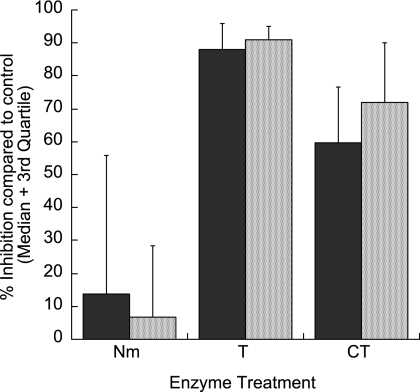
The invasion of erythrocytes by Plasmodium falciparum occurs through multiple pathways that can be studied in vitro by examining the invasion of erythrocytes treated with enzymes such as neuraminidase, trypsin, and chymotrypsin. We have studied the invasion pathways used by 31 Kenyan P. falciparum isolates from children with uncomplicated or severe malaria. Six distinct invasion profiles were detected, out of eight possible profiles. The majority of isolates (23 of 31) showed neuraminidase-resistant, trypsin-sensitive invasion, characteristic of the pathway mediated by an unknown parasite ligand and erythrocyte receptor "X." The neuraminidase-sensitive, trypsin-sensitive phenotype consistent with invasion mediated by the binding of parasite ligand erythrocyte binding antigen 175 to glycophorin A, the most common invasion profile in a previous study of Gambian field isolates, was seen in only 3 of 31 Kenyan isolates. No particular invasion profile was associated with severe P. falciparum malaria, and there was no significant difference in the levels of inhibition by the various enzyme treatments between isolates from children with severe malaria and those from children with uncomplicated malaria (P, >0.1 for all enzymes; Mann-Whitney U test). These results do not support the hypothesis that differences in invasion phenotypes play an important role in malaria virulence and indicate that considerable gaps remain in our knowledge of the molecular basis of invasion pathways in natural P. falciparum infections.
Figures
References
-
- Binks, R. H., and D. J. Conway. 1999. The major allelic dimorphisms in four Plasmodium falciparum merozoite proteins are not associated with alternative pathways of erythrocyte invasion. Mol. Biochem. Parasitol. 103:123-127. - PubMed
-
- Chotivanich, K., R. Udomsangpetch, J. A. Simpson, P. Newton, S. Pukrittayakamee, S. Looareesuwan, and N. J. White. 2000. Parasite multiplication potential and the severity of Falciparum malaria. J. Infect. Dis. 181:1206-1209. - PubMed
-
- Cortes, A., A. Benet, B. M. Cooke, J. W. Barnwell, and J. C. Reeder. 2004. Ability of Plasmodium falciparum to invade Southeast Asian ovalocytes varies between parasite lines. Blood 104:2961-2966. - PubMed
-
- Deans, A. M., K. E. Lyke, M. A. Thera, C. V. Plowe, A. Kone, O. K. Doumbo, O. Kai, K. Marsh, M. J. Mackinnon, A. Raza, and J. A. Rowe. 2006. Low multiplication rates of African Plasmodium falciparum isolates and lack of association of multiplication rate and red blood cell selectivity with malaria virulence. Am. J. Trop. Med. Hyg. 74:554-563. - PMC - PubMed
Publication types
MeSH terms
Substances
Grants and funding
LinkOut - more resources
Full Text Sources
Other Literature Sources
