


Review
doi: 10.1083/jcb.200701024.
Epub 2007 Apr 16.
Sending proteins to dense core secretory granules: still a lot to sort out
Affiliations
- PMID: 17438078
- PMCID: PMC2064127
- DOI: 10.1083/jcb.200701024
Item in Clipboard
Review
Sending proteins to dense core secretory granules: still a lot to sort out
J Cell Biol.
.
Abstract
The intracellular sorting of peptide hormone precursors to the dense core secretory granules (DCSGs) is essential for their bioactivation. Despite the fundamental importance of this cellular process, the nature of the sorting signals for entry of proteins into DCSGs remains a source of vigorous debate. This review highlights recent discoveries that are consistent with a model in which several protein domains, acting in a cell-specific fashion and at different steps in the sorting process, act in concert to regulate the entry of proteins into DCSGs.
Figures
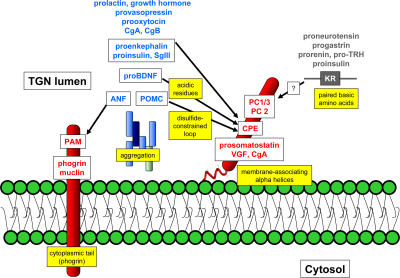
Proteins sorted to DCSGs can be functionally subdivided into three groups. Tethers (red) either traverse or associate with membranes. Many DCSG cargo proteins also aggregate to form the dense core (blue), and these aggregates may contain more than one protein. Some DCSG proteins associate with membrane tethers (arrows). The yellow boxes indicate the various protein domains or mechanisms that have been implicated in DCSG sorting. Note that some proteins (such as insulin) may have multiple DCSG sorting mechanisms. See text for details.
References
-
- Arnaoutova, I., A.M. Smith, L.C. Coates, J.C. Sharpe, S. Dhanvantari, C.R. Snell, N.P. Birch, and Y.P. Loh. 2003. The prohormone processing enzyme PC3 is a lipid raft-associated transmembrane protein. Biochemistry. 42:10445–10455. - PubMed
-
- Assadi, M., J.C. Sharpe, C. Snell, and Y.P. Loh. 2004. The C-terminus of prohormone convertase 2 is sufficient and necessary for Raft association and sorting to the regulated secretory pathway. Biochemistry. 43:7798–7807. - PubMed
-
- Bell-Parikh, L.C., B.A. Eipper, and R.E. Mains. 2001. Response of an integral granule membrane protein to changes in pH. J. Biol. Chem. 276:29854–29863. - PubMed
-
- Beuret, N., H. Stettler, A. Renold, J. Rutishauser, and M. Spiess. 2004. Expression of regulated secretory proteins is sufficient to generate granule-like structures in constitutively secreting cells. J. Biol. Chem. 279:20242–20249. - PubMed
