


On the functions of the h subunit of eukaryotic initiation factor 3 in late stages of translation initiation
- PMID: 17439654
- PMCID: PMC1896003
- DOI: 10.1186/gb-2007-8-4-r60
On the functions of the h subunit of eukaryotic initiation factor 3 in late stages of translation initiation
Abstract
Background: The eukaryotic translation initiation factor 3 (eIF3) has multiple roles during the initiation of translation of cytoplasmic mRNAs. How individual subunits of eIF3 contribute to the translation of specific mRNAs remains poorly understood, however. This is true in particular for those subunits that are not conserved in budding yeast, such as eIF3h.
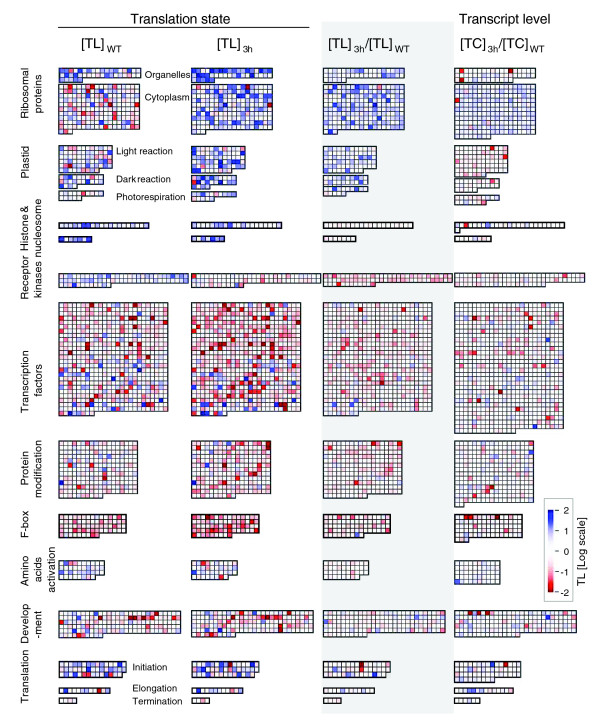
Results: Working with stable reporter transgenes in Arabidopsis thaliana mutants, it was demonstrated that the h subunit of eIF3 contributes to the efficient translation initiation of mRNAs harboring upstream open reading frames (uORFs) in their 5' leader sequence. uORFs, which can function as devices for translational regulation, are present in over 30% of Arabidopsis mRNAs, and are enriched among mRNAs for transcriptional regulators and protein modifying enzymes. Microarray comparisons of polysome loading in wild-type and eif3h mutant seedlings revealed that eIF3h generally helps to maintain efficient polysome loading of mRNAs harboring multiple uORFs. In addition, however, eIF3h also boosted the polysome loading of mRNAs with long leaders or coding sequences. Moreover, the relative polysome loading of certain functional groups of mRNAs, including ribosomal proteins, was actually increased in the eif3h mutant, suggesting that regulons of translational control can be revealed by mutations in generic translation initiation factors.
Conclusion: The intact eIF3h protein contributes to efficient translation initiation on 5' leader sequences harboring multiple uORFs, although mRNA features independent of uORFs are also implicated.
Figures




References
-
- Unbehaun A, Borukhov SI, Hellen CU, Pestova TV. Release of initiation factors from 48S complexes during ribosomal subunit joining and the link between establishment of codon-anticodon base-pairing and hydrolysis of eIF2-bound GTP. Genes Dev. 2004;18:3078–3093. doi: 10.1101/gad.1255704. - DOI - PMC - PubMed
-
- Dong Z, Zhang JT. Initiation factor eIF3 and regulation of mRNA translation, cell growth, and cancer. Crit Rev Oncol Hematol. 2006;59:169–180. - PubMed
Publication types
MeSH terms
Substances
LinkOut - more resources
Full Text Sources
Molecular Biology Databases
