


Influenza epidemics and acute respiratory disease activity are associated with a surge in autopsy-confirmed coronary heart disease death: results from 8 years of autopsies in 34,892 subjects
- PMID: 17440221
- PMCID: PMC7108465
- DOI: 10.1093/eurheartj/ehm035
Influenza epidemics and acute respiratory disease activity are associated with a surge in autopsy-confirmed coronary heart disease death: results from 8 years of autopsies in 34,892 subjects
Abstract
Aims: To determine whether influenza can trigger heart attacks, we investigated the impact of influenza epidemics on autopsy-proven coronary deaths.
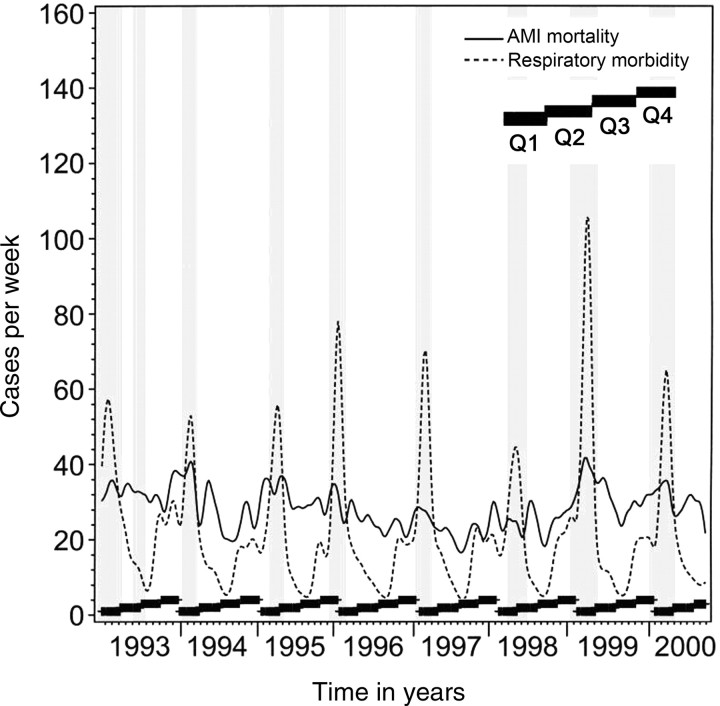
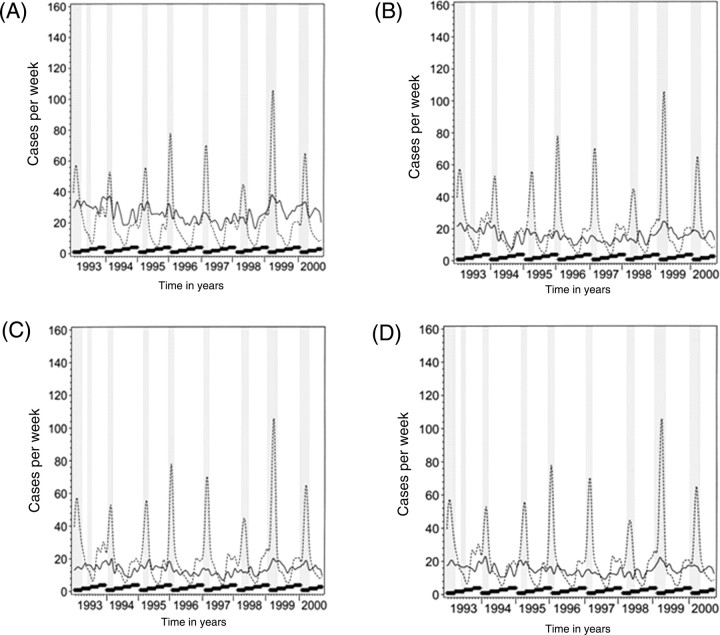
Methods and results: We studied weekly death due to acute myocardial infarction (AMI) and chronic ischaemic heart disease (IHD) in autopsies conducted in 1993 to 2000 in St Petersburg, Russia. We plotted the weekly acute respiratory disease (ARD) counts and influenza epidemics against AMI and chronic IHD deaths. There were 11,892 subjects dying of AMI and 23 000 subjects dying of chronic IHD. Median age was 75 for women and 65 for men. In every year, a peak of AMI and chronic IHD deaths were present and coincided with the influenza epidemic and peak ARD activity. A similar pattern was seen for each subgroup of men, women, subjects 50 years or older, and subjects 70 years or older. When comparing the average influenza epidemic weeks to average off-season weeks, the odds for AMI and chronic IHD death increased by 1.30 (95% confidence interval (CI): 1.08-1.56) and 1.10 (95% CI: 0.97-1.26), respectively.
Conclusion: Influenza epidemics are associated with a rise in autopsy-confirmed coronary deaths. Influenza vaccination should be advocated for patients at high risk of developing cardiovascular events.
Figures

Comment in
-
The role of infection in cardiovascular disease: more support but many questions remain.Eur Heart J. 2007 May;28(10):1178-9. doi: 10.1093/eurheartj/ehm073. Epub 2007 Apr 30. Eur Heart J. 2007. PMID: 17470675 No abstract available.
References
-
- Couch RB. Prevention and treatment of influenza. N Engl J Med. 2000;343:1778–1787. - PubMed
-
- Thompson WW, Shay DK, Weintraub E, Brammer L, Cox N, Anderson LJ, Fukuda K. Mortality associated with influenza and respiratory syncytial virus in the United States. JAMA. 2003;289:179–186. - PubMed
-
- Madjid M, Naghavi M, Litovsky S, Casscells SW. Influenza and cardiovascular disease: a new opportunity for prevention and the need for further studies. Circulation. 2003;108:2730–2736. - PubMed
-
- Spodick DH, Flessas AP, Johnson MM. Association of acute respiratory symptoms with onset of acute myocardial infarction: prospective investigation of 150 consecutive patients and matched control patients. Am J Cardiol. 1984;53:481–482. - PubMed
