


Brief report: parental report of sleep behaviors following moderate or severe pediatric traumatic brain injury
- PMID: 17442693
- PMCID: PMC4280793
- DOI: 10.1093/jpepsy/jsm003
Brief report: parental report of sleep behaviors following moderate or severe pediatric traumatic brain injury
Abstract
Objective: Determine the effect of moderate and severe traumatic brain injuries (TBI) on the sleep of school-aged children.
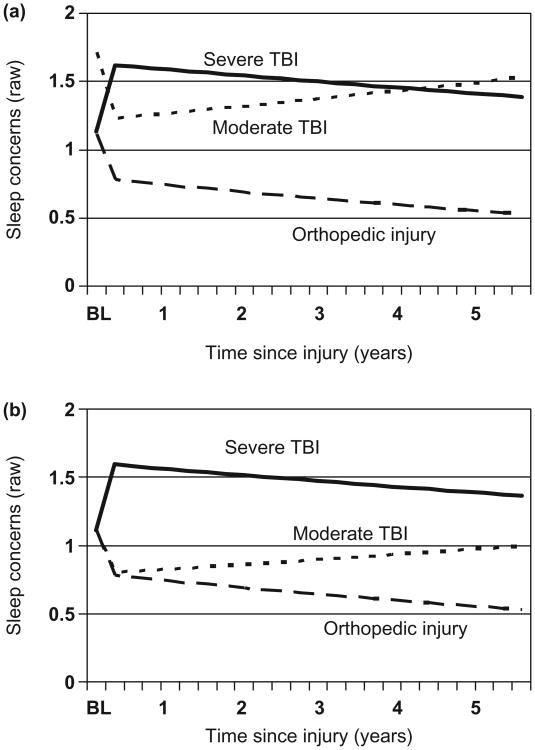
Methods: A concurrent cohort-prospective design compared children aged 6-12 years who sustained moderate TBI (baseline n = 56), severe TBI (n = 53), or only orthopedic injuries (n = 80). Retrospective parental report of pre-injury sleep was collected about 3 weeks post-injury. Post-injury assessments occurred prospectively a mean of 6, 12, and 48 months later.
Results: Growth curve analyses compared the groups over time. The moderate TBI group had worse pre-injury sleep than the other groups. The moderate TBI and orthopedic injury groups displayed a small decline in sleep problems from pre- to post-injury. Children with severe TBI displayed increased post-injury sleep problems.
Conclusions: Children who sustain severe TBI are at elevated risk for post-injury sleep problems. Because sleep problems may result in daytime impairments and family distress, additional clinical and research attention is warranted.
Conflict of interest statement
Figures
References
-
- Achenbach T. Manual for the Child Behavior Checklist 4–18 and 1991 Profile. Burlington, VT: Univerisity of vermont department of psychiatry; 1991.
-
- Blunden S, Beebe DW. The contribution of intermittent hypoxia, sleep debt and sleep disruption to daytime performance deficits in children: Consideration of respiratory and non-respiratory sleep disorders. Sleep Medicine Reviews. 2006;10:109–118. - PubMed
-
- Bryant RA, Marosszeky JE, Crooks J, Gurka JA. Posttraumatic stress disorder after severe traumatic brain injury. American Journal of Psychiatry. 2000;157:629–631. - PubMed
-
- Farmer MY, Singer HS, Melleits ED, Hall D, Charney E. Neurobehavioral sequelae of minor head injuries in children. Pediatric Neuroscience. 1987;13:304–308. - PubMed
-
- Gregory AM, O'Connor TG. Sleep problems in childhood: A longitudinal study of developmental change and association with behavioral problems. Journal of the American Academy of Child and Adolescent Psychiatry. 2002;41:964–971. - PubMed
Publication types
MeSH terms
Grants and funding
LinkOut - more resources
Full Text Sources
Medical
