


Alterations in upper airway cross-sectional area in response to lower body positive pressure in healthy subjects
- PMID: 17442706
- PMCID: PMC2094267
- DOI: 10.1136/thx.2006.071183
Alterations in upper airway cross-sectional area in response to lower body positive pressure in healthy subjects
Abstract
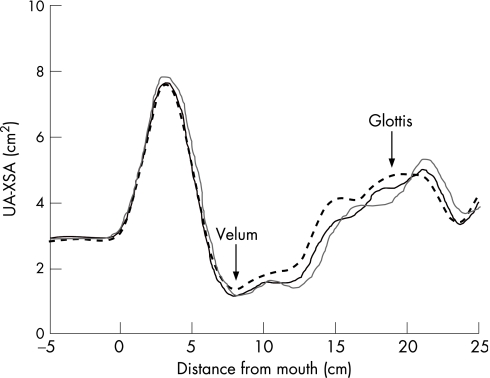
Background: Fluid accumulation in the neck during recumbency might narrow the upper airway (UA) and thereby contribute to its collapse in patients with obstructive sleep apnoea (OSA). It is hypothesised that acute fluid shifts from the legs to the upper body in healthy subjects would increase neck circumference and reduce the cross-sectional area of the UA (UA-XSA).
Methods: In 27 healthy non-obese subjects of mean (SE) age 39 (3) years and body mass index 23.2 (0.6) kg/m2 studied while supine, leg fluid volume was measured using bioelectrical impedance, neck circumference using a mercury strain gauge and mean UA-XSA between the velum and the glottis using acoustic pharyngometry at end expiration. Measurements were made at baseline after which subjects were randomly assigned to a 5 min time control period or to a 5 min application of lower body positive pressure (LBPP) at 40 mm Hg by anti-shock trousers, separated by a 15 min washout period. Subjects then crossed over to the opposite arm of the study.
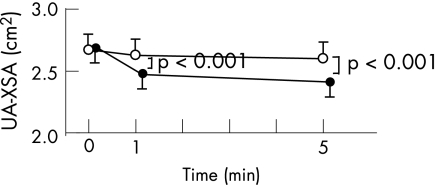
Results: Compared with control, application of LBPP significantly reduced leg fluid volume (p<0.001) and increased neck circumference (p<0.001), both at 1 min and 5 min, and reduced UA-XSA after both 1 min (-0.15 cm2; 95% CI -0.23 to -0.09, p<0.001) and 5 min (-0.20 cm2; 95% CI -0.33 to -0.09, p<0.001).
Conclusion: In healthy subjects, displacement of fluid from the legs by LBPP causes distension of the neck and narrowing of the UA lumen. Fluid displacement from the lower to the upper body while recumbent may contribute to pharyngeal narrowing and obstruction to airflow in patients with OSA. This may have particular pathological significance in oedematous states such as heart and renal failure.
Conflict of interest statement
Competing interests: None.
References
-
- Davies R J, Stradling J R. The relationship between neck circumference, radiographic pharyngeal anatomy, and the obstructive sleep apnoea syndrome. Eur Respir J 19903509–514. - PubMed
-
- Katz I, Stradling J, Slutsky A S.et al Do patients with obstructive sleep apnea have thick necks? Am Rev Respir Dis 19901411228–1231. - PubMed
-
- Javaheri S, Parker T J, Liming J D.et al Sleep apnea in 81 ambulatory male patients with stable heart failure. Types and their prevalences, consequences, and presentations. Circulation 1998972154–2159. - PubMed
-
- Kuhlmann U, Becker H F, Birkhahn M.et al Sleep‐apnea in patients with end‐stage renal disease and objective results. Clin Nephrol 200053460–466. - PubMed
-
- Sin D D, Fitzgerald F, Parker J D.et al Risk factors for central and obstructive sleep apnea in 450 men and women with congestive heart failure. Am J Respir Crit Care Med 19991601101–1106. - PubMed
Publication types
MeSH terms
LinkOut - more resources
Full Text Sources
Other Literature Sources
