Meta-Analysis
. 2007 Apr 18;2007(2):CD006003.
doi: 10.1002/14651858.CD006003.pub2.

Routine abdominal drainage for uncomplicated open cholecystectomy

Affiliations
Meta-Analysis

Routine abdominal drainage for uncomplicated open cholecystectomy

K S Gurusamy et al. Cochrane Database Syst Rev. .

Abstract

Background: Cholecystectomy is the removal of gallbladder and is performed mainly for symptomatic gallstones. Although laparoscopic cholecystectomy is currently preferred over open cholecystectomy for elective cholecystectomy, reports of randomised clinical trials comparing the choice of cholecystectomy (open or laparoscopic) in acute cholecystitis are still being conducted. Drainage in open cholecystectomy is a matter of considerable debate. Surgeons use drains primarily to prevent subhepatic abscess or bile peritonitis from an undrained bile leak. Critics of drain condemn drain use as it increases wound and chest infection.

Objectives: To assess the benefits and harms of routine abdominal drainage in uncomplicated open cholecystectomy.

Search strategy: We searched The Cochrane Hepato-Biliary Group Controlled Trials Register, the Cochrane Central Register of Controlled Trials (CENTRAL) in The Cochrane Library, MEDLINE, EMBASE, and Science Citation Index Expanded until April 2006.

Selection criteria: We included randomised clinical trials comparing 'no drain' versus 'drain' in patients who had undergone uncomplicated open cholecystectomy (irrespective of language, publication status, and the type of drain). Randomised clinical trials comparing one drain with another were also included.

Data collection and analysis: We collected the data on the characteristics and methodological quality of each trial, number of abdominal collections requiring different treatments, bile peritonitis, wound infection, chest complications, and hospital stay from each trial. We analysed the data with both the fixed-effect and the random-effects models using RevMan Analysis. For each outcome, we calculated the odds ratio (OR) with 95% confidence intervals (CI) based on intention-to-treat analysis.

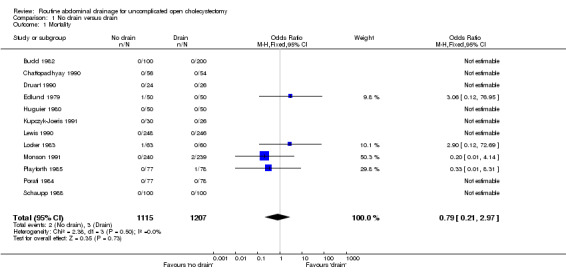
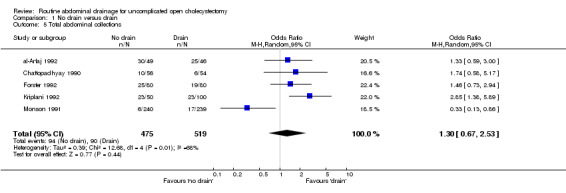
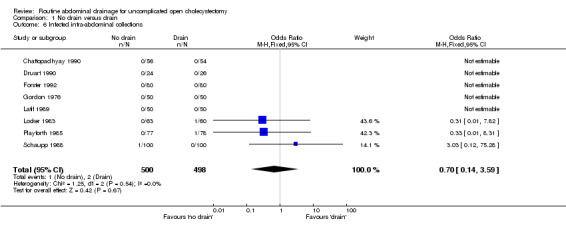
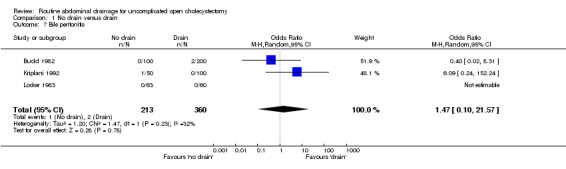
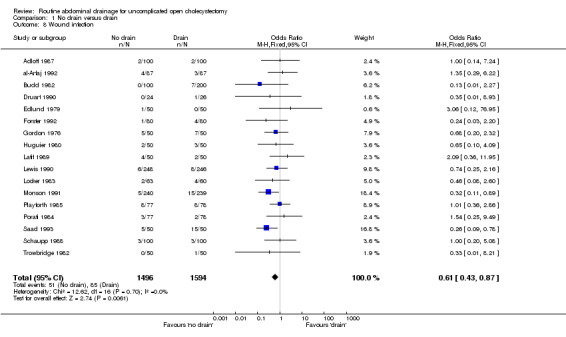
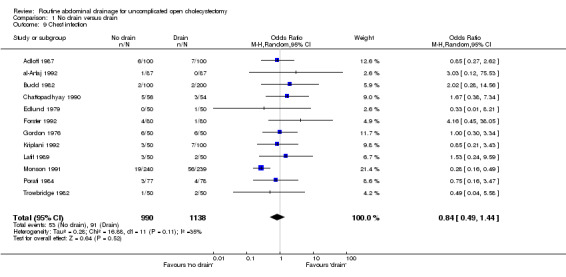
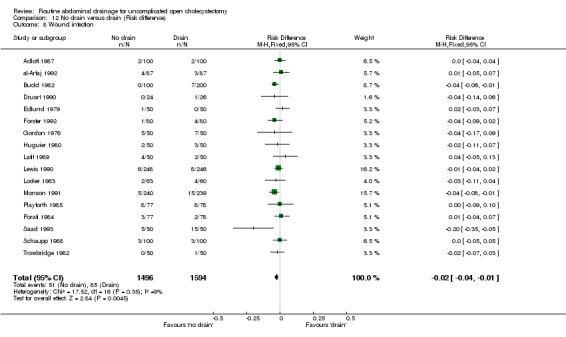
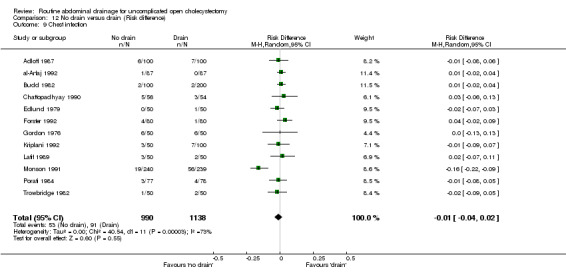
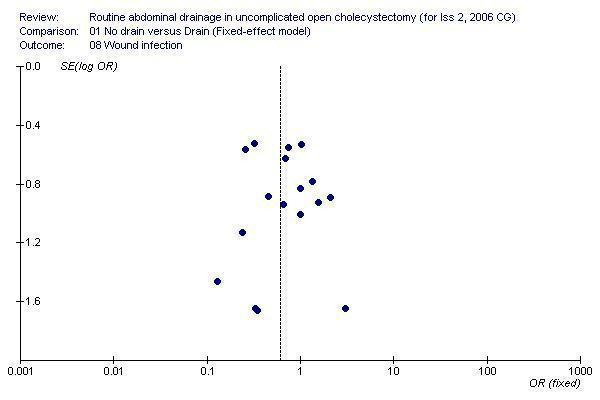
Main results: Twenty eight trials involving 3659 patients were included. There were 20 comparisons of 'no drain' versus 'drain' and 12 comparisons of one drain with another. There was no statistically significant difference in mortality, bile peritonitis, total abdominal collections, abdominal collections requiring different treatments, or infected abdominal collections. 'No drain' group had statistically significant lower wound infection (OR 0.61, 95% CI 0.43 to 0.87) and statistically significant lower chest infection (OR 0.59, 95% CI 0.42 to 0.84) than drain group. We found no significant differences between different types of drains.

Authors' conclusions: Drains increase the harms to the patient without providing any additional benefit for patients undergoing open cholecystectomy and should be avoided in open cholecystectomy.


Conflict of interest statement

None known.

Figures
1
1
1.1
1.1. Analysis
Comparison 1 No drain versus drain, Outcome 1 Mortality.
1.2
1.2. Analysis
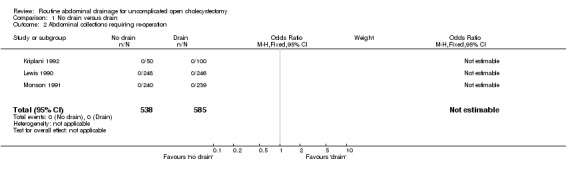
Comparison 1 No drain versus drain, Outcome 2 Abdominal collections requiring re‐operation.
1.3
1.3. Analysis
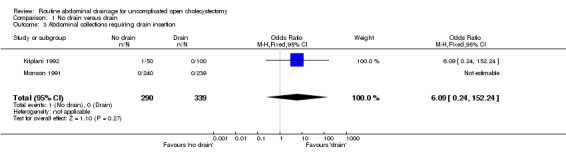
Comparison 1 No drain versus drain, Outcome 3 Abdominal collections requiring drain insertion.
1.4
1.4. Analysis
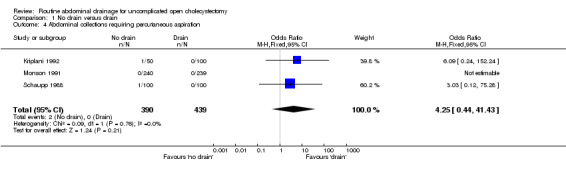
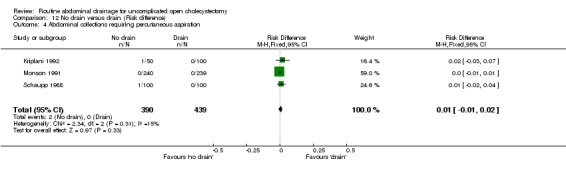
Comparison 1 No drain versus drain, Outcome 4 Abdominal collections requiring percutaneous aspiration.
1.5
1.5. Analysis
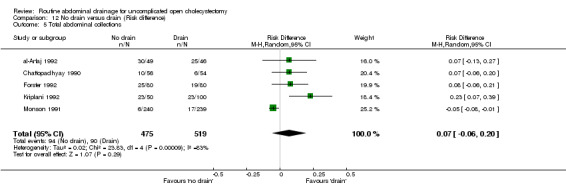
Comparison 1 No drain versus drain, Outcome 5 Total abdominal collections.
1.6
1.6. Analysis
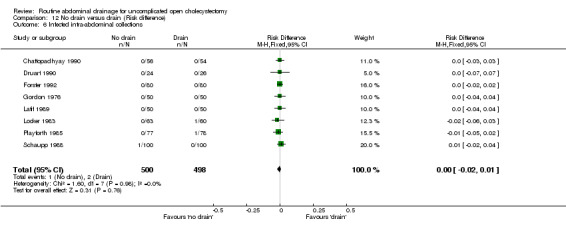
Comparison 1 No drain versus drain, Outcome 6 Infected intra‐abdominal collections.
1.7
1.7. Analysis
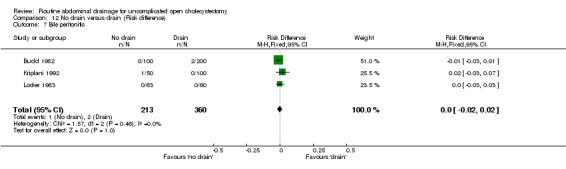
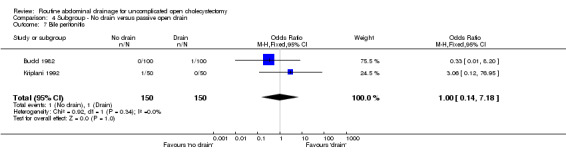
Comparison 1 No drain versus drain, Outcome 7 Bile peritonitis.
1.8
1.8. Analysis
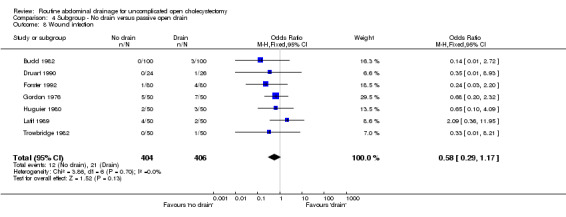
Comparison 1 No drain versus drain, Outcome 8 Wound infection.
1.9
1.9. Analysis
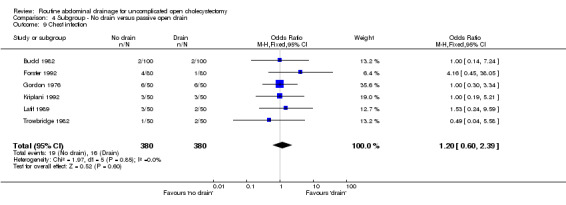
Comparison 1 No drain versus drain, Outcome 9 Chest infection.
1.10
1.10. Analysis
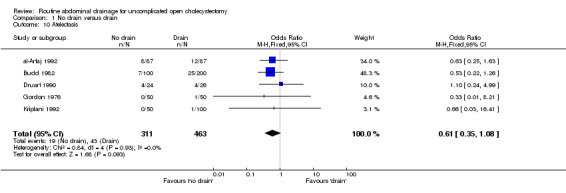
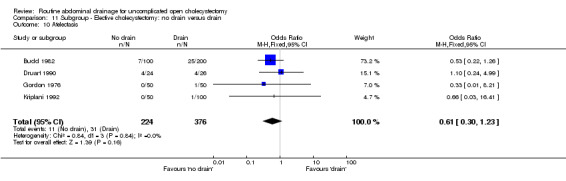
Comparison 1 No drain versus drain, Outcome 10 Atelectasis.
1.11
1.11. Analysis
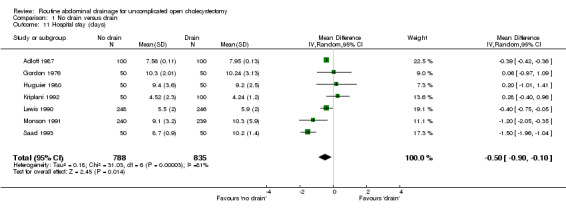
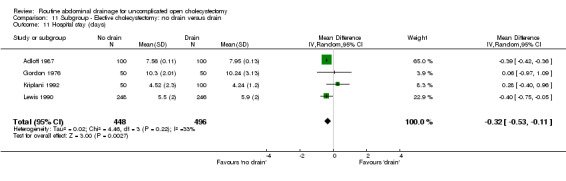
Comparison 1 No drain versus drain, Outcome 11 Hospital stay (days).
2.1
2.1. Analysis
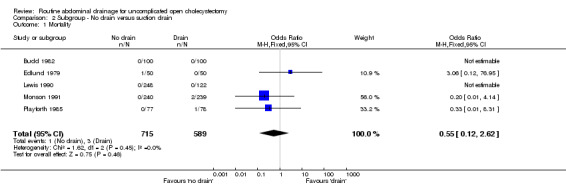
Comparison 2 Subgroup ‐ No drain versus suction drain, Outcome 1 Mortality.
2.2
2.2. Analysis
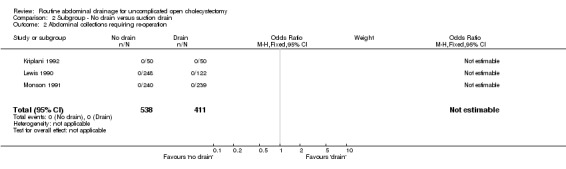
Comparison 2 Subgroup ‐ No drain versus suction drain, Outcome 2 Abdominal collections requiring re‐operation.
2.3
2.3. Analysis
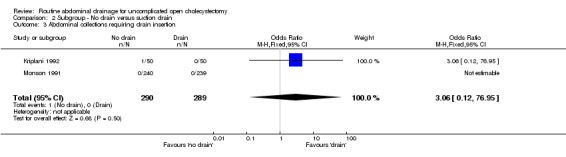
Comparison 2 Subgroup ‐ No drain versus suction drain, Outcome 3 Abdominal collections requiring drain insertion.
2.4
2.4. Analysis
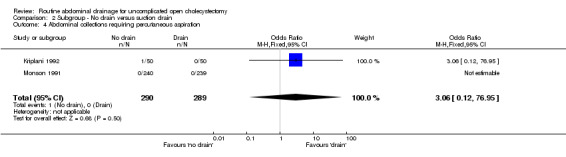
Comparison 2 Subgroup ‐ No drain versus suction drain, Outcome 4 Abdominal collections requiring percutaneous aspiration.
2.5
2.5. Analysis
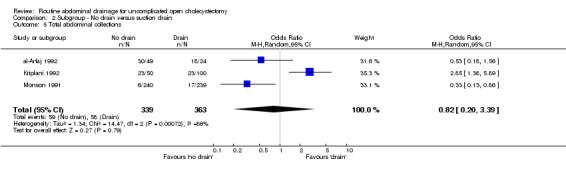
Comparison 2 Subgroup ‐ No drain versus suction drain, Outcome 5 Total abdominal collections.
2.6
2.6. Analysis
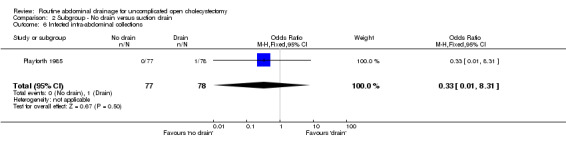
Comparison 2 Subgroup ‐ No drain versus suction drain, Outcome 6 Infected intra‐abdominal collections.
2.7
2.7. Analysis
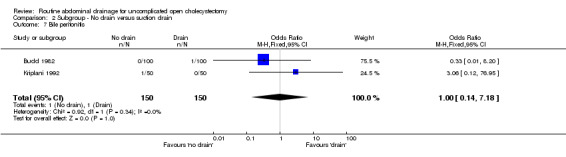
Comparison 2 Subgroup ‐ No drain versus suction drain, Outcome 7 Bile peritonitis.
2.8
2.8. Analysis
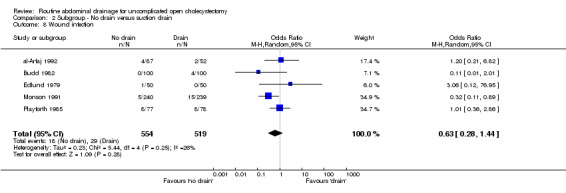
Comparison 2 Subgroup ‐ No drain versus suction drain, Outcome 8 Wound infection.
2.9
2.9. Analysis
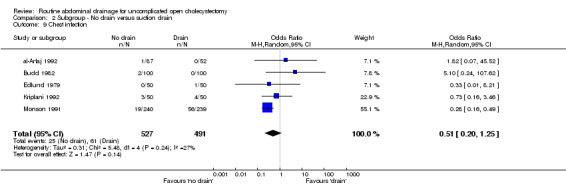
Comparison 2 Subgroup ‐ No drain versus suction drain, Outcome 9 Chest infection.
2.10
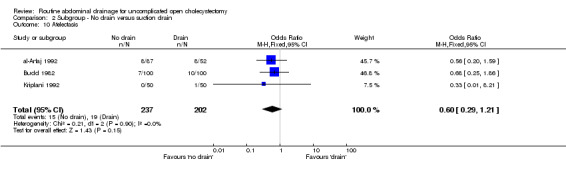
2.10. Analysis
Comparison 2 Subgroup ‐ No drain versus suction drain, Outcome 10 Atelectasis.
2.11
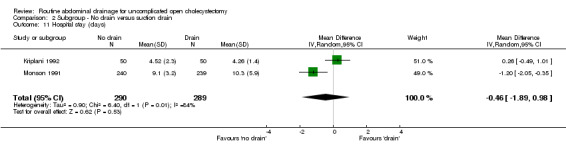
2.11. Analysis
Comparison 2 Subgroup ‐ No drain versus suction drain, Outcome 11 Hospital stay (days).
3.1
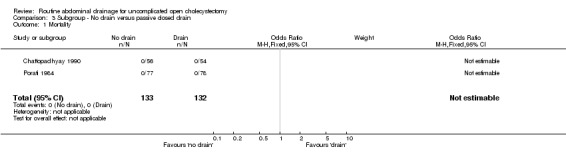
3.1. Analysis
Comparison 3 Subgroup ‐ No drain versus passive closed drain, Outcome 1 Mortality.
3.2
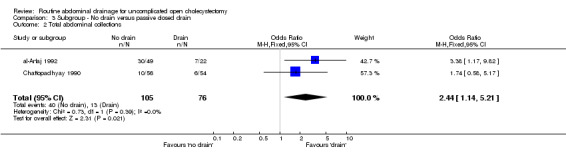
3.2. Analysis
Comparison 3 Subgroup ‐ No drain versus passive closed drain, Outcome 2 Total abdominal collections.
3.3
3.3. Analysis
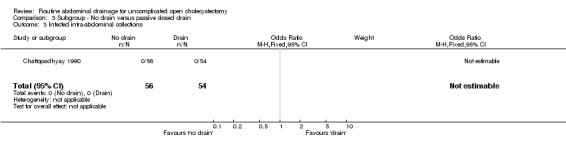
Comparison 3 Subgroup ‐ No drain versus passive closed drain, Outcome 3 Infected intra‐abdominal collections.
3.4
3.4. Analysis
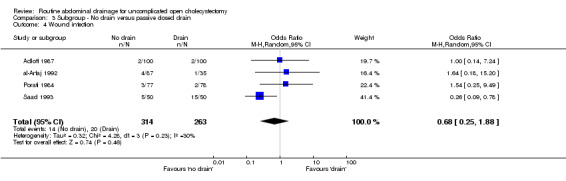
Comparison 3 Subgroup ‐ No drain versus passive closed drain, Outcome 4 Wound infection.
3.5
3.5. Analysis
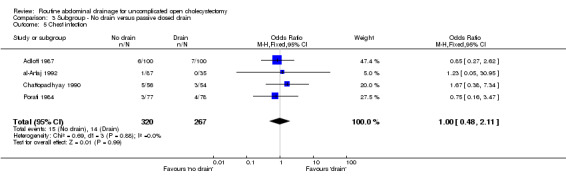
Comparison 3 Subgroup ‐ No drain versus passive closed drain, Outcome 5 Chest infection.
3.6
3.6. Analysis
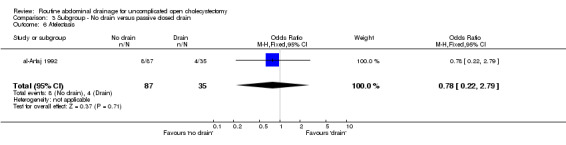
Comparison 3 Subgroup ‐ No drain versus passive closed drain, Outcome 6 Atelectasis.
3.7
3.7. Analysis
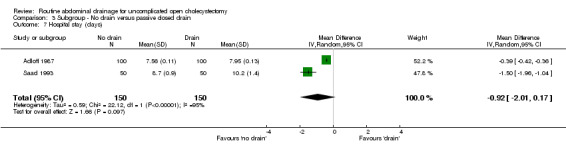
Comparison 3 Subgroup ‐ No drain versus passive closed drain, Outcome 7 Hospital stay (days).
4.1
4.1. Analysis
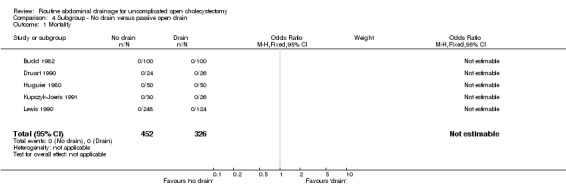
Comparison 4 Subgroup ‐ No drain versus passive open drain, Outcome 1 Mortality.
4.2
4.2. Analysis
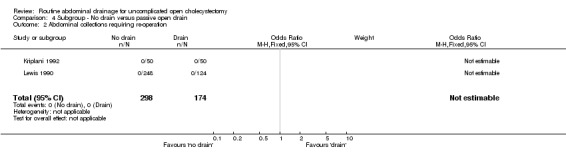
Comparison 4 Subgroup ‐ No drain versus passive open drain, Outcome 2 Abdominal collections requiring re‐operation.
4.3
4.3. Analysis
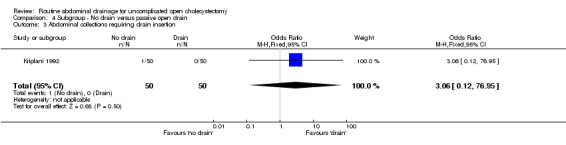
Comparison 4 Subgroup ‐ No drain versus passive open drain, Outcome 3 Abdominal collections requiring drain insertion.
4.4
4.4. Analysis
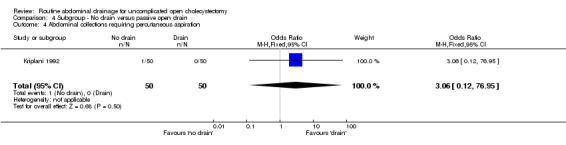
Comparison 4 Subgroup ‐ No drain versus passive open drain, Outcome 4 Abdominal collections requiring percutaneous aspiration.
4.5
4.5. Analysis
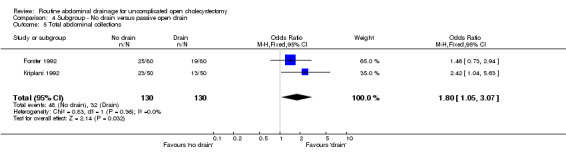
Comparison 4 Subgroup ‐ No drain versus passive open drain, Outcome 5 Total abdominal collections.
4.6
4.6. Analysis
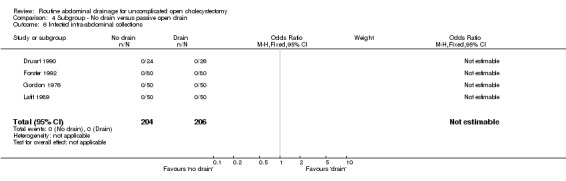
Comparison 4 Subgroup ‐ No drain versus passive open drain, Outcome 6 Infected intra‐abdominal collections.
4.7
4.7. Analysis
Comparison 4 Subgroup ‐ No drain versus passive open drain, Outcome 7 Bile peritonitis.
4.8
4.8. Analysis
Comparison 4 Subgroup ‐ No drain versus passive open drain, Outcome 8 Wound infection.
4.9
4.9. Analysis
Comparison 4 Subgroup ‐ No drain versus passive open drain, Outcome 9 Chest infection.
4.10
4.10. Analysis
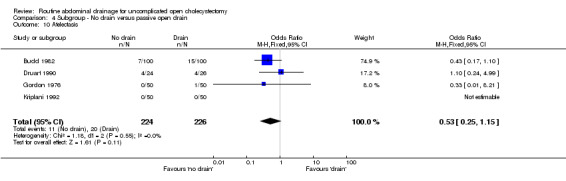
Comparison 4 Subgroup ‐ No drain versus passive open drain, Outcome 10 Atelectasis.
4.11
4.11. Analysis
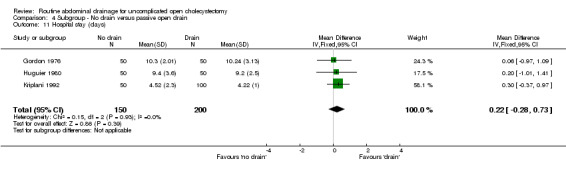
Comparison 4 Subgroup ‐ No drain versus passive open drain, Outcome 11 Hospital stay (days).
5.1
5.1. Analysis
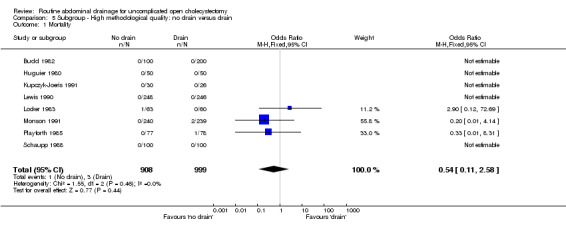
Comparison 5 Subgroup ‐ High methodological quality: no drain versus drain, Outcome 1 Mortality.
5.2
5.2. Analysis
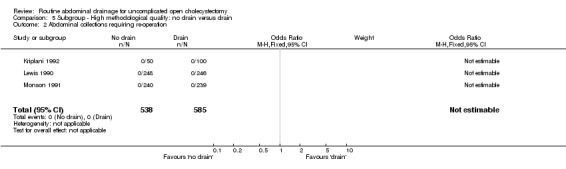
Comparison 5 Subgroup ‐ High methodological quality: no drain versus drain, Outcome 2 Abdominal collections requiring re‐operation.
5.3
5.3. Analysis
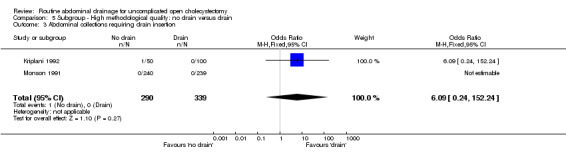
Comparison 5 Subgroup ‐ High methodological quality: no drain versus drain, Outcome 3 Abdominal collections requiring drain insertion.
5.4
5.4. Analysis
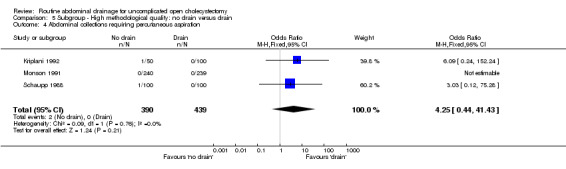
Comparison 5 Subgroup ‐ High methodological quality: no drain versus drain, Outcome 4 Abdominal collections requiring percutaneous aspiration.
5.5
5.5. Analysis
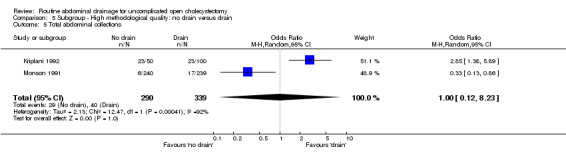
Comparison 5 Subgroup ‐ High methodological quality: no drain versus drain, Outcome 5 Total abdominal collections.
5.6
5.6. Analysis
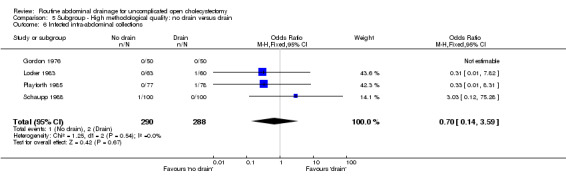
Comparison 5 Subgroup ‐ High methodological quality: no drain versus drain, Outcome 6 Infected intra‐abdominal collections.
5.7
5.7. Analysis
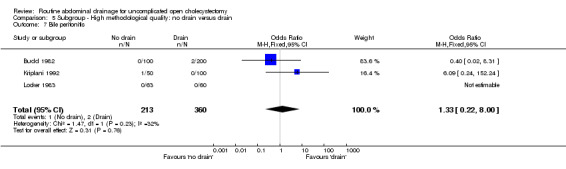
Comparison 5 Subgroup ‐ High methodological quality: no drain versus drain, Outcome 7 Bile peritonitis.
5.8
5.8. Analysis
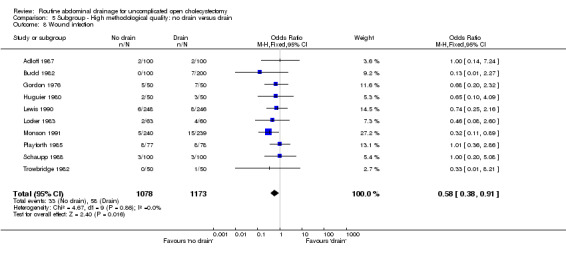
Comparison 5 Subgroup ‐ High methodological quality: no drain versus drain, Outcome 8 Wound infection.
5.9
5.9. Analysis
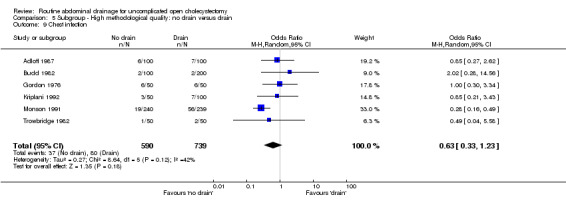
Comparison 5 Subgroup ‐ High methodological quality: no drain versus drain, Outcome 9 Chest infection.
5.10
5.10. Analysis
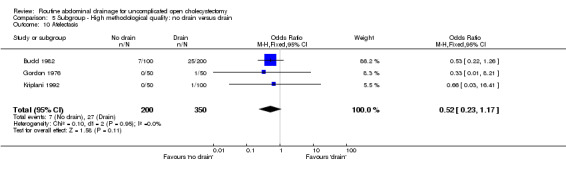
Comparison 5 Subgroup ‐ High methodological quality: no drain versus drain, Outcome 10 Atelectasis.
5.11
5.11. Analysis
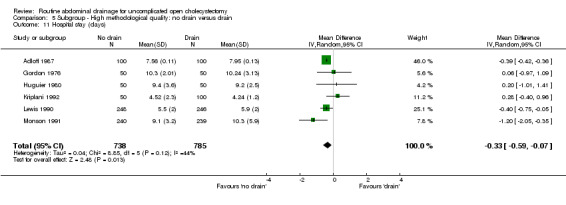
Comparison 5 Subgroup ‐ High methodological quality: no drain versus drain, Outcome 11 Hospital stay (days).
6.1
6.1. Analysis
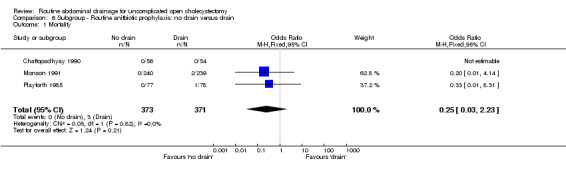
Comparison 6 Subgroup ‐ Routine anitbiotic prophylaxis: no drain versus drain, Outcome 1 Mortality.
6.2
6.2. Analysis
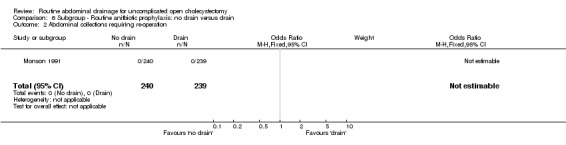
Comparison 6 Subgroup ‐ Routine anitbiotic prophylaxis: no drain versus drain, Outcome 2 Abdominal collections requiring re‐operation.
6.3
6.3. Analysis
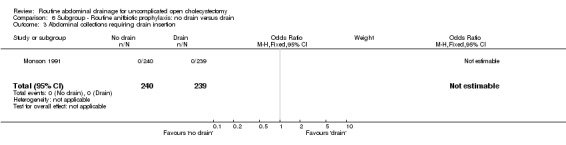
Comparison 6 Subgroup ‐ Routine anitbiotic prophylaxis: no drain versus drain, Outcome 3 Abdominal collections requiring drain insertion.
6.4
6.4. Analysis
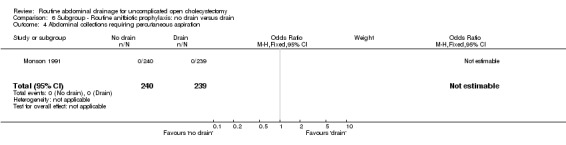
Comparison 6 Subgroup ‐ Routine anitbiotic prophylaxis: no drain versus drain, Outcome 4 Abdominal collections requiring percutaneous aspiration.
6.5
6.5. Analysis
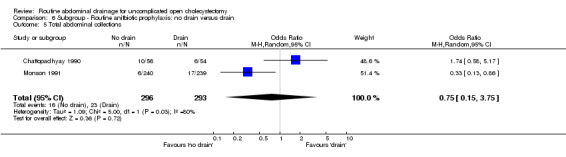
Comparison 6 Subgroup ‐ Routine anitbiotic prophylaxis: no drain versus drain, Outcome 5 Total abdominal collections.
6.6
6.6. Analysis
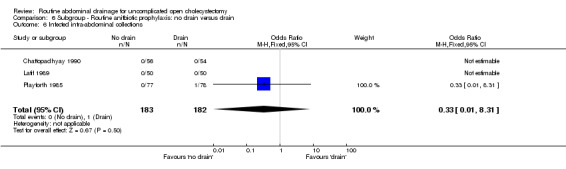
Comparison 6 Subgroup ‐ Routine anitbiotic prophylaxis: no drain versus drain, Outcome 6 Infected intra‐abdominal collections.
6.7
6.7. Analysis
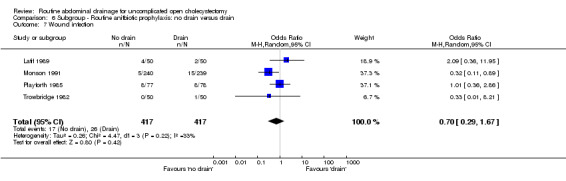
Comparison 6 Subgroup ‐ Routine anitbiotic prophylaxis: no drain versus drain, Outcome 7 Wound infection.
6.8
6.8. Analysis
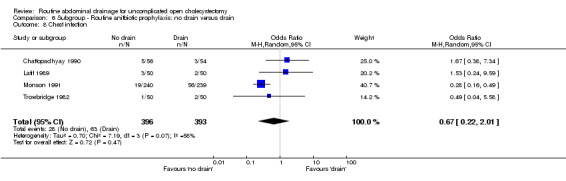
Comparison 6 Subgroup ‐ Routine anitbiotic prophylaxis: no drain versus drain, Outcome 8 Chest infection.
6.9
6.9. Analysis
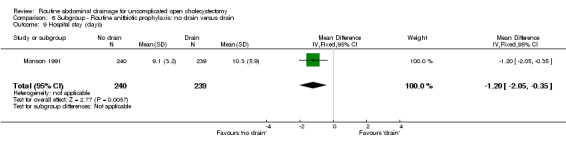
Comparison 6 Subgroup ‐ Routine anitbiotic prophylaxis: no drain versus drain, Outcome 9 Hospital stay (days).
7.1
7.1. Analysis
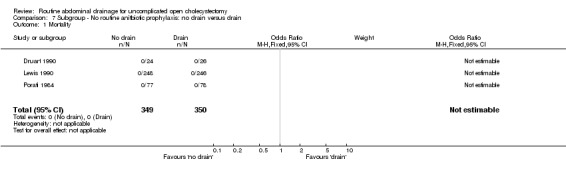
Comparison 7 Subgroup ‐ No routine anitbiotic prophylaxis: no drain versus drain, Outcome 1 Mortality.
7.2
7.2. Analysis
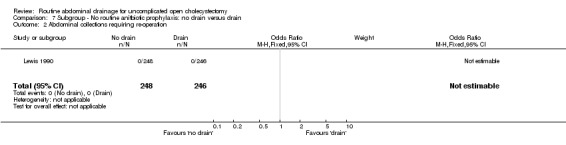
Comparison 7 Subgroup ‐ No routine anitbiotic prophylaxis: no drain versus drain, Outcome 2 Abdominal collections requiring re‐operation.
7.3
7.3. Analysis
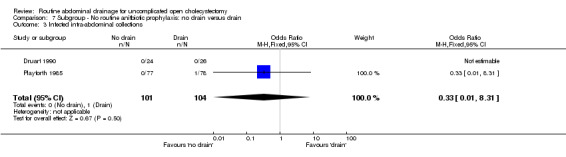
Comparison 7 Subgroup ‐ No routine anitbiotic prophylaxis: no drain versus drain, Outcome 3 Infected intra‐abdominal collections.
7.4
7.4. Analysis
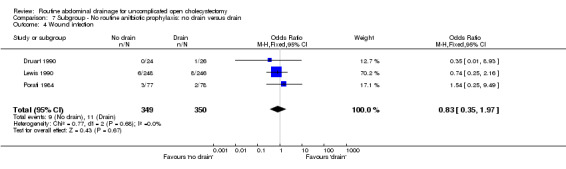
Comparison 7 Subgroup ‐ No routine anitbiotic prophylaxis: no drain versus drain, Outcome 4 Wound infection.
7.5
7.5. Analysis
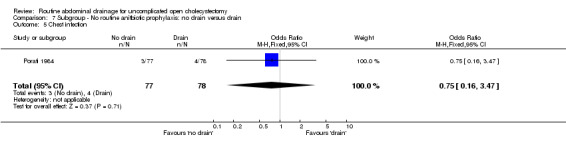
Comparison 7 Subgroup ‐ No routine anitbiotic prophylaxis: no drain versus drain, Outcome 5 Chest infection.
7.6
7.6. Analysis
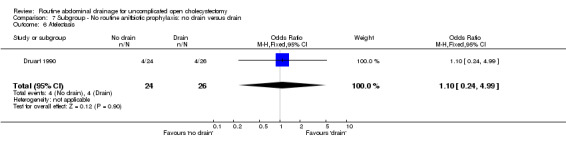
Comparison 7 Subgroup ‐ No routine anitbiotic prophylaxis: no drain versus drain, Outcome 6 Atelectasis.
7.7
7.7. Analysis
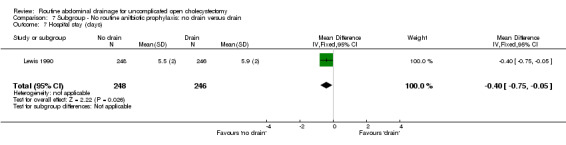
Comparison 7 Subgroup ‐ No routine anitbiotic prophylaxis: no drain versus drain, Outcome 7 Hospital stay (days).
8.1
8.1. Analysis
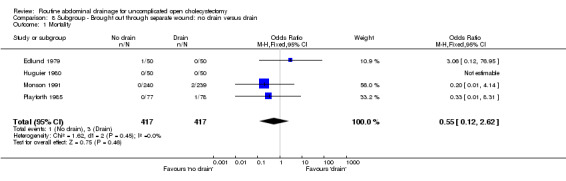
Comparison 8 Subgroup ‐ Brought out through separate wound: no drain versus drain, Outcome 1 Mortality.
8.2
8.2. Analysis
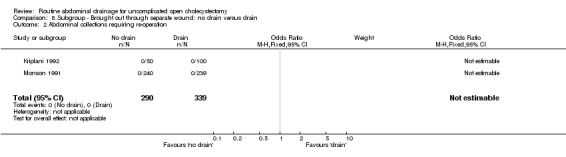
Comparison 8 Subgroup ‐ Brought out through separate wound: no drain versus drain, Outcome 2 Abdominal collections requiring re‐operation.
8.3
8.3. Analysis
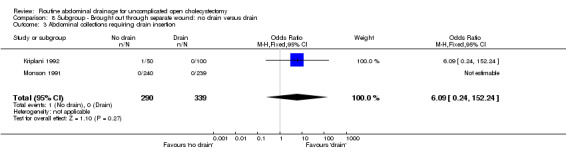
Comparison 8 Subgroup ‐ Brought out through separate wound: no drain versus drain, Outcome 3 Abdominal collections requiring drain insertion.
8.4
8.4. Analysis
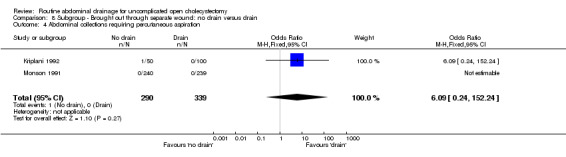
Comparison 8 Subgroup ‐ Brought out through separate wound: no drain versus drain, Outcome 4 Abdominal collections requiring percutaneous aspiration.
8.5
8.5. Analysis
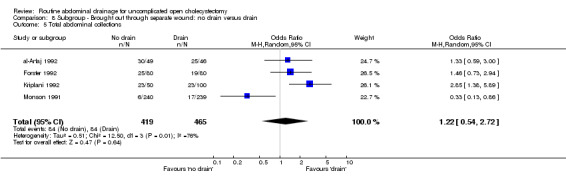
Comparison 8 Subgroup ‐ Brought out through separate wound: no drain versus drain, Outcome 5 Total abdominal collections.
8.6
8.6. Analysis
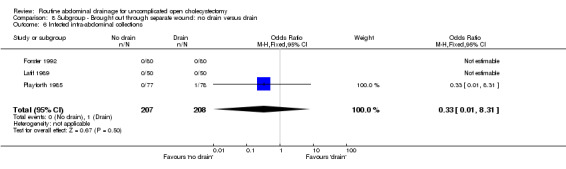
Comparison 8 Subgroup ‐ Brought out through separate wound: no drain versus drain, Outcome 6 Infected intra‐abdominal collections.
8.7
8.7. Analysis
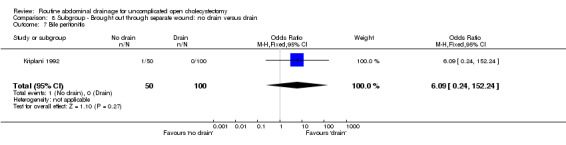
Comparison 8 Subgroup ‐ Brought out through separate wound: no drain versus drain, Outcome 7 Bile peritonitis.
8.8
8.8. Analysis
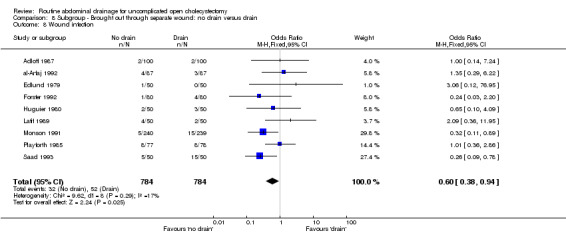
Comparison 8 Subgroup ‐ Brought out through separate wound: no drain versus drain, Outcome 8 Wound infection.
8.9
8.9. Analysis
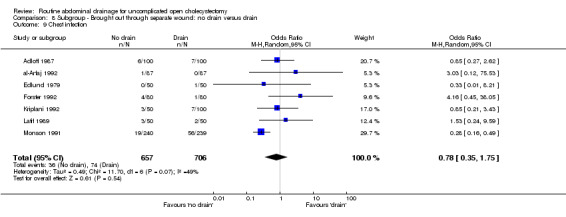
Comparison 8 Subgroup ‐ Brought out through separate wound: no drain versus drain, Outcome 9 Chest infection.
8.10
8.10. Analysis
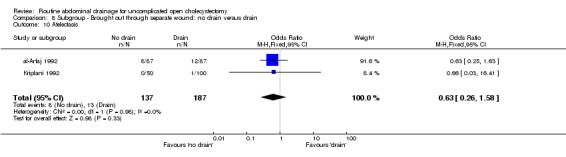
Comparison 8 Subgroup ‐ Brought out through separate wound: no drain versus drain, Outcome 10 Atelectasis.
8.11
8.11. Analysis
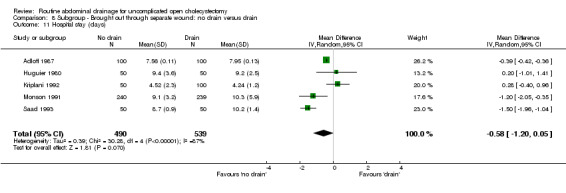
Comparison 8 Subgroup ‐ Brought out through separate wound: no drain versus drain, Outcome 11 Hospital stay (days).
9.1
9.1. Analysis
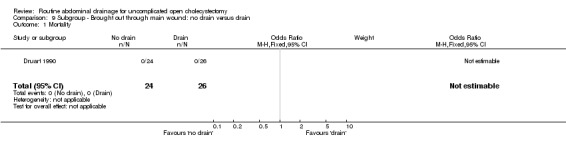
Comparison 9 Subgroup ‐ Brought out through main wound: no drain versus drain, Outcome 1 Mortality.
9.2
9.2. Analysis
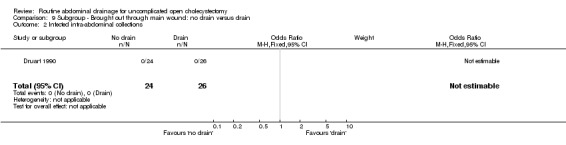
Comparison 9 Subgroup ‐ Brought out through main wound: no drain versus drain, Outcome 2 Infected intra‐abdominal collections.
9.3
9.3. Analysis
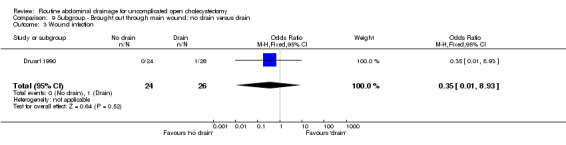
Comparison 9 Subgroup ‐ Brought out through main wound: no drain versus drain, Outcome 3 Wound infection.
9.4
9.4. Analysis
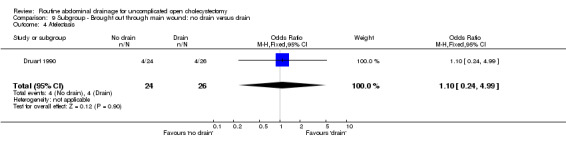
Comparison 9 Subgroup ‐ Brought out through main wound: no drain versus drain, Outcome 4 Atelectasis.
10.1
10.1. Analysis
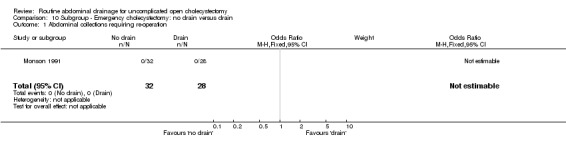
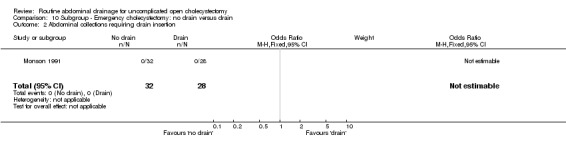
Comparison 10 Subgroup ‐ Emergency cholecystectomy: no drain versus drain, Outcome 1 Abdominal collections requiring re‐operation.
10.2
10.2. Analysis
Comparison 10 Subgroup ‐ Emergency cholecystectomy: no drain versus drain, Outcome 2 Abdominal collections requiring drain insertion.
10.3
10.3. Analysis
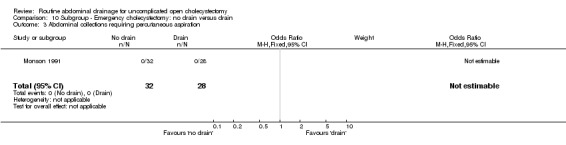
Comparison 10 Subgroup ‐ Emergency cholecystectomy: no drain versus drain, Outcome 3 Abdominal collections requiring percutaneous aspiration.
10.4
10.4. Analysis
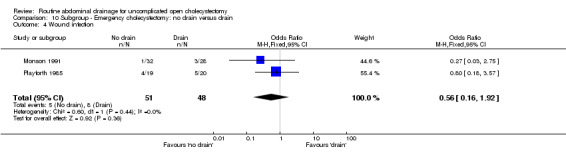
Comparison 10 Subgroup ‐ Emergency cholecystectomy: no drain versus drain, Outcome 4 Wound infection.
10.5
10.5. Analysis
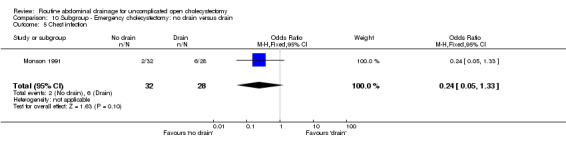
Comparison 10 Subgroup ‐ Emergency cholecystectomy: no drain versus drain, Outcome 5 Chest infection.
11.1
11.1. Analysis
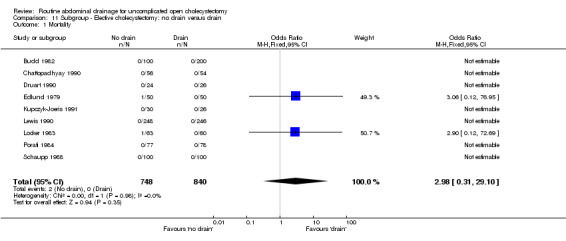
Comparison 11 Subgroup ‐ Elective cholecystectomy: no drain versus drain, Outcome 1 Mortality.
11.2
11.2. Analysis
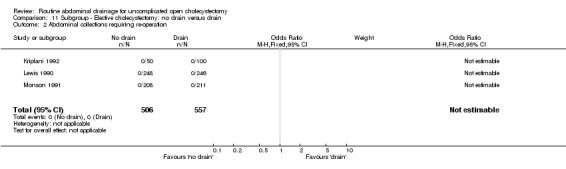
Comparison 11 Subgroup ‐ Elective cholecystectomy: no drain versus drain, Outcome 2 Abdominal collections requiring re‐operation.
11.3
11.3. Analysis
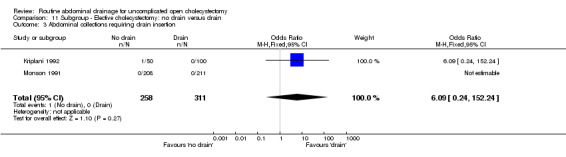
Comparison 11 Subgroup ‐ Elective cholecystectomy: no drain versus drain, Outcome 3 Abdominal collections requiring drain insertion.
11.4
11.4. Analysis
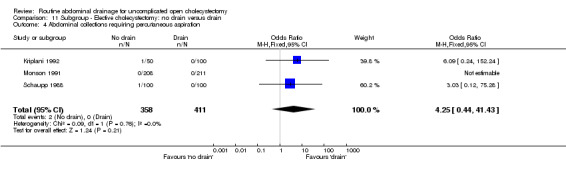
Comparison 11 Subgroup ‐ Elective cholecystectomy: no drain versus drain, Outcome 4 Abdominal collections requiring percutaneous aspiration.
11.5
11.5. Analysis
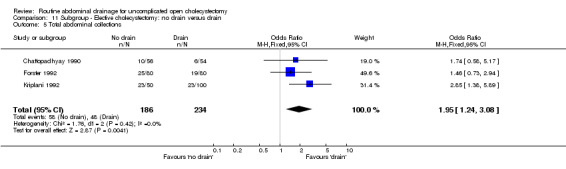
Comparison 11 Subgroup ‐ Elective cholecystectomy: no drain versus drain, Outcome 5 Total abdominal collections.
11.6
11.6. Analysis
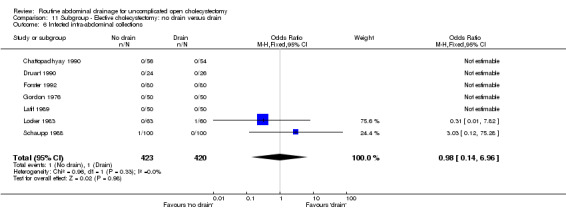
Comparison 11 Subgroup ‐ Elective cholecystectomy: no drain versus drain, Outcome 6 Infected intra‐abdominal collections.
11.7
11.7. Analysis
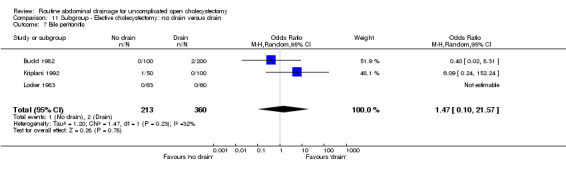
Comparison 11 Subgroup ‐ Elective cholecystectomy: no drain versus drain, Outcome 7 Bile peritonitis.
11.8
11.8. Analysis
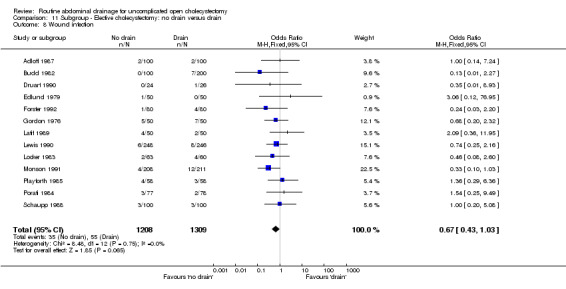
Comparison 11 Subgroup ‐ Elective cholecystectomy: no drain versus drain, Outcome 8 Wound infection.
11.9
11.9. Analysis
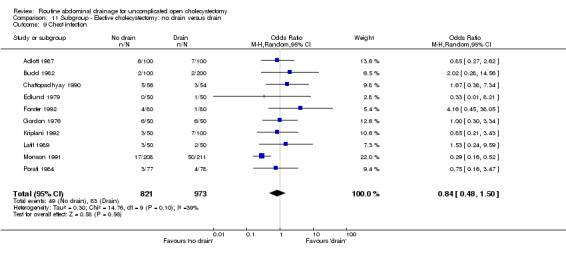
Comparison 11 Subgroup ‐ Elective cholecystectomy: no drain versus drain, Outcome 9 Chest infection.
11.10
11.10. Analysis
Comparison 11 Subgroup ‐ Elective cholecystectomy: no drain versus drain, Outcome 10 Atelectasis.
11.11
11.11. Analysis
Comparison 11 Subgroup ‐ Elective cholecystectomy: no drain versus drain, Outcome 11 Hospital stay (days).
12.1
12.1. Analysis
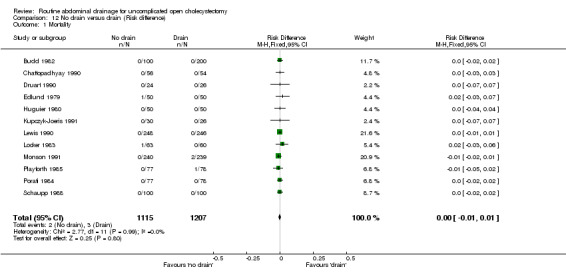
Comparison 12 No drain versus drain (Risk difference), Outcome 1 Mortality.
12.2
12.2. Analysis
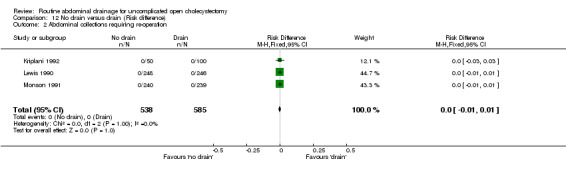
Comparison 12 No drain versus drain (Risk difference), Outcome 2 Abdominal collections requiring re‐operation.
12.3
12.3. Analysis
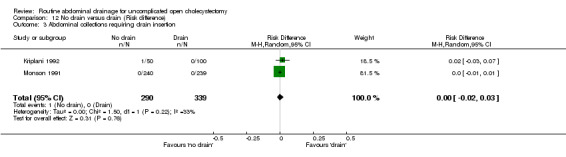
Comparison 12 No drain versus drain (Risk difference), Outcome 3 Abdominal collections requiring drain insertion.
12.4
12.4. Analysis
Comparison 12 No drain versus drain (Risk difference), Outcome 4 Abdominal collections requiring percutaneous aspiration.
12.5
12.5. Analysis
Comparison 12 No drain versus drain (Risk difference), Outcome 5 Total abdominal collections.
12.6
12.6. Analysis
Comparison 12 No drain versus drain (Risk difference), Outcome 6 Infected intra‐abdominal collections.
12.7
12.7. Analysis
Comparison 12 No drain versus drain (Risk difference), Outcome 7 Bile peritonitis.
12.8
12.8. Analysis
Comparison 12 No drain versus drain (Risk difference), Outcome 8 Wound infection.
12.9
12.9. Analysis
Comparison 12 No drain versus drain (Risk difference), Outcome 9 Chest infection.
12.10
12.10. Analysis
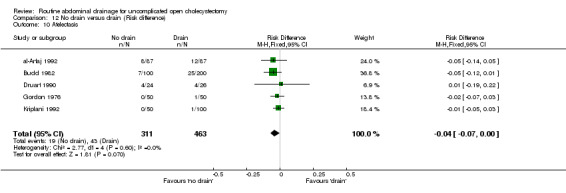
Comparison 12 No drain versus drain (Risk difference), Outcome 10 Atelectasis.
13.1
13.1. Analysis
Comparison 13 Suction drain versus passive closed drain, Outcome 1 Mortality.
13.2
13.2. Analysis
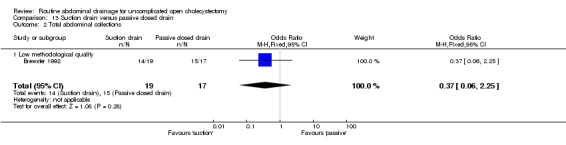
Comparison 13 Suction drain versus passive closed drain, Outcome 2 Total abdominal collections.
13.3
13.3. Analysis
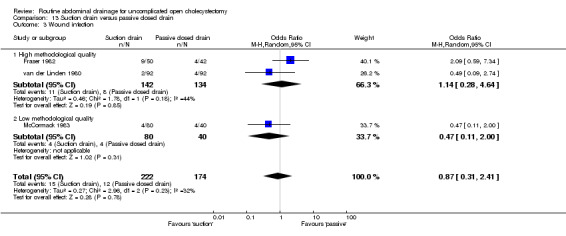
Comparison 13 Suction drain versus passive closed drain, Outcome 3 Wound infection.
13.4
13.4. Analysis
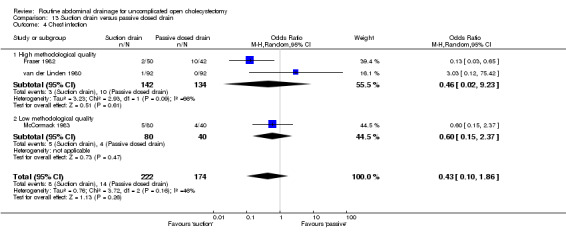
Comparison 13 Suction drain versus passive closed drain, Outcome 4 Chest infection.
13.5
13.5. Analysis
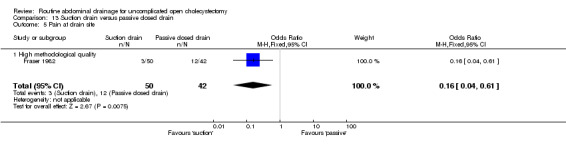
Comparison 13 Suction drain versus passive closed drain, Outcome 5 Pain at drain site.
14.1
14.1. Analysis
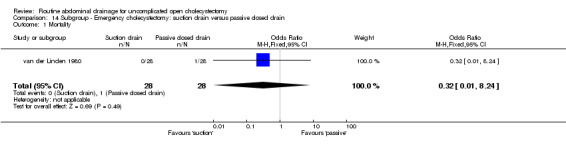
Comparison 14 Subgroup ‐ Emergency cholecystectomy: suction drain versus passive closed drain, Outcome 1 Mortality.
15.1
15.1. Analysis
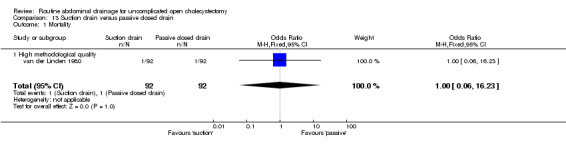
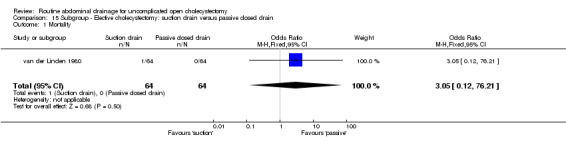
Comparison 15 Subgroup ‐ Elective cholecystectomy: suction drain versus passive closed drain, Outcome 1 Mortality.
15.2
15.2. Analysis
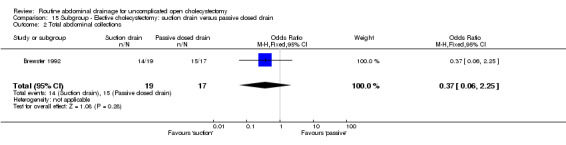
Comparison 15 Subgroup ‐ Elective cholecystectomy: suction drain versus passive closed drain, Outcome 2 Total abdominal collections.
15.3
15.3. Analysis
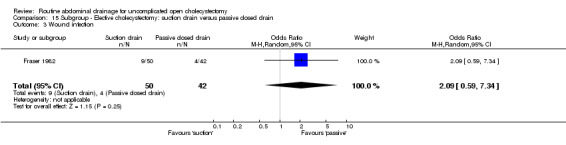
Comparison 15 Subgroup ‐ Elective cholecystectomy: suction drain versus passive closed drain, Outcome 3 Wound infection.
15.4
15.4. Analysis
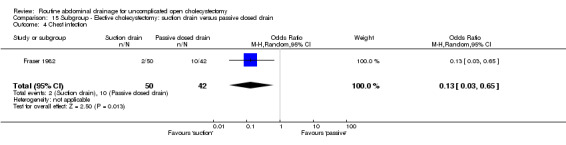
Comparison 15 Subgroup ‐ Elective cholecystectomy: suction drain versus passive closed drain, Outcome 4 Chest infection.
15.5
15.5. Analysis
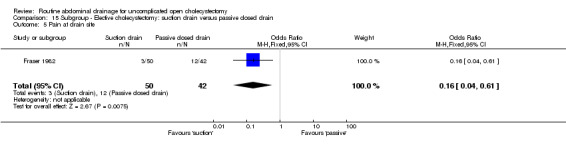
Comparison 15 Subgroup ‐ Elective cholecystectomy: suction drain versus passive closed drain, Outcome 5 Pain at drain site.
16.1
16.1. Analysis
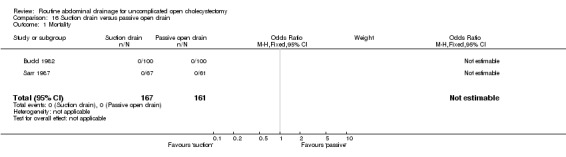
Comparison 16 Suction drain versus passive open drain, Outcome 1 Mortality.
16.2
16.2. Analysis
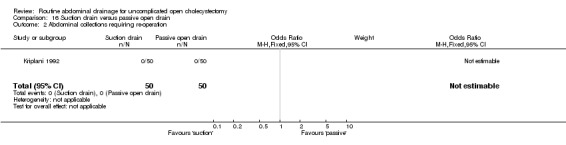
Comparison 16 Suction drain versus passive open drain, Outcome 2 Abdominal collections requiring re‐operation.
16.3
16.3. Analysis
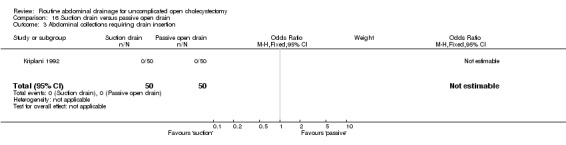
Comparison 16 Suction drain versus passive open drain, Outcome 3 Abdominal collections requiring drain insertion.
16.4
16.4. Analysis
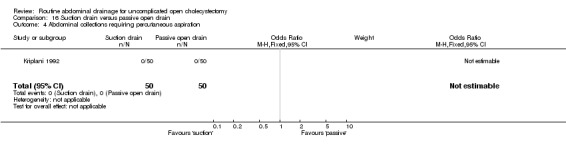
Comparison 16 Suction drain versus passive open drain, Outcome 4 Abdominal collections requiring percutaneous aspiration.
16.5
16.5. Analysis
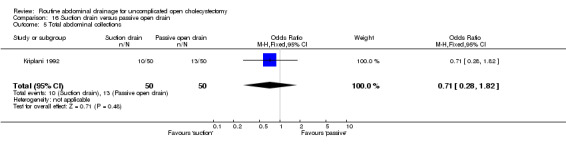
Comparison 16 Suction drain versus passive open drain, Outcome 5 Total abdominal collections.
16.6
16.6. Analysis
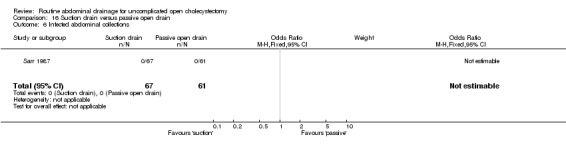
Comparison 16 Suction drain versus passive open drain, Outcome 6 Infected abdominal collections.
16.7
16.7. Analysis
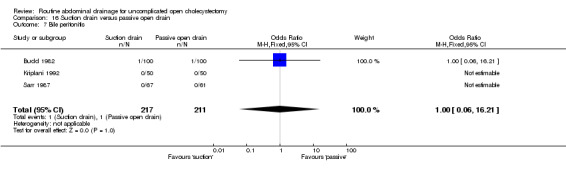
Comparison 16 Suction drain versus passive open drain, Outcome 7 Bile peritonitis.
16.8
16.8. Analysis
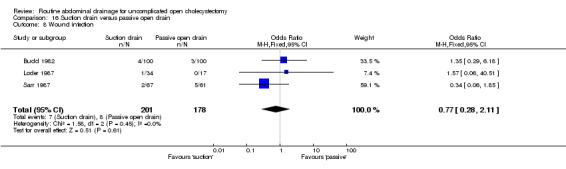
Comparison 16 Suction drain versus passive open drain, Outcome 8 Wound infection.
16.9
16.9. Analysis
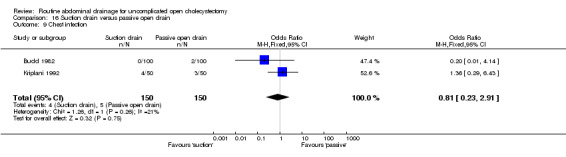
Comparison 16 Suction drain versus passive open drain, Outcome 9 Chest infection.
16.10
16.10. Analysis
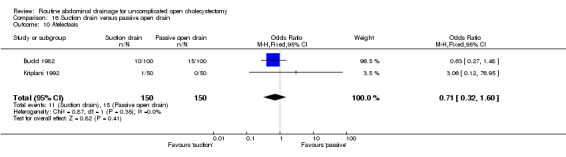
Comparison 16 Suction drain versus passive open drain, Outcome 10 Atelectasis.
16.11
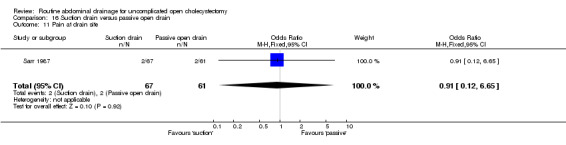
16.11. Analysis
Comparison 16 Suction drain versus passive open drain, Outcome 11 Pain at drain site.
16.12
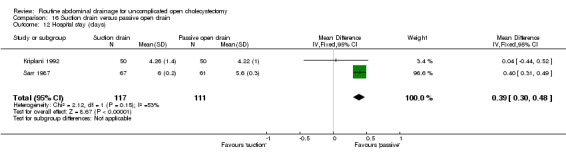
16.12. Analysis
Comparison 16 Suction drain versus passive open drain, Outcome 12 Hospital stay (days).
17.1
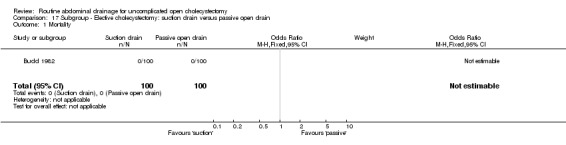
17.1. Analysis
Comparison 17 Subgroup ‐ Elective cholecystectomy: suction drain versus passive open drain, Outcome 1 Mortality.
17.2
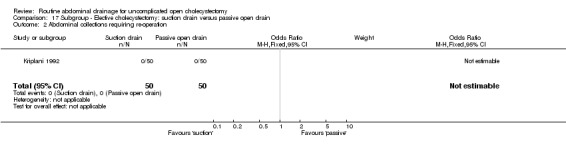
17.2. Analysis
Comparison 17 Subgroup ‐ Elective cholecystectomy: suction drain versus passive open drain, Outcome 2 Abdominal collections requiring re‐operation.
17.3
17.3. Analysis
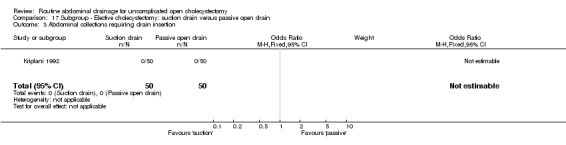
Comparison 17 Subgroup ‐ Elective cholecystectomy: suction drain versus passive open drain, Outcome 3 Abdominal collections requiring drain insertion.
17.4
17.4. Analysis
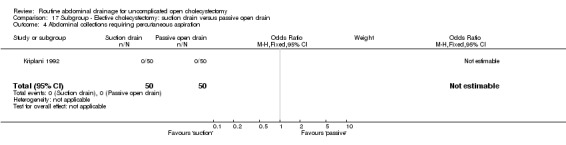
Comparison 17 Subgroup ‐ Elective cholecystectomy: suction drain versus passive open drain, Outcome 4 Abdominal collections requiring percutaneous aspiration.
17.5
17.5. Analysis
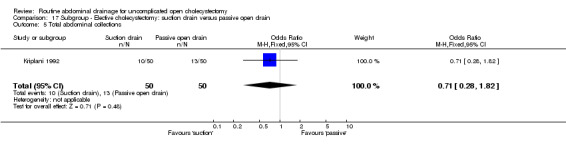
Comparison 17 Subgroup ‐ Elective cholecystectomy: suction drain versus passive open drain, Outcome 5 Total abdominal collections.
17.6
17.6. Analysis
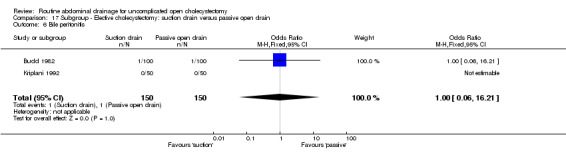
Comparison 17 Subgroup ‐ Elective cholecystectomy: suction drain versus passive open drain, Outcome 6 Bile peritonitis.
17.7
17.7. Analysis
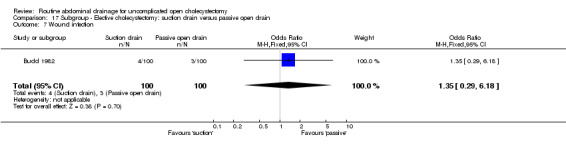
Comparison 17 Subgroup ‐ Elective cholecystectomy: suction drain versus passive open drain, Outcome 7 Wound infection.
17.8
17.8. Analysis
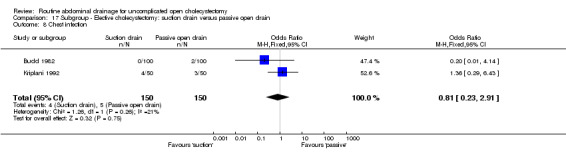
Comparison 17 Subgroup ‐ Elective cholecystectomy: suction drain versus passive open drain, Outcome 8 Chest infection.
17.9
17.9. Analysis
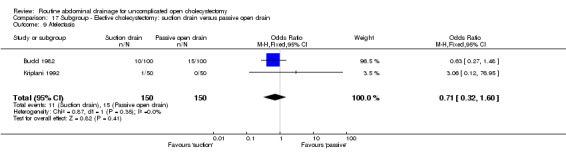
Comparison 17 Subgroup ‐ Elective cholecystectomy: suction drain versus passive open drain, Outcome 9 Atelectasis.
17.10
17.10. Analysis
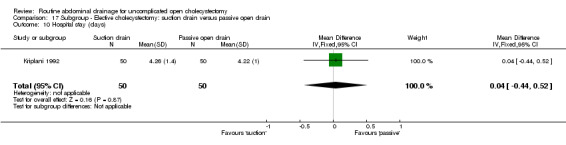
Comparison 17 Subgroup ‐ Elective cholecystectomy: suction drain versus passive open drain, Outcome 10 Hospital stay (days).
18.1
18.1. Analysis
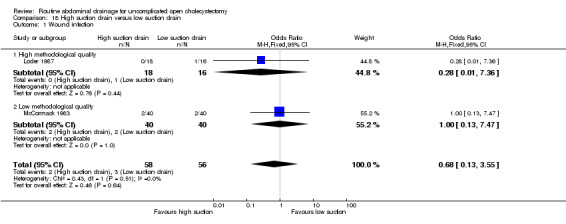
Comparison 18 High suction drain versus low suction drain, Outcome 1 Wound infection.
18.2
18.2. Analysis
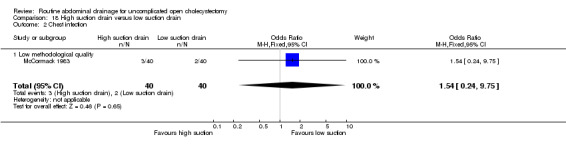
Comparison 18 High suction drain versus low suction drain, Outcome 2 Chest infection.
19.1
19.1. Analysis
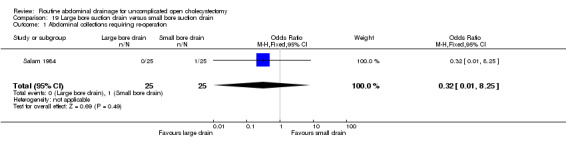
Comparison 19 Large bore suction drain versus small bore suction drain, Outcome 1 Abdominal collections requiring re‐operation.
19.2
19.2. Analysis
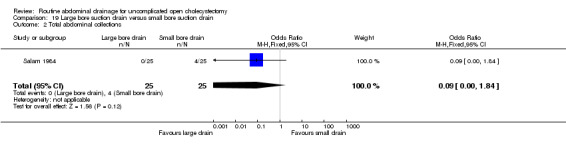
Comparison 19 Large bore suction drain versus small bore suction drain, Outcome 2 Total abdominal collections.
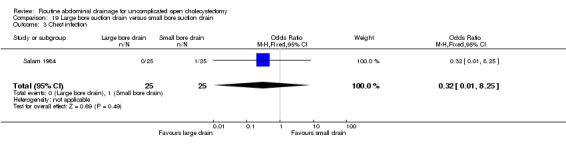
19.3
19.3. Analysis
Comparison 19 Large bore suction drain versus small bore suction drain, Outcome 3 Chest infection.
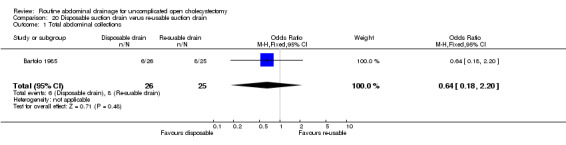
20.1
20.1. Analysis
Comparison 20 Disposable suction drain verus re‐usable suction drain, Outcome 1 Total abdominal collections.
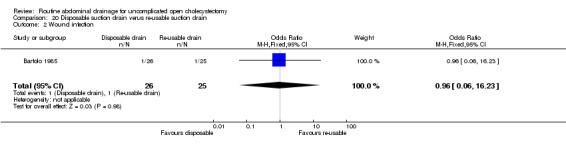
20.2
20.2. Analysis
Comparison 20 Disposable suction drain verus re‐usable suction drain, Outcome 2 Wound infection.

Update of

References

References to studies included in this review

Adloff 1987 {published data only}
    1. Adloff M, Arnaud JP, Ollier JC. Cholecystectomy with or without prophylactic drainage. Randomised prospective study of 200 cases. Medecine & Chirurgie Digestives 1987;16(1):9‐12.
al‐Arfaj 1992 {published data only}
    1. al‐Arfaj AL, Shahab K, al‐Ghassab G, al‐Breiki H, al‐Shawan S, Azab A. Drainage after cholecystectomy. A prospective randomized clinical trial. International Surgery 1992;77(4):274‐6. - PubMed
Bartolo 1985 {published data only}
    1. Bartolo DC, Andrews H, Virjee J, Leaper DJ. The new ReliaVac drain after cholecystectomy. A comparative clinical and ultrasonic trial. Journal of the Royal College of Surgeons of Edinburgh 1985;30(6):358‐9. - PubMed
Brewster 1992 {published data only}
    1. Brewster NT, King PM, Cunningham C, Adam RD, Griffiths JM. Passive tube and suction drainage after elective cholecystectomy ‐ a comparison using ultrasonography. Journal of the Royal College of Surgeons of Edinburgh 1992;37(5):325‐7. - PubMed
Budd 1982 {published data only}
    1. Budd DC, Cochran RC, Fouty WJ Jr. Cholecystectomy with and without drainage. A randomized, prospective study of 300 patients. American Journal of Surgery 1982;143(3):307‐9. - PubMed
Chattopadhyay 1990 {published data only}
    1. Chattopadhyay TK, Kapoor VK, Gupta S. Cholecystectomy with and without drainage. Indian Journal of Gastroenterology 1990;9(4):322‐3. - PubMed
Druart 1990 {published data only}
    1. Druart ML, Fetelian D, Engelman E, Limbosch JM. Elective cholecystectomy without drainage and without prophylactic antibiotics. A prospective randomized trial with clinical and bacteriological aspects. Acta Chirurgica Belgica 1990;90(3):79‐85. - PubMed
Edlund 1979 {published data only}
    1. Edlund G, Gedda S, Linden W. Intraperitoneal drains and nasogastric tubes in elective cholecystectomy. A controlled clinical trial. American Journal of Surgery 1979;137(6):775‐9. - PubMed
Forster 1992 {published data only}
    1. Forster R, Schnabel M, Krahl M, Lindlar R, Rothmund M. Routine drainage following uncomplicated, elective cholecystectomy? A prospective, randomized study. Der Chirurg 1992;63(7):558‐62. - PubMed
Fraser 1982 {published data only}
    1. Fraser I, Everson NW, Nash JR. A randomised prospective trial of two drainage methods after cholecystectomy. Annals of the Royal College of Surgeons of England 1982;64(3):183‐5. - PMC - PubMed
Gordon 1976 {published data only}
    1. Gordon AB, Bates T, Fiddian RV. A controlled trial of drainage after cholecystectomy. The British Journal of Surgery 1976;63(4):278‐82. - PubMed
Huguier 1980 {published data only}
    1. Huguier M. Drainage after cholecystectomy. A controlled trial. Annales de Chirurgie 1980;34(1):48‐50. - PubMed
Kriplani 1992 {published data only}
    1. Kriplani AK, Sawhney S, Kumar S, Kapur BM. Influence of intraperitoneal drainage after cholecystectomy; a prospective ultrasonographic study. Tropical Gastroenterology 1992;13(4):146‐51. - PubMed
Kupczyk‐Joeris 1991 {published data only}
    1. Kupczyk‐Joeris D, Schumpelick V, Toens C, Truong S, Goltz I. Elective cholecystectomy with and without subhepatic drainage. A controlled, prospective study. Zentralblatt fur Chirurgie 1991;116(20):1187‐93. - PubMed
Latif 1989 {published data only}
    1. Latif AA, Hussain SA, Choudhary A, Al‐Saigh A. Cholecystectomy without drainage: a controlled clinical trial. Annals of Saudi Medicine 1989;9(1):36‐8.
Lewis 1990 {published data only}
    1. Lewis RT, Allan CM, Goodall RG, Marien B, Park M, Lloyd‐Smith W, et al. The conduct of cholecystectomy: incision, drainage, bacteriology and postoperative complications. Canadian Journal of Surgery 1982;25(3):304‐7. - PubMed
    1. Lewis RT, Goodall RG, Marien B, Park M, Lloyd‐Smith W, Wiegand FM. Simple elective cholecystectomy: to drain or not. American Journal of Surgery 1990;159(2):241‐5. - PubMed
Locker 1983 {published data only}
    1. Locker D, Norwood SH, Torma MJ, Fontenelle LJ. A prospective randomized study of drained and undrained cholecystectomies. The American Surgeon 1983;49(10):528‐30. - PubMed
Loder 1987 {published data only}
    1. Loder PB, Smith GH, Morris S, Bambach CP, Smith RC. A randomised comparison of three drainage systems following cholecystectomy. The Australian and New Zealand Journal of Surgery 1987;57(8):531‐5. - PubMed
McCormack 1983 {published data only}
    1. McCormack TT, Abel PD, Collins CD. Abdominal drainage following cholecystectomy: high, low, or no suction?. Annals of the Royal College of Surgeons of England 1983;65(5):326‐8. - PMC - PubMed
Monson 1991 {published data only}
    1. Monson JR, Guillou PJ, Keane FB, Tanner WA, Brennan TG. Cholecystectomy is safer without drainage: the results of a prospective, randomized clinical trial. Surgery 1991;109(6):740‐6. - PubMed
    1. Monson JR, MacFie J, Irving H, Keane FB, Brennan TG, Tanner WA. Influence of intraperitoneal drains on subhepatic collections following cholecystectomy: a prospective clinical trial. The British Journal of Surgery 1986;73(12):993‐4. - PubMed
    1. Monson JRT, Irving H, Tanner AW, Macfie J, Brennan TG. Does drainage increase the risk of subhepatic collection following cholecystectomy? ‐ a prospective study. Gut 1985;26(10):A1158.
Playforth 1985 {published data only}
    1. Playforth MJ, Sauven P, Evans M, Pollock AV. Suction drainage of the gallbladder bed does not prevent complications after cholecystectomy: a random control clinical trial. The British Journal of Surgery 1985;72(4):269‐71. - PubMed
Porati 1984 {published data only}
    1. Porati M, Sina G, Monguzzi A, Ballabio R, Colombi I. [Cholecystectomy without drainage. Randomized clinical study]. Minerva Chirurgica 1984;39(15‐16):1081‐6. - PubMed
Saad 1993 {published data only}
    1. Saad AM, Hassan AM. Cholecystectomy with and without drainage: a prospective randomised study. East African Medical Journal 1993;70(8):499‐501. - PubMed
Salam 1984 {published data only}
    1. Salam IM, McMullin JP, O'Higgins NJ. A comparison of two types of vacuum drainage after cholecystectomy. Annals of the Royal College of Surgeons of England 1984;66(3):190‐1. - PMC - PubMed
Sarr 1987 {published data only}
    1. Sarr MG, Parikh KJ, Minken SL, Zuidema GD, Cameron JL. Closed‐suction versus Penrose drainage after cholecystectomy. A prospective, randomized evaluation. The American Journal of Surgery 1987;153(4):394‐8. - PubMed
Schaupp 1988 {published data only}
    1. Schaupp W, Menges HW, Schworm HD. The "ideal" cholecystectomy. A prospective, randomized study. Der Chirurg 1988;59(10):661‐4. - PubMed
Trowbridge 1982 {published data only}
    1. Trowbridge PE. A randomized study of cholecystectomy with and without drainage. Surgery, Gynecology & Obstetrics 1982;155(2):171‐6. - PubMed
van der Linden 1980 {published data only}
    1. Linden W, Gedda S, Edlund G. Randomized trial of drainage after cholecystectomy. Suction versus static drainage through a main wound versus a stab incision. American Journal of Surgery 1980;141(2):289‐94. - PubMed

References to studies excluded from this review

Diez 1990 {published data only}
    1. Diez JA, Pujato MR, Ferreres AR. The need of drainage after cholecystectomy. HPB Surgery: a World Journal of Hepatic, Pancreatic and Biliary Surgery 1990;3(1):5‐10. - PMC - PubMed
Farha 1981 {published data only}
    1. Farha GJ, Chang FC, Matthews EH. Drainage in elective cholecystectomy. American Journal of Surgery 1981;142(6):678‐80. - PubMed
Gupta 1978 {published data only}
    1. Gupta S, Rauscher G, Stillman R, Fitzerald J, Powers J. The rational use of drains after cholecystectomy. Surgery, Gynecology & Obstetrics 1978;146(2):191‐2. - PubMed
Hanna 1970 {published data only}
    1. Hanna E. Efficiency of peritoneal drainage. Surgery, Gynecology & Obstetrics 1970;131(5):983‐5. - PubMed
Irwin 1988 {published data only}
    1. Irwin ST, Moorehead RJ, Parks TG. Effect of drainage on subhepatic collections and respiratory function after elective cholecystectomy. The British Journal of Surgery 1988;75(5):476. - PubMed
Jha 1986 {published data only}
    1. Jha IN, Singh HB, Prasad N. Clinical trial of drainage following cholecystectomy: suction versus static drainage. Journal of the Indian Medical Association 1986;84(11):341‐2. - PubMed
Kapoor 1993 {published data only}
    1. Kapoor VK, Ibrarullah M, Baijal SS, Kulshreshtha A, Mittal BR, Saxena R, et al. Cholecystectomy and drainage: ultrasonographic and radioisotopic evaluation. World Journal of Surgery 1993;17(1):101‐4. - PubMed
Maull 1978 {published data only}
    1. Maull KI, Daugherty ME, Shearer GR, Sachatello CR, Ernst CB, Meeker WR, et al. Cholecystectomy: to drain or not to drain. A randomized prospective study of 200 patients. The Journal of Surgical Research 1978;24(4):259‐63. - PubMed
Maull 1981 {published data only}
    1. Maull KI, Shirazi KK, Whitley RE, Halloran LG, Gayle WE, Haynes BW. The effect of prophylactic drainage on sub‐hepatic fluid collections after elective cholecystectomy ‐ a prospective randomized ultrasonographic study. American Surgeon 1981;47(2):85‐8. - PubMed
Peer 1993 {published data only}
    1. Peer GQ, Wani NA. Role of intraperitoneal drains on subhepatic collection following routine uncomplicated cholecystectomy. Journal of the Indian Medical Association 1993;91(7):175‐6. - PubMed
Ragoonanan 1983 {published data only}
    1. Ragoonanan C, Crosby DL, Morgan WP, Rees BI. Peritoneal drainage following cholecystectomy: a controlled trial. Annals of the Royal College of Surgeons of England 1983;65(6):403. - PMC - PubMed
Rivas 1980 {published data only}
    1. Rivas A, Holliday H, Wright J. Cholecystectomy with closed suction drainage. Southern Medical Journal 1980;73(2):161‐2. - PubMed
Salam 1994 {published data only}
    1. Salam IM. Passive tube and suction drainage after elective cholecystectomy: a comparison using ultrasonography. Journal of the Royal College of Surgeons of Edinburgh 1994;39(2):134‐5. - PubMed
Salles 1992 {published data only}
    1. Salles RA, Santos Jr AP, Freitas RG, Silva ML, Coelho CA. Cholecystectomy with or without drainage. Revista do Colegio Brasileiro de Cirurgioes 1992;19(6):269‐71.
Shirazi 1982 {published data only}
    1. Shirazi KK, Maull KI. Subhepatic sonography following cholecystectomy. Journal of Ultrasound in Medicine 1982;1(7):271‐3. - PubMed
Stone 1978 {published data only}
    1. Stone HH, Hooper CA, Millikan WJ Jr. Abdominal drainage following appendectomy and cholecystectomy. Annals of Surgery 1978;187(6):606‐12. - PMC - PubMed
Truedson 1983 {published data only}
    1. Truedson H. Cholecystectomy with and without intraperitoneal drain. Acta Chirurgica Scandinavica 1983;149(4):393‐9. - PubMed
van der Linden 1981 {published data only}
    1. Linden W, Gedda S, Edlund G. Sump drainage versus static drainage after cholecystectomy. Surgery, Gynecology & Obstetrics 1981;152(6):829‐30. - PubMed

Additional references

DeMets 1987
    1. DeMets DL. Methods for combining randomized clinical trials: strengths and limitations. Statistics in Medicine 1987;6(3):341‐50. - PubMed
DerSimonian 1986
    1. DerSimonian R, Laird N. Meta‐analysis in clinical trials. Controlled Clinical Trials 1986;7(3):177‐88. - PubMed
Egger 1997
    1. Egger M, Davey SG, Schneider M, Minder C. Bias in meta‐analysis detected by a simple, graphical test. BMJ (Clinical Research Ed.) 1997;315(7109):629‐34. - PMC - PubMed
Fullarton 1994
    1. Fullarton GM, Bell G. Prospective audit of the introduction of laparoscopic cholecystectomy in the west of Scotland. West of Scotland Laparoscopic Cholecystectomy Audit Group. Gut 1994;35(8):1121‐6. - PMC - PubMed
Gluud 2006
    1. Gluud C, Als‐Nielsen B, D'Amico G, Fingerhut A, Gluud LL, Khan S, et al. Hepato‐Biliary Group. About The Cochrane Collaboration (Cochrane Review Groups (CRGs)) 2006, Issue 3. Art. No.: LIVER.
Higgins 2002
    1. Higgins JPT, Thompson SG. Quantifying heterogeneity in a meta‐analysis. Statistics in Medicine 2002;21(11):1539‐58. - PubMed
Higgins 2006
    1. Higgins JPT, Green S, editors. Cochrane Handbook for Systematic Reviews of Interventions 4.2.6 [updated September 2006]. The Cochrane Library, Issue 4, 2006. Chichester, UK: John Wiley & sons, Ltd.
Johansson 2005
    1. Johansson M, Thune A, Nelvin L, Stiernstam M, Westman B, Lundell L. Randomized clinical trial of open versus laparoscopic cholecystectomy in the treatment of acute cholecystitis. The British Journal of Surgery 2005;92(1):44‐9. - PubMed
Keus 2006a
    1. Keus F, Jong JAF, Gooszen HG, Laarhoven CJHM. Laparoscopic versus open cholecystectomy for patients with symptomatic cholecystolithiasis. Cochrane Database of Systematic Reviews 2006, Issue 4. Art. No.: CD006231. DOI: 10.1002/14651858.CD006231. - PubMed
Keus 2006b
    1. Keus F, Jong JAF, Gooszen HG, Laarhoven CJHM. Laparoscopic versus small‐incision cholecystectomy for patients with symptomatic cholecystolithiasis. Cochrane Database of Systematic Reviews 2006, Issue 4. Art. No.: CD006229. DOI: 10.1002/14651858.CD006229. - PMC - PubMed
Kjaergard 2001
    1. Kjaergard LL, Villumsen J, Gluud C. Reported methodologic quality and discrepancies between large and small randomized trials in meta‐analyses. Annals of Internal Medicine 2001;135(11):982‐9. - PubMed
Macaskill 2001
    1. Macaskill P, Walter SD, Irwig L. A comparison of methods to detect publication bias in meta‐analysis. Statistics in Medicine 2001;20(4):641‐54. - PubMed
Moher 1998
    1. Moher D, Pham B, Jones A, Cook DJ, Jadad AR, Moher M, et al. Does quality of reports of randomised trials affect estimates of intervention efficacy reported in meta‐analyses?. Lancet 1998;352(9128):609‐13. - PubMed
Newell 1992
    1. Newell DJ. Intention‐to‐treat analysis: implications for quantitative and qualitative research. International Journal of Epidemiology 1992;21(5):837‐41. - PubMed
NIH 1992
    1. NIH consensus statement on gallstones and laparoscopic cholecystectomy. National Institutes of Health Consensus Development Conference Statement September 14‐16, 1992. http://consensus.nih.gov/1992/1992GallstonesLaparoscopy090html.htm (accessed 15 November 2006).
Rai 2005
    1. Rai R, Sinha A, Rai S. Randomized clinical trial of open versus laparoscopic cholecystectomy in the treatment of acute cholecystitis (Br J Surg 2005; 92: 44‐49). The British Journal of Surgery 2005;92(4):494. - PubMed
RevMan 2003 [Computer program]
    1. Copenhagen: The Nordic Cochrane Centre, The Cochrane Collaboration. Review Manager (RevMan). Version 4.2 for Windows. Copenhagen: The Nordic Cochrane Centre, The Cochrane Collaboration, 2003.
Ronaghan 1986
    1. Ronaghan JE, Miller SF, Finley RK Jr, Jones LM, Elliott DW. A statistical analysis of drainage versus nondrainage of elective cholecystectomy. Surgery, Gynecology & Obstetrics 1986;162(3):253‐5. - PubMed
Royle 2003
    1. Royle P, Milne R. Literature searching for randomized controlled trials used in Cochrane reviews: rapid versus exhaustive searches. International Journal of Technology Assessment in Health Care 2003;19(4):591‐603. - PubMed
Schulz 1995
    1. Schulz KF, Chalmers I, Hayes RJ, Altman DG. Empirical evidence of bias. Dimensions of methodological quality associated with estimates of treatment effects in controlled trials. JAMA 1995;273(5):408‐12. - PubMed
StatsDirect 2.4 [Computer program]
    1. StatsDirect Ltd. StatsDirect Statistical software Version 2.4.5. StatsDirect Ltd, 2005.
Sweeting 2004
    1. Sweeting MJ, Sutton AJ, Lambert PC. What to add to nothing? Use and avoidance of continuity corrections in meta‐analysis of sparse data. Statistics in Medicine 2004;23(9):1351‐75. - PubMed

LinkOut - more resources