


Familiarity accentuates gaze cuing in women but not men
- PMID: 17443967
- PMCID: PMC2373814
- DOI: 10.1098/rsbl.2006.0564
Familiarity accentuates gaze cuing in women but not men
Abstract
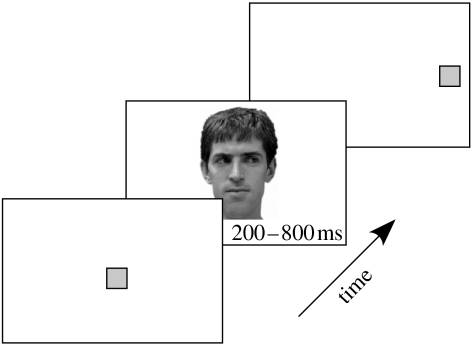
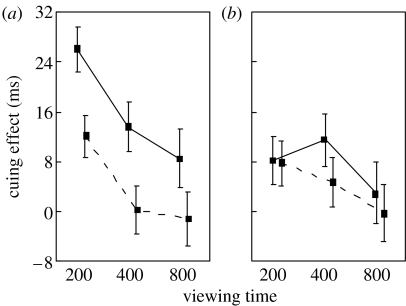
Gaze cuing, the tendency to shift attention in the direction other individuals are looking, is hypothesized to depend on a distinct neural module. One expectation of such a module is that information processing should be encapsulated within it. Here, we tested whether familiarity, a type of social knowledge, penetrates the neural circuits governing gaze cuing. Male and female subjects viewed the face of an adult male looking left or right and then pressed a keypad to indicate the location of a target appearing randomly left or right. Responses were faster for targets congruent with gaze direction. Moreover, gaze cuing was stronger in females than males. Contrary to the modularity hypothesis, familiarity enhanced gaze cuing, but only in females. Sex differences in the effects of familiarity on gaze cuing may reflect greater adaptive significance of social information for females than males.
Figures
References
-
- Adams R.B, Kleck R.E. Effects of direct and averted gaze on the perception of facially communicated emotion. Emotion. 2005;5:3–11. doi:10.1037/1528-3542.5.1.3 - DOI - PubMed
-
- Baron-Cohen S. MIT Press; Cambridge, MA: 1995. Mindblindness: an essay on autism and theory of mind.
-
- Bayliss A.P, Tipper S.P. Predictive cues and personality judgements: should eye trust you? Psychol. Sci. 2006;17:514–520. doi:10.1111/j.1467-9280.2006.01737.x - DOI - PMC - PubMed
-
- Bayliss A.P, di Pellegrino G, Tipper S.P. Sex differences in eye gaze and symbolic cueing of attention. Q. J. Exp. Psychol. A. 2005;58A:631–650. - PubMed
-
- Deaner R.O, Platt M.L. Reflexive social attention in monkeys and humans. Curr. Biol. 2003;13:1609–1613. doi:10.1016/j.cub.2003.08.025 - DOI - PubMed
Publication types
MeSH terms
Grants and funding
LinkOut - more resources
Full Text Sources
