


A protocol for phenotypic detection and enumeration of circulating endothelial cells and circulating progenitor cells in human blood
- PMID: 17446880
- PMCID: PMC2686125
- DOI: 10.1038/nprot.2007.111
A protocol for phenotypic detection and enumeration of circulating endothelial cells and circulating progenitor cells in human blood
Abstract
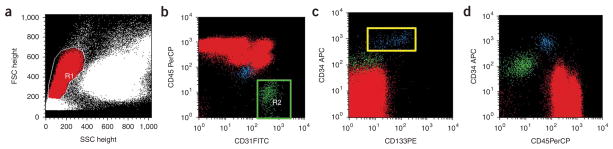
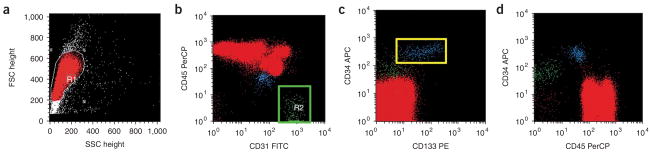
Blood circulating endothelial cells (CECs) and circulating hematopoietic progenitor cells (CPCs) represent two cell populations that are thought to play important roles in tissue vascularization. CECs and CPCs are currently studied as surrogate markers in patients for more than a dozen pathologies, including heart disease and cancer. However, data interpretation has often been difficult because of multiple definitions, methods and protocols used to evaluate and count these cells by different laboratories. Here, we propose a cytometry protocol for phenotypic identification and enumeration of CECs and CPCs in human blood using four surface markers: CD31, CD34, CD133 and CD45. This method allows further phenotypic analyses to explore the biology of these cells. In addition, it offers a platform for longitudinal studies of these cells in patients with different pathologies. The protocol is relatively simple, inexpensive and can be adapted for multiple flow cytometer types or software. The procedure should take 2-2.5 h, and is expected to detect 0.1-6.0% viable CECs and 0.01-0.20% CPCs within blood mononuclear cell population.
Figures
References
-
- Rafii S, Lyden D, Benezra R, Hattori K, Heissig B. Vascular and haematopoietic stem cells: novel targets for anti-angiogenesis therapy? Nat Rev Cancer. 2002;2:826–835. - PubMed
-
- Aicher A, et al. Essential role of endothelial nitric oxide synthase for mobilization of stem and progenitor cells. Nat Med. 2003;9:1370–1376. - PubMed
-
- Bertolini F, Shaked Y, Mancuso P, Kerbel RS. The multifaceted circulating endothelial cell in cancer: towards marker and target identification. Nat Rev Cancer. 2006;6:835–845. - PubMed
-
- Jain RK, Duda DG, Clark JW, Loeffler JS. Lessons from phase III clinical trials on anti-VEGF therapy for cancer. Nat Clin Pract Oncol. 2006;3:24–40. - PubMed
-
- Monestiroli S, et al. Kinetics and viability of circulating endothelial cells as surrogate angiogenesis marker in an animal model of human lymphoma. Cancer Res. 2001;61:4341–4344. - PubMed
Publication types
MeSH terms
Substances
Grants and funding
LinkOut - more resources
Full Text Sources
Other Literature Sources
Medical
Research Materials
Miscellaneous
