


Paroxetine reduces social anxiety in individuals with a co-occurring alcohol use disorder
- PMID: 17448631
- PMCID: PMC2254554
- DOI: 10.1016/j.janxdis.2007.03.001
Paroxetine reduces social anxiety in individuals with a co-occurring alcohol use disorder
Abstract
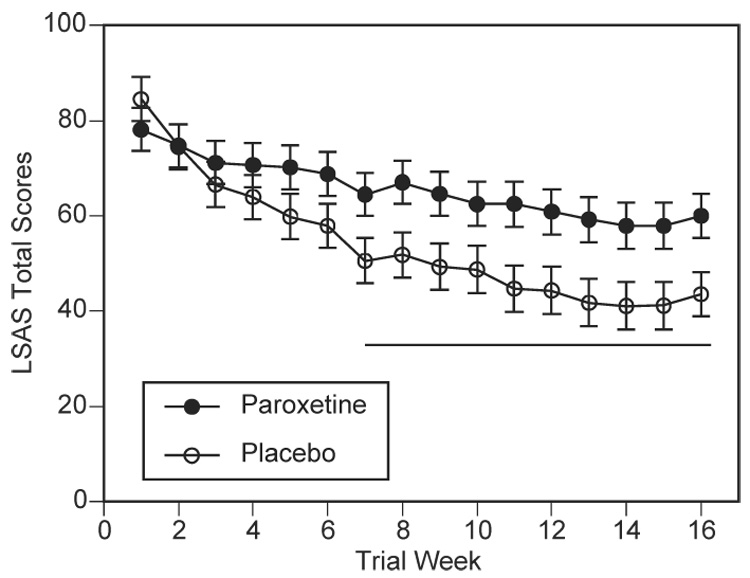
Patients with social anxiety disorder who are seen in clinical practice commonly have additional psychiatric comorbidity, including alcohol use disorders. The first line treatment for social anxiety disorder is selective-serotonin-reuptake-inhibitors (SSRIs), such as paroxetine. However, the efficacy of SSRIs has been determined with studies that excluded alcoholics. Forty two subjects with social anxiety and a co-occurring alcohol use disorder participated in a 16-week, double-blind, placebo-controlled clinical trial to determine the efficacy of paroxetine for social anxiety in patients with co-occurring alcohol problems. Paroxetine was superior to placebo in reducing social anxiety, as measured by the Liebowitz Social Anxiety Scale total and subscale scores and additional measures of social anxiety. This study provides the first evidence-based recommendation for the use of an SSRI to treat social anxiety in this patient population.
Figures
References
-
- American Psychiatric Association. Diagnostic and Statistical Manual of Mental Disorders, Fourth Edition Text Revision: DSM-IV-TR. Washington, DC: 2000.
-
- Baker SL, Heinrichs N, Kim HJ, Hofmann SG. The Liebowitz Social Anxiety Scale as a self-report instrument: a preliminary psychometric analysis. Behaviour Research & Therapy. 2002;40:701–715. - PubMed
-
- Baldwin D, Bobes J, Stein DJ, Scharwaechter I, Faure M. Paroxetine in social phobia/social anxiety disorder: Randomized, double-blind, placebo-controlled study. British Journal of Psychiatry. 1999;175:120–126. - PubMed
-
- Beck AT, Steer RA, Brown GK. BDI-II: Beck Depression Inventory-Second Edition, Manual. San Antonio: The Psychological Corporation, Harcourt Brace and Company; 1996.
-
- Brown SA, Irwin M, Schuckit MA. Changes in anxiety among abstinent male alcoholics. Journal of Studies on Alcohol. 1991;52:55–61. - PubMed
Publication types
MeSH terms
Substances
Grants and funding
LinkOut - more resources
Full Text Sources
Medical
