Comparative Study
. 2007 May 1;104(18):7489-94.
doi: 10.1073/pnas.0701705104. Epub 2007 Apr 20.

More genes underwent positive selection in chimpanzee evolution than in human evolution

Affiliations
Comparative Study

More genes underwent positive selection in chimpanzee evolution than in human evolution

Margaret A Bakewell et al. Proc Natl Acad Sci U S A. .

Abstract

Observations of numerous dramatic and presumably adaptive phenotypic modifications during human evolution prompt the common belief that more genes have undergone positive Darwinian selection in the human lineage than in the chimpanzee lineage since their evolutionary divergence 6-7 million years ago. Here, we test this hypothesis by analyzing nearly 14,000 genes of humans and chimps. To ensure an accurate and unbiased comparison, we select a proper outgroup, avoid sequencing errors, and verify statistical methods. Our results show that the number of positively selected genes is substantially smaller in humans than in chimps, despite a generally higher nonsynonymous substitution rate in humans. These observations are explainable by the reduced efficacy of natural selection in humans because of their smaller long-term effective population size but refute the anthropocentric view that a grand enhancement in Darwinian selection underlies human origins. Although human and chimp positively selected genes have different molecular functions and participate in different biological processes, the differences do not ostensibly correspond to the widely assumed adaptations of these species, suggesting how little is currently known about which traits have been under positive selection. Our analysis of the identified positively selected genes lends support to the association between human Mendelian diseases and past adaptations but provides no evidence for either the chromosomal speciation hypothesis or the widespread brain-gene acceleration hypothesis of human origins.


Conflict of interest statement

The authors declare no conflict of interest.

Figures
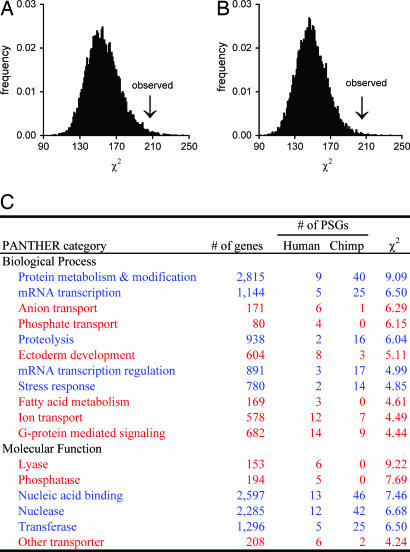
Fig. 1.
Fig. 1.
Functional differences between human and chimp unshared PSGs. (A and B) Human and chimp PSGs show a significantly larger difference in distribution across biological process groups (A) and molecular function groups (B) than by chance (P = 0.84% and 0.26%, respectively, one-tail randomization test). The bars show the frequency distribution of the χ2 values in 10,000 random divisions of the 373 unshared PSGs into 147 human PSGs and 226 chimp PSGs. The arrow indicates the observed χ2. Here, the randomization test is superior to the standard χ2 test because the functional groups are not independent of one another, and a single gene may belong to more than one group. Similar results are obtained when the seven shared PSGs are included. (C) Biological process and molecular function groups that show the greatest differences between human and chimp unshared PSGs, as ranked by individual χ2 values. Shown are the groups that each contribute at least 2% of the total χ2 of all groups. Groups with a higher frequency of human PSGs than chimp PSGs are shown in red; those with a higher frequency of chimp PSGs than human PSGs are shown in blue.
Fig. 2.
Fig. 2.
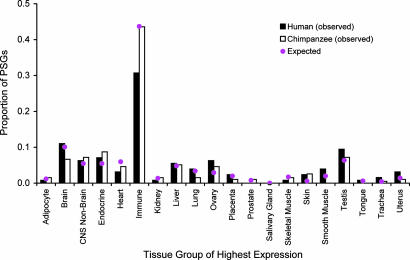
Frequency distribution of human and chimp PSGs across 20 peak-expression tissue groups. The overall difference between the distributions of the two species is not statistically significant (χ2 = 23.8, df = 19, P = 0.21). Only smooth muscle (χ2 = 7.7, P = 0.0056) shows a significant difference in proportion of PSGs between the two species, but the significance disappears when multiple testing is corrected for. Pink dots show the expected distribution of PSGs when there is no enrichment of PSGs in any tissue groups.
Fig. 3.
Fig. 3.
Distributions of human and chimp PSGs among chromosomes. Contrary to the chromosomal speciation hypothesis, PSGs are slightly less abundant on rearranged chromosomes than on colinear chromosomes (P = 0.10 and 0.055 for the human and chimp lineages, respectively, χ2 test). The human chromosome numbers are used. The expected number of PSGs on each chromosome is calculated under the assumption that the probability of a gene being targeted by positive selection is not affected by the chromosome on which it is located.

References

    1. Chimpanzee Sequencing and Analysis Consortium. Nature. 2005;437:69–87. - PubMed
    1. Chen FC, Li WH. Am J Hum Genet. 2001;68:444–456. - PMC - PubMed
    1. Ebersberger I, Metzler D, Schwarz C, Paabo S. Am J Hum Genet. 2002;70:1490–1497. - PMC - PubMed
    1. Britten RJ. Proc Natl Acad Sci USA. 2002;99:13633–13635. - PMC - PubMed
    1. Wildman DE, Uddin M, Liu G, Grossman LI, Goodman M. Proc Natl Acad Sci USA. 2003;100:7181–7188. - PMC - PubMed

Publication types