The influence of a disaster on the health of rescue workers: a longitudinal study
- PMID: 17452661
- PMCID: PMC1852883
- DOI: 10.1503/cmaj.060626
The influence of a disaster on the health of rescue workers: a longitudinal study
Abstract
Background: Rescue workers strive, after disasters, to help victims and restrict damage, often in dangerous circumstances. We examined the effect of a disaster on the physical and psychological health of rescue workers (firefighters, police officers and medical emergency services personnel) who provided assistance after the explosion of a fireworks depot in the Netherlands in May 2000.
Methods: We carried out a 4-year longitudinal study of 1403 rescue workers employed in or near the affected neighbourhood (the study group) and a control group of 1650 uninvolved rescue workers (from another city of similar size and urbanization). Health outcomes were measured as prevalence, incidence (both measured as the percent of workers who took sick leave), frequency of the absences and number of sick days (both per 100 workers), and duration (mean length of sickness absences, in days).
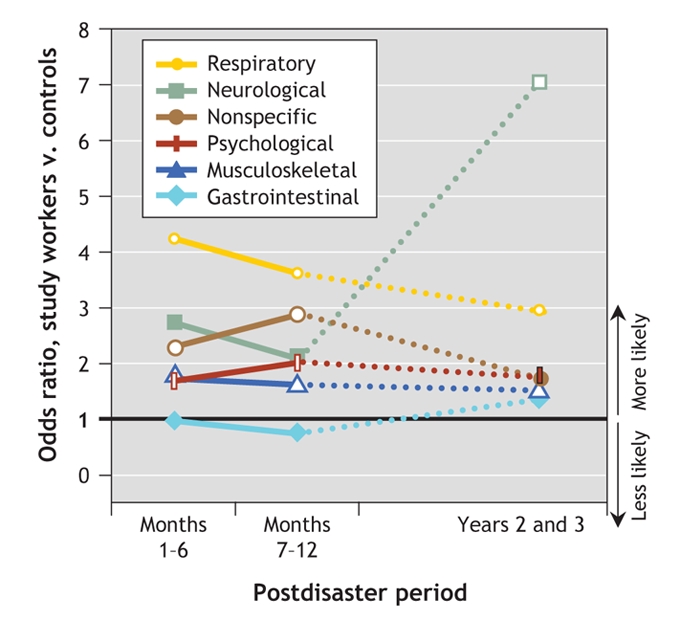
Results: Sick leave among the study workers increased substantially during the 18 months after the explosion. For example, the prevalence of absences attributed to psychological problems increased from 2.5% of workers during the 6 months before the disaster to 4.6% during the first 6-month period after the explosion and 5.1% during the second. That for respiratory problems rose from 5.4% predisaster to 14.9% 6-12 months afterward. In comparison with controls, immediate increases occurred in musculoskeletal, psychological, respiratory and nonspecific ill health (e.g., malaise, fatigue) during the first year postdisaster. Rates of sick leave for musculoskeletal and respiratory reasons remained elevated until 3 years postdisaster, whereas leave for psychological problems and other ill health had returned to predisaster levels by then. Neurological problems increased after a 1-year delay. No significant increase in gastrointestinal problems was observed among the study workers, in comparison with controls.
Interpretation: Many health problems arise immediately after a disaster and may persist for years. Health care workers should realize, however, that some disaster-related effects may not emerge until a year or more after the event.
Figures
Comment in
-
The long-term health consequences of disasters and mass traumas.CMAJ. 2007 Apr 24;176(9):1293-4. doi: 10.1503/cmaj.070368. CMAJ. 2007. PMID: 17452663 Free PMC article. No abstract available.
References
-
- Norris FH, Friedman MJ, Watson PJ, et al. 60 000 disaster victims speak: part I. An empirical review of the empirical literature, 1981–2001. Psychiatry 2002;65:207-39. - PubMed
-
- Noji EK. Public health issues in disaster. Crit Care Med 2005;33(Suppl 1):S29-S33. - PubMed
-
- Aoki N, Nishimura A, Pretto EA, et al. Survival and cost analysis of fatalities of the Kobe earthquake in Japan. Prehosp Emerg Care 2004;8:217-22. - PubMed
-
- Marmar CR, Weiss DS, Metzler TJ, et al. Longitudinal course and predictors of continuing distress following critical incident exposure in emergency services personnel. J Nerv Ment Dis 1999;187:15-22. - PubMed
Publication types
MeSH terms
LinkOut - more resources
Full Text Sources
Medical
Molecular Biology Databases