


Cue self-relevance affects autobiographical memory specificity in individuals with a history of major depression
- PMID: 17454667
- PMCID: PMC2797706
- DOI: 10.1080/09658210701256530
Cue self-relevance affects autobiographical memory specificity in individuals with a history of major depression
Abstract
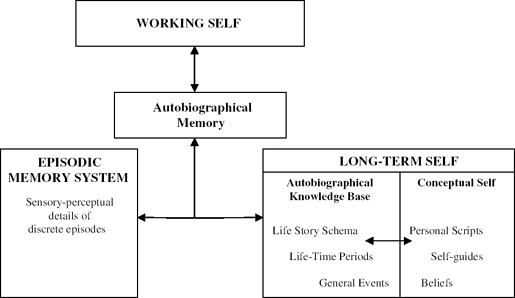
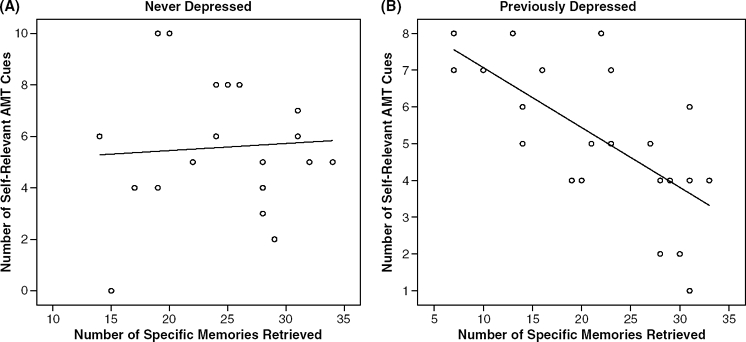
Previously depressed and never-depressed individuals identified personal characteristics (self-guides) defining their ideal, ought, and feared selves. One week later they completed the autobiographical memory test (AMT). For each participant the number of AMT cues that reflected self-guide content was determined to produce an index of AMT cue self-relevance. Individuals who had never been depressed showed no significant relationship between cue self-relevance and specificity. In contrast, in previously depressed participants there was a highly significant negative correlation between cue self-relevance and specificity--the greater the number of AMT cues that reflected self-guide content, the fewer specific memories participants recalled. It is suggested that in individuals with a history of depression, cues reflecting self-guide content are more likely to prompt a shift to processing of information within the long-term self (Conway, Singer, & Tagini, 2004), increasing the likelihood that self-related semantic information will be provided in response to cues on the autobiographical memory test.
Figures
References
-
- Beck A. T., Steer R. A., Brown G. K. Manual for the BDI-II. San Antonio, TX: Psychological Corporation; 1996.
-
- Brewin C, Reynolds M., Tata P. Autobiographical memory processes and the course of depression. Journal of Abnormal Psychology. 1999;108:511–517. - PubMed
-
- Brittlebank A. D., Scott J., Williams J. M. G., Ferrier I. N. Autobiographical memory in depression: State or trait marker. British Journal of Psychiatry. 1993;162:118–121. - PubMed
-
- Burke M., Mathews A. Autobiographical memory and clinical anxiety. Cognition & Emotion. 1992;6:23–35.
-
- Carver C. S., Lawrence J. W., Scheier M. F. Self-discrepancies and affect: incorporating the role of feared selves. Personality and Social Psychology Bulletin. 1999;25:783–792.
Publication types
MeSH terms
Grants and funding
LinkOut - more resources
Full Text Sources
Medical